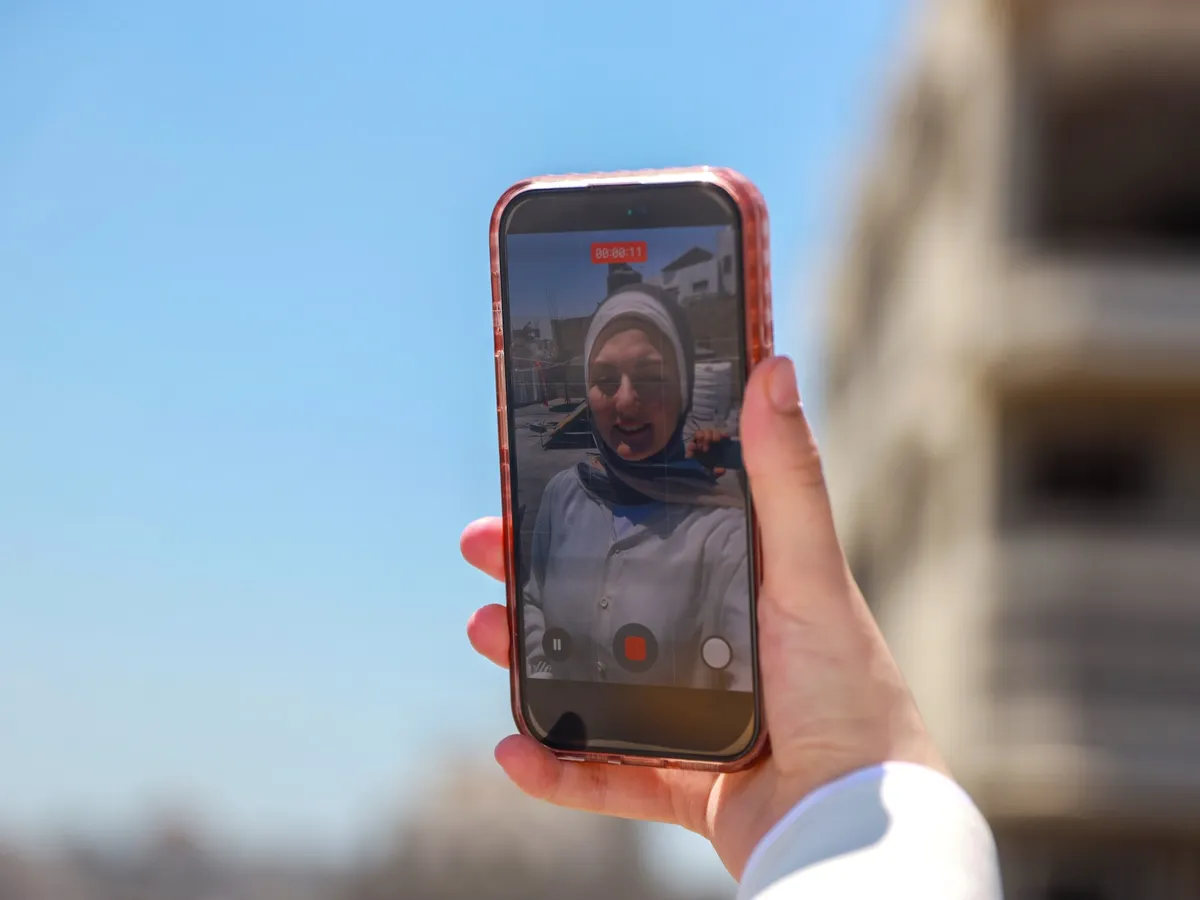
Until recently, her daughter accepted the rule: no personal phone before finishing secondary school, no social media. If Eman needed WhatsApp for school, YouTube for homework, or to speak to friends during the COVID pandemic, she borrowed her mother's device. Everything passed through Beirut first before it reached Eman.The arrangement was not born of blind obedience. Eman describes herself as stubborn, and arguments over phones, curfews and going out were hardly uncommon. But, as her parents' only daughter, she also trusted that the limits they set came from a desire to protect her rather than control her.Beirut's rules were strict, but they were far from unusual. In Gaza, relatively few teenagers aged below 16 own smartphones, and even among wealthier families, whether a child has a phone often depends as much on parental approval as financial means. In Eman's class, only a handful of girls had phones of their own. Most borrowed a parent's device, and owning one before finishing school was considered a matter of luck rather than expectation.Eman wanted one all the same. Her close friend, Hanaa, had her own phone throughout their school years, and Eman remembers pleading with her mother for one too. The arguments were frequent, but Beirut never relented. The family rule was simple: no personal phone until she had finished school and turned 18.At the time, the wait felt impossibly long. Looking back now, Eman can scarcely imagine what finally receiving that long-awaited phone would come to mean.During the genocide, though, the phone became something else entirely.She would carry Beirut’s old iPhone 11 Pro Max as her family fled their home under Israeli bombardment, climbed onto rooftops during communications blackouts that lasted for months, and uploaded videos capturing these moments that would eventually reach millions.The phone became a torch when there was no light, a camera, a witness, a notebook, a map, an archive, a classroom, a newsroom and, increasingly, a responsibility.It transformed Beirut, too. The mother who had once refused to let her daughter have a phone now became the one urging her to use it.The device Eman now hands back to her mother each night is different. For her 18th birthday, her parents spent 6,000 shekels ($1,950) and bought her a brand-new iPhone 16 — a bright pink handset tucked inside a plastic case decorated with roses and butterflies, its lock screen a smiling selfie.Eman Lulu stands overlooking the destruction of Gaza City [Abdelhakim Abu Riash/Al Jazeera]In the weeks that followed October 7, 2023, the family's 300-year-old home in Gaza's Old City was destroyed. Their current apartment sits barely 100 metres away, in eastern Gaza City. Scarred by bullet holes and shattered windows, it survived the surrounding bombardment, though the family has still been forced to flee it repeatedly during military operations."I wanted the world to see what was happening to us," Beirut says.Small in stature, Beirut sits beside her husband and daughter on the sofa, her soft, delicate features making her look more like Eman’s sister than mother and daughter. She speaks with unguarded emotion, hands rarely still, her eyes widening as she recalls that morning."Our house was bombed while we were inside it ... we ran out barefoot, took nothing, the house burning behind us ... we survived by a miracle ... it was five in the morning ... at that moment I wished the whole world could see what was happening."The first videos Eman posted were simple records of daily life. Images of destruction. Memories of her childhood home before it was damaged. Fragments of ordinary existence interrupted by war. They attracted little attention.Then the audience changed. As Israel barred international journalists from entering Gaza, millions searching for a glimpse of life inside the Strip increasingly found it on social media. A handful of viewers became a few thousand. Thousands slowly became tens of thousands.Eman smiles, shaking her head. "There was no clear plan behind the content. The ideas were already there, because it was just our life," she says."I was taking the ideas from the everyday things we were living and doing under the war ... open the camera and say, this happened to us, or that happened."Then one afternoon a video took off.Eman and her parents riding through Gaza on a donkey cart, known locally as a karra. With vehicles destroyed and diesel and petrol no longer entering the Strip, donkey carts had become one of the only ways to get around. She filmed the journey exactly as it was: her, her father and her mother passing between the rubble of destroyed neighbourhoods."Me, dad and mom," she captioned it."The clip got a huge amount of engagement," Eman says, her eyes widening as she gestures animatedly with both hands, a broad smile spreading across her face as she relives the moment. "I started gaining 100,000 followers every day. Within about a week I'd reached 500,000."The numbers kept climbing. Roughly two weeks later, she woke to find her audience had passed two million. Eventually, it would reach five million.
SRCAl Jazeera
LANGEN
LEANCenter
WORDS831
ENT10
FRI · 2026-07-31 · 09:23 GMTBRIEF NSR-2026-0731-97820
NSR-2026-0731-97820News Report·EN·Human Interest
Her mother said no to a phone. Then came the Gaza genocide
Eman Lulu, a teenager in Gaza, initially faced her mother's rule of no personal phone until after secondary school. However, during the ongoing conflict, her mother's old iPhone became a vital tool for Eman.
Maram HumaidAl JazeeraFiled 2026-07-31 · 09:23 GMTLean · CenterRead · 4 min
Al JazeeraFIG 01
Reading time
4min
Word count
831words
Sources cited
1cited
Entities identified
10entities
Quality score
100%
§ 01
Briefing Summary
AI-generatedNEWSAR · AI
Eman Lulu, a teenager in Gaza, initially faced her mother's rule of no personal phone until after secondary school. However, during the ongoing conflict, her mother's old iPhone became a vital tool for Eman. She used it to document their experiences as they fled their home, endured communication blackouts, and captured footage that reached millions globally. The phone served as a camera, witness, and archive, transforming its role from a forbidden item to a necessity. As international journalists were barred from Gaza, Eman's videos, initially simple records of daily life, gained a massive audience, with one video of her family on a donkey cart leading to a surge in followers.
Confidence 0.90Sources 1Claims 5Entities 10
§ 02
Article analysis
Model · rule-basedFraming
Human Interest
Conflict
Tone
Mixed Tone
AI-assessed
CalmNeutralAlarmist
Factuality
0.60 / 1.00
Mixed
LowHigh
Sources cited
1
Limited
FewMany
§ 03
Key claims
5 extracted01
The mother stated, 'I wanted the world to see what was happening to us.'
quoteBeirut
Confidence
1.00
02
The family's 300-year-old home in Gaza's Old City was destroyed in the weeks following October 7, 2023.
factualarticle
Confidence
1.00
03
The daughter used her mother's old iPhone 11 Pro Max to document and share experiences during the conflict after October 7, 2023.
factualarticle
Confidence
1.00
04
A mother initially refused her daughter a personal phone, citing rules against smartphones before finishing secondary school.
quoteEman and Beirut
Confidence
1.00
05
In Gaza, few teenagers under 16 own smartphones, with ownership often depending on parental approval.
factualarticle
Confidence
0.80
§ 04
Full report
4 min read · 831 words§ 05
Entities
10 identifiedKey playerOppositionContextPositiveNeutralNegative
Organizations1
§ 06
Keywords & salience
9 termsgaza genocide
1.00
personal phone
0.90
parental approval
0.80
israeli bombardment
0.70
communications blackouts
0.70
witness
0.60
newsroom
0.50
archive
0.50
destruction of gaza city
0.40
§ 07
Topic connections
Interactive graph Network visualization showing 51 related topics
View Full Graph Person Organization Location Event|Click node to navigate|Edge numbers = shared articles