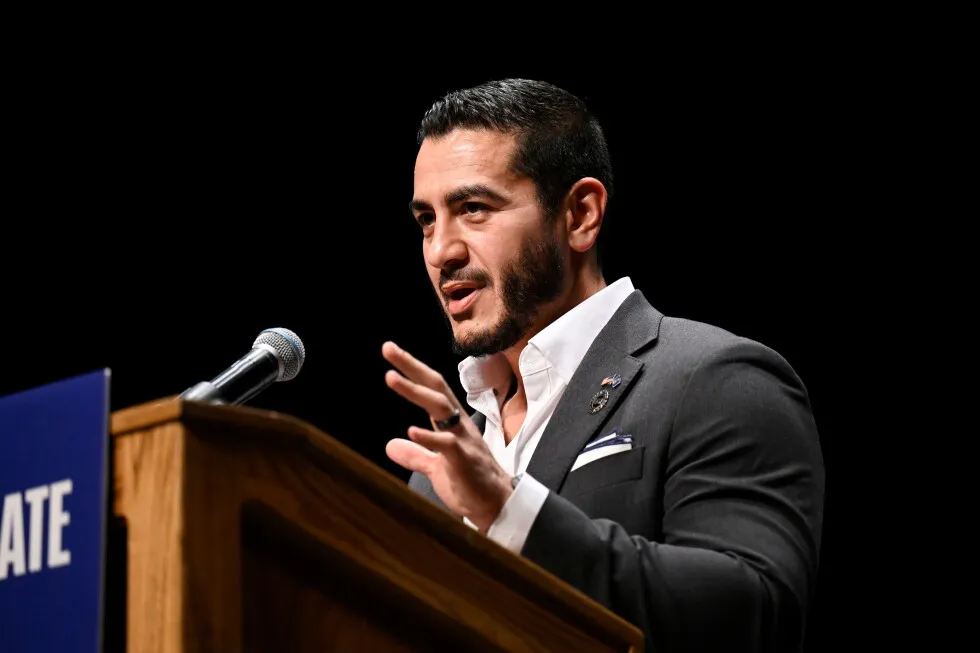
As progressives seek to take on inequality, some cite religion as a motivating factor 1 of 3 | Progressive Democrats have won major electoral victories across the country in recent months. As inequality and affordability become flashpoints for the midterms, many candidates and supporters are citing religion as a rationale for their positions. 2 of 3 | Michigan Democratic U.S. Senate primary candidate Abdul El-Sayed addresses the crowd during a campaign rally, Saturday, July 18, 2026, in Detroit. (AP Photo/Jose Juarez) 3 of 3 | From left foreground, U.S. Rep. Alexandria Ocasio-Cortez, D-N.Y., Michigan Democratic U.S. Senate primary candidate Abdul El-Sayed, and U.S. Sen. Bernie Sanders, I-VT. join hands together following a campaign rally, Saturday, July 18, 2026, in Detroit. (AP Photo/Jose Juarez) 1 of 3 Progressive Democrats have won major electoral victories across the country in recent months. As inequality and affordability become flashpoints for the midterms, many candidates and supporters are citing religion as a rationale for their positions. Add AP News on Google Add AP News as your preferred source to see more of our stories on Google. Share 2 of 3 | Michigan Democratic U.S. Senate primary candidate Abdul El-Sayed addresses the crowd during a campaign rally, Saturday, July 18, 2026, in Detroit. (AP Photo/Jose Juarez) 2 of 3 Michigan Democratic U.S. Senate primary candidate Abdul El-Sayed addresses the crowd during a campaign rally, Saturday, July 18, 2026, in Detroit. (AP Photo/Jose Juarez) Add AP News on Google Add AP News as your preferred source to see more of our stories on Google. Share 3 of 3 | From left foreground, U.S. Rep. Alexandria Ocasio-Cortez, D-N.Y., Michigan Democratic U.S. Senate primary candidate Abdul El-Sayed, and U.S. Sen. Bernie Sanders, I-VT. join hands together following a campaign rally, Saturday, July 18, 2026, in Detroit. (AP Photo/Jose Juarez) 3 of 3 From left foreground, U.S. Rep. Alexandria Ocasio-Cortez, D-N.Y., Michigan Democratic U.S. Senate primary candidate Abdul El-Sayed, and U.S. Sen. Bernie Sanders, I-VT. join hands together following a campaign rally, Saturday, July 18, 2026, in Detroit. (AP Photo/Jose Juarez) Add AP News on Google Add AP News as your preferred source to see more of our stories on Google. Share Updated [hour]:[minute] [AMPM] [timezone], [monthFull] [day], [year] Detroit (AP) — The jokes practically wrote themselves as an eclectic group of progressive pastors, imams and a rabbi walked into a room, finding their seats around a table to talk about religion and politics.Though there was no shortage of levity, a sense of urgency filled the Detroit meeting room as Abdul El-Sayed, a former gubernatorial candidate who is running as a Democrat for the U.S. Senate in Michigan, began speaking about how his Muslim faith informs his progressive views.The public health researcher asked the group of faith leaders ahead of Tuesday’s primary, “What does the inspiration of holding yourself accountable to something bigger than you mean for what you do for the people around you?” El-Sayed added, “If you can’t eat food and I have something to do about it, I better do it.”Progressive Democratic politicians have won major electoral victories across the country in recent months amid growing frustrations surrounding inequality, affordability and potential threats to job security posed by artificial intelligence. As the economy becomes a flashpoint for the November midterms, many of these candidates and voters who support them are citing religion as a justification for their positions. “We’re in an era of historical inequality,” El-Sayed told The Associated Press. “Most faith traditions — certainly the Abrahamic faith traditions — put a lot more burden on the wealthy.”The interfaith roundtable took place days after a high-profile rally for El-Sayed, who has made “Medicare for All” a fixture of his campaign and is running against the more moderate Rep. Haley Stevens. It featured speeches from progressive heavy hitters like Sen. Bernie Sanders of Vermont and Rep. Alexandria Ocasio-Cortez of New York. 5 MIN READ 5 MIN READ 6 MIN READ Though not a member of the Democratic Socialists of America, El-Sayed is being endorsed by liberal allies, many of them members of the DSA, while being criticized by Republicans and centrist Democrats for being too far left to be electable in a swing state. If elected in November, he would be the first Muslim senator in U.S. history.Representatives for Stevens, who is identified in congressional profiles as a Protestant, did not respond to requests for comment. Progressive ideologies carry different connotations for different generationsReligious support for progressive economic and labor movements is not new, even if it has ebbed and flowed in the U.S. over the centuries. Pope Leo XIV’s recent encyclical was in many ways an ode to “Rerum novarum,” Pope Leo XIII’s seminal 1891 text on labor, wages and unions that helped shape Catholic social teaching.This embrace of religion isn’t unique to the Democratic Party’s progressive wing. More moderate candidates like James Talarico, the seminarian running for the U.S. Senate in Texas, also highlight their faith. But as left-leaning Democrats and democratic socialists like New York Mayor Zohran Mamdani, who is Muslim, score wins in local and national races, Republicans have repeatedly decried the party’s progressive wing as communists devoid of religion.“Republicans and conservatives believe in natural rights that flow from a creator. I think communism rejects that. It espouses a very atheistic, centralized sort of secular view of society,” said Douglas Blair, a spokesperson for Heritage Action for America.Megan Romer, a DSA national co-chair and ordained ruling elder within the Presbyterian Church (USA), conceded socialism is a troubling concept for some people of faith. “People’s idea of it is, ‘Oh, that’s when you’re not allowed to have a religion, right?’ Which has been true in some socialist projects,” she said.But experts say that narrative carries less weight among many younger Americans who have no memory of the Cold War and the anti-religious associations it begot.Theology informs more than just faithThough there are more Democrats unaffiliated with religion than Republicans, many people of faith do not see progressive ideologies like socialism as contradictory to their beliefs. They cite Black religious activists who were outspoken critics of capitalism, including Martin Luther King Jr., Malcolm X and W.E.B. Du Bois, as models for their thinking about the relationship between religion and politics. The Rev. Andrew Wilkes, who co-pastors the Double Love Experience Church in New York City, became interested in democratic socialism more than a decade ago after presiding over a funeral for someone whose insurance wouldn’t cover a critical operation. “It was not God that sent him home but an unjustly organized healthcare system and economy,” he said.“There’s an increasing recognition, I would say, connecting socialism to a sense of a moral compass,” Wilkes said, adding that religion can bring optimism and creativity in a time of pessimism. “There’s a level of world-building that faith can speak to.”Romer, who joined the DSA in 2018 in part because of Sanders’ unsuccessful presidential run two years earlier, thinks there is a theological component to why Christianity in particular has thrived among conservatives. “That flavor of Christianity is a very individualistic one. They talk a lot about your personal relationship with God,” she said. “My interpretation of Christianity is one that, I think the early Christians — they were not communists in the modern sense, but they lived in communal situations.” Attitudes toward capitalism are changing, and religion is playing a roleThis faith-driven economic focus is not limited to elections.Clergy and Laity United for Economic Justice is a nonprofit organization that works with congregations throughout Southern California to support workers’ rights. Earlier this month, it facilitated a visit to Live Oak United Church of Christ in Brea, California, to support efforts to unionize a local grocery store chain.“We just feel very, very overworked,” Luis Cueva, a Mother’s Market employee, told members of the congregation after their Sunday service as he asked for support. “Jesus was a socialist,” Cueva said after the meeting, citing his teachings about it being difficult for rich people to go to heaven. “It means a lot to know that the church is willing to help.”About half of U.S. adults have a positive view of capitalism, according to a poll last year from Gallup, down from 61% in 2010. Democrats have driven part of the shift, but favorable views of capitalism have also declined among independents.President Donald Trump and other Republicans have cast these attitudes and candidates as being fundamentally at odds with religion. “These are hard core, godless communists,” Trump said recently during a speech to the Faith & Freedom Coalition. “All communists are godless. They don’t believe in God.”Faith can be both a political asset and a liabilityAlthough there are myriad points of contention within the Democratic Party, such as support for Israel, El-Sayed considers economic issues a top issue for his campaign. “I talk about taking money out of politics because it’s the reason life is not affordable,” he said. “People are realizing that politicians on both sides of the aisle really are being paid off by the same people.”The son of Egyptian immigrants, El-Sayed is aware that his Islamic faith can be weaponized or misunderstood. But since having a religious experience in college that followed a rebellious childhood, he takes seriously the implications of his faith.“If you put your morals on a mantel, they’re not morals. They’re just, you know, things that you can admire and then you give yourself the permission to step away from them when it’s convenient,” he said.As the roundtable concluded, leaders from each faith took turns praying. Their heads lifted, but the Rev. Horace Sheffield chimed in with one last request on behalf of El-Sayed.“I don’t think y’all were specific enough. So I’m gonna say it real simple,” he said. “Lord, let him win.”___Associated Press religion coverage receives support through the AP’s collaboration with The Conversation US, with funding from Lilly Endowment Inc. The AP is solely responsible for this content. Fauria covers religion and culture for The Associated Press. She is based in Los Angeles.
SRCAssociated Press (AP)
LANGEN
LEANCenter
WORDS1 658
ENT10
FRI · 2026-07-31 · 11:53 GMTBRIEF NSR-2026-0731-97841
NSR-2026-0731-97841News Report·EN·Social Justice
As progressives seek to take on inequality, some cite religion as a motivating factor
Progressive Democratic candidates and voters are increasingly citing religion as a motivation for their stances on issues like inequality and affordability, particularly as these concerns become central to upcoming elections. Michigan U.S.
By
KRYSTA FAURIAAssociated Press (AP)Filed 2026-07-31 · 11:53 GMTLean · CenterRead · 7 min
Associated Press (AP)FIG 01
Reading time
7min
Word count
1 658words
Sources cited
3cited
Entities identified
10entities
Quality score
100%
§ 01
Briefing Summary
AI-generatedNEWSAR · AI
Progressive Democratic candidates and voters are increasingly citing religion as a motivation for their stances on issues like inequality and affordability, particularly as these concerns become central to upcoming elections. Michigan U.S. Senate candidate Abdul El-Sayed, a Muslim, explained that his faith informs his progressive views, emphasizing a moral obligation to address societal disparities. This trend is not new, with historical religious support for labor movements and figures like Martin Luther King Jr. cited as influences. While some Republicans criticize progressive ideologies as anti-religious, many progressives argue their beliefs align with religious tenets of social justice and caring for the less fortunate. This interfaith support for progressive causes highlights a growing connection between faith and political action aimed at economic fairness.
Confidence 0.90Sources 3Claims 4Entities 10
§ 02
Article analysis
Model · rule-basedFraming
Social Justice
Political Strategy
Tone
Measured
AI-assessed
CalmNeutralAlarmist
Factuality
0.70 / 1.00
Factual
LowHigh
Sources cited
3
Well sourced
FewMany
§ 03
Key claims
4 extracted01
Abdul El-Sayed's Muslim faith informs his progressive views.
quoteAbdul El-Sayed
Confidence
1.00
02
Progressive Democrats have won major electoral victories across the country in recent months.
factual
Confidence
0.90
03
Many candidates and supporters are citing religion as a rationale for their positions on inequality and affordability.
factual
Confidence
0.80
04
Inequality and affordability are becoming flashpoints for the midterms.
factual
Confidence
0.80
§ 04
Full report
7 min read · 1 658 words§ 05
Entities
10 identifiedKey playerOppositionContextPositiveNeutralNegative
People3
Organizations1
Events1
§ 06
Keywords & salience
9 termsprogressive democrats
0.90
inequality
0.80
religion
0.70
affordability
0.60
political motivation
0.50
midterms
0.50
abdul el-sayed
0.40
bernie sanders
0.40
alexandria ocasio-cortez
0.40
§ 07
Topic connections
Interactive graph Network visualization showing 34 related topics
View Full Graph Person Organization Location Event|Click node to navigate|Edge numbers = shared articles