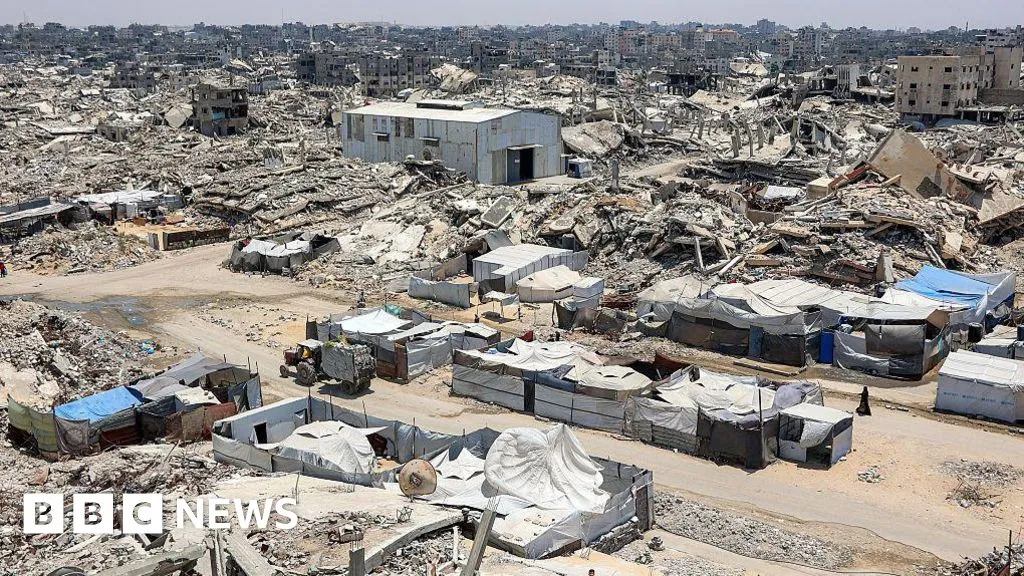
BBCHamas says it has accepted a disarmament plan for Gaza which will see it lay down its arms - a decision US President Donald Trump has described as "a monumental step toward lasting peace and security".The group said it had negotiated "responsibly and positively" and reached "national consensus" among the Palestinian factions. Israel – which remains highly sceptical about Hamas's willingness to disarm – says it will not withdraw from Gaza until it does so. In addition to a 15-point roadmap published by the US-led Board of Peace, the BBC has seen a four-page plan for the phased disarmament of Hamas and gradual Israeli withdrawal.What does the plan say about Hamas disarming?Hamas giving up its weapons - as predicted - has been a main sticking point in advancing President Trump's 20-point plan for ending the war in Gaza.That plan, unveiled in September last year, included the creation of the Board of Peace to oversee the agreement's implementation and "handle the funding for the redevelopment of Gaza".The principles in the roadmap and the document seen by the BBC say: "A process shall begin to inventory and store heavy weapons, military production sites, weapons depots, and tunnels". It says this is conditional on Israel meeting its commitments under the initial ceasefire agreement reached in October last year.This clause still sounds like a significant breakthrough. The process would be overseen by the Palestinian-national-committee" class="entity-link entity-organization" data-entity-id="175793" data-entity-type="organization">Palestinian National Committee - a group of independent technocrats to which Hamas has agreed to hand over power - and with the deployment of the International Stabilisation Force to Gaza. The document refers not just to Hamas but other Palestinian factions joining the disarmament process.The roadmap documents then links this "to a phased Israeli withdrawal" and specifies that "no weapons shall be transferred or handed over to Israel or to any non-Palestinian party".Can this be done?The exact mechanism of how the handover of weapons would work is not clear. It is believed that all heavy weapons – including Hamas's remaining rockets - and other military hardware would be moved into a secure storage managed by the National Committee. As yet, the committee has not entered Gaza. It has been working from Cairo.In terms of timeframe, the document we have seen says only that this would happen "in a gradual, sequential, and time-bound manner, based on an implementation schedule to be prepared within 14 days."Hamas has since said giving up its heavy weapons is contingent on Israel ending "all forms of aggression" and withdrawing its forces from Gaza.Israel's commitment to ending its attack on Gaza is a "fundamental prerequisite" for moving forward with the deal, the group said in a statement.Underground tunnel networks, weapons stores and manufacturing sites would be mapped and destroyed.Remaining personal arms and police weapons would need to be registered and handed over in stages to the new Palestinian police force working under the supervision of the International Stabilisation Force (ISF). Hundreds of new Palestinian police recruits have already been trained in Egypt and Jordan. Israel's cabinet recently approved some 200 international troops from "friendly countries" entering Gaza as part of the ISF, but it has not yet been deployed.Hamas has been seeking assurances that pro-Israel militia in Gaza will be dismantled and will also give up their arms.What does Israel make of the plan?Israel is deeply sceptical about Hamas' willingness to give up its weapons or its control in Gaza. Far-right National Security Minister Itamar Ben-Gvir said via Telegram the plan is "not acceptable" to Israel. Israeli officials have insisted that there will be no Israeli withdrawal from the Yellow Line - which demarcates the area it controls - before Hamas is disarmed.What makes this more unclear is that Israel currently controls more than the 53% of Gaza in which its troops were set to remain under the terms of the October ceasefire deal. As the BBC has recently reported, yellow concrete blocks delineating the Yellow Line have been moved westwards so that Israel controls more than 60% of the strip.Part of the document seen by the BBC is an annex. This requires Israeli forces to withdraw to the agreed Yellow Line "within 24 hours of the Israeli government's approval of the plan." It says they should not return "as long as Hamas complies with the implementation of the agreement."The plan talks about civil servants – what is this about?Hamas announced earlier this month that it had dissolved its government in Gaza and was preparing to transfer power to the National Committee as part of the ceasefire deal. In negotiations it has wanted to ensure that the tens of thousands of civil servants that its government employed in Gaza prior to the war should be compensated or given new jobs.The public workers include Hamas police and security forces but also health and education staff. Many, though not all, are likely to be supporters of Hamas.The plan agrees to treat all public employees "lawfully, fairly, and with dignity regarding their rights." It remains to be seen what security vetting will be used for civil servants working with the National Committee.Why is Hamas agreeing now?In recent talks on advancing Trump's peace plan, Hamas has been put under intense pressure from regional mediators - who were themselves being pushed by Washington to show progress.The recent appointment of the Hamas chief negotiator, Khalil al-Hayya as overall leader of the group - replacing a five-member council - has simplified decision-making. He has strong backing from Gaza members and the Hamas armed wing.Regional events may also have played a role in timing. Early in the Iran war, Hamas officials were said to be taking more hardline positions, hoping that Tehran - a backer of the group - would emerge victorious and that this would strengthen their position. Those close to Hamas, say they have since lost hope in this idea.Palestinian officials involved in the talks suggest the new leadership was ready to take this landmark political decision driven by the devastating humanitarian conditions in Gaza.What is it like in Gaza today?The announcement has, so far, been met with little enthusiasm in Gaza, though some people told the BBC they saw a glimmer of hope. After years of failed ceasefires and collapsed agreements, many Palestinians have grown deeply sceptical of a new political deal.The Israel Defense Forces (IDF) confirmed to the BBC earlier reports of an Israeli strike on Gaza just hours after Trump announced the deal, in which it was reported that several Palestinians were injured.More than two million Palestinians are living in terrible conditions in Gaza, battling disease, a lack of access to food, clean water, and adequate shelter.These people are living in a shrinking chunk of land, as Israel continues to build land barriers, further displacing families and expanding its "Yellow Line" temporary control area deeper into the territory.At least 1,168 Palestinians including children have been killed in Israeli attacks since the ceasefire took effect, according to figures from the Hamas health ministry whose figures are considered reliable by the United Nations.Four Israeli soldiers have been killed in Palestinian attacks in Gaza over the same period.Israel has destroyed more than 1,500 buildings in areas of Gaza that have remained under its control since the ceasefire, satellite images seen by BBC Verify last November showed. The actual number is likely much higher, with imagery unavailable for some areas.According to UN estimates, around 60 million tonnes of debris has been generated since October 2023.
SRCBBC News - World
LANGEN
LEANCenter
WORDS1 230
ENT10
FRI · 2026-07-31 · 16:00 GMTBRIEF NSR-2026-0731-97953
NSR-2026-0731-97953News Report·EN·Diplomatic
What's in the Gaza peace deal roadmap?
Hamas has announced its acceptance of a disarmament plan for Gaza, which includes laying down its arms and an Israeli troop withdrawal. This development, described by US President Donald Trump as a significant step towards peace, is based on a 15-point US-led roadmap and a four-page document seen by the BBC.
2 hours agoShareSaveAdd as preferred on GoogleYolande KnellMiddle East correspondent, JerusalemBBC News - WorldFiled 2026-07-31 · 16:00 GMTLean · CenterRead · 5 min
BBC News - WorldFIG 01
Reading time
5min
Word count
1 230words
Sources cited
3cited
Entities identified
10entities
Quality score
100%
§ 01
Briefing Summary
AI-generatedNEWSAR · AI
Hamas has announced its acceptance of a disarmament plan for Gaza, which includes laying down its arms and an Israeli troop withdrawal. This development, described by US President Donald Trump as a significant step towards peace, is based on a 15-point US-led roadmap and a four-page document seen by the BBC. The plan outlines a phased disarmament process for Hamas and other Palestinian factions, overseen by the Palestinian National Committee and an International Stabilisation Force, with heavy weapons to be stored securely. This disarmament is conditional on Israel fulfilling its commitments under an initial ceasefire agreement. Israel, however, remains skeptical of Hamas's willingness to disarm and insists on no withdrawal until Hamas lays down its weapons. The plan also addresses the future of civil servants employed by Hamas's former government.
Confidence 0.90Sources 3Claims 5Entities 10
§ 02
Article analysis
Model · rule-basedFraming
Diplomatic
Conflict
Tone
Measured
AI-assessed
CalmNeutralAlarmist
Factuality
0.70 / 1.00
Factual
LowHigh
Sources cited
3
Well sourced
FewMany
§ 03
Key claims
5 extracted01
US President Donald Trump described Hamas's decision as 'a monumental step toward lasting peace and security'.
quoteDonald Trump
Confidence
1.00
02
Hamas states giving up heavy weapons is contingent on Israel ending 'all forms of aggression' and withdrawing forces.
factualHamas
Confidence
0.90
03
Israel says it will not withdraw from Gaza until Hamas disarms.
factualIsrael
Confidence
0.90
04
Hamas says it has accepted a disarmament plan for Gaza.
factualHamas
Confidence
0.90
05
The plan includes a process to inventory and store heavy weapons, military production sites, weapons depots, and tunnels.
factualUS-led Board of Peace / BBC
Confidence
0.80
§ 04
Full report
5 min read · 1 230 words§ 05
Entities
10 identifiedKey playerOppositionContextPositiveNeutralNegative
People1
Organizations5
§ 06
Keywords & salience
9 termshamas disarmament
1.00
gaza peace deal
1.00
israeli withdrawal
0.90
roadmap
0.80
palestinian factions
0.70
board of peace
0.60
ceasefire agreement
0.50
international stabilisation force
0.40
heavy weapons
0.40
§ 07
Topic connections
Interactive graph Network visualization showing 51 related topics
View Full Graph Person Organization Location Event|Click node to navigate|Edge numbers = shared articles