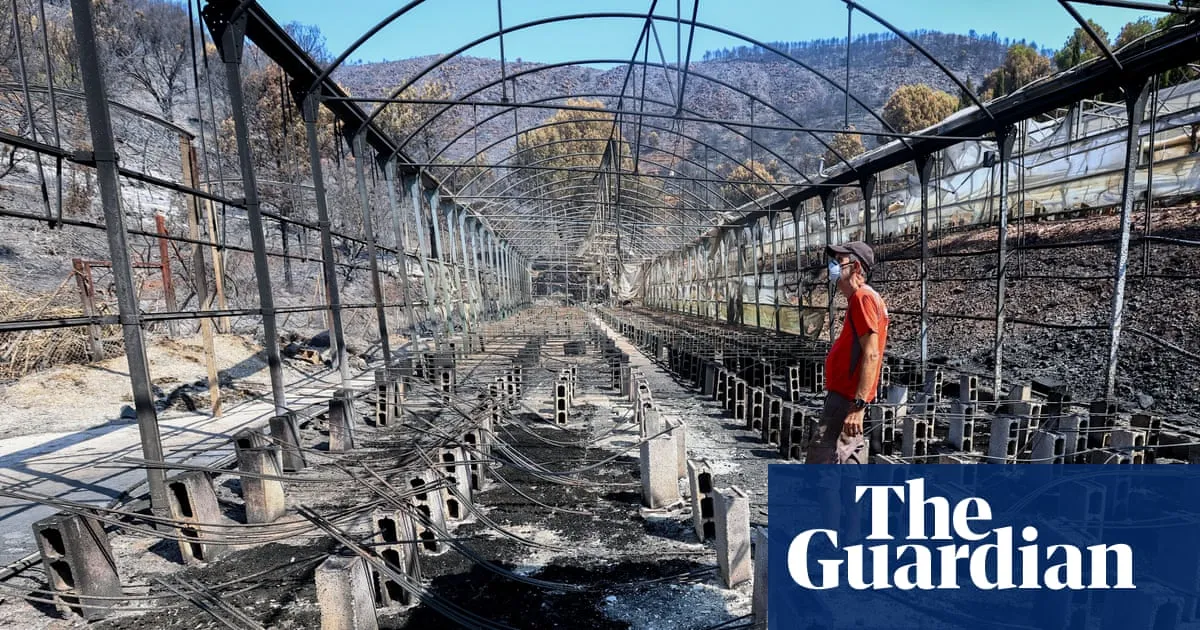
A senior policymaker at the European Central Bank has said the climate emergency and the breakdown of nature poses a dramatically growing risk to the global economy.Frank Elderson, a member of the ECB’s executive board, said the eurozone lender of last resort was stepping up its monitoring of the financial risks linked to the destruction of “ecosystem services”, which are nature-related processes or assets that support human activity.“These services are not stable but they are in rapid decline. That’s why we talk about the climate and nature crises,” he said. “So knowing that dependency, and knowing those exposures by the banks, we come to the conclusion that this is relevant.”Across France and Spain, wildfires have raged amid record-breaking temperatures, torching land, businesses and homes, in an emergency that will carry a heavy economic cost beside the direct human toll.In an interview with the Guardian before the current devastation across Europe, Elderson said it was clear the rising frequency of natural disasters linked to global heating pos a threat to financial stability.He said more work needed to be done to assess the risk from the collapse of ecosystem services, as reliance on nature was more complicated to map than the impact of a single extreme weather event.ecosystem services are defined as any benefit that can be drawn from a natural structure or process – for example, water can be used as a raw material, an energy source through hydropower, or for transportation. It is also a habitat for marine life critical for food production, and a basis for recreational services.“Nature-related risks can pose material economic and financial risks, including through their impacts on credit risk, growth, inflation and – over the long-term – potential financial instability,” Elderson said.“I did interviews [previously] saying, you know, if you destroy nature, you destroy the core on which our economies depend. And that got people’s attention. This is not some kind of a flower-power, tree-hugging exercise. This is core economics. This is core financial stability, core price stability.”As the supervisor responsible for Europe’s largest banks, the ECB has launched a programme of work to assess how the escalating damage to ecosystem services could expose the financial system to risk.The central bank plans to publish analysis later this year investigating how “ecosystem degradation pathways” could translate into credit loss dynamics for the eurozone’s banks.A Dutch lawyer and central banker, Elderson was instrumental in the creation of the Network for Greening the Financial System (NGFS) in 2017, alongside Mark Carney and François Villeroy de Galhau, the then chiefs of the Bank of England and Banque de France. He served as founding chair of the group of 114 global central banks and financial supervisors pushing to develop climate risk management.The green agenda in financial services has faced pushback under the US presidency of Donald Trump, as some businesses battle to remain engaged in the fossil-fuel economy.Trump pulled the US out of the NGFS last year, leaving Europe to take the lead on climate-related risks without the involvement of the world’s most powerful economy.Elderson said the banking industry remained convinced that climate and nature-related risks had to be addressed.“I would think it’s very difficult to find a bank in Europe that will honestly tell you that they think this is not relevant,” he said. “I think that time has passed.”
SRCThe Guardian - World News
LANGEN
LEANCenter-Left
WORDS551
ENT12
SAT · 2026-08-01 · 04:00 GMTBRIEF NSR-2026-0801-98082
NSR-2026-0801-98082News Report·EN·Economic Impact
ECB official warns climate crisis poses growing threat to ‘core financial stability’
Frank Elderson, a senior policymaker at the European Central Bank (ECB), has warned that the climate and nature crises pose a growing threat to core financial stability. He stated that the ECB is increasing its monitoring of financial risks associated with the decline of "ecosystem services," which are vital natural processes supporting human activity.
Richard Partington Senior economics correspondentThe Guardian - World NewsFiled 2026-08-01 · 04:00 GMTLean · Center-LeftRead · 3 min
The Guardian - World NewsFIG 01
Reading time
3min
Word count
551words
Sources cited
3cited
Entities identified
12entities
Quality score
100%
§ 01
Briefing Summary
AI-generatedNEWSAR · AI
Frank Elderson, a senior policymaker at the European Central Bank (ECB), has warned that the climate and nature crises pose a growing threat to core financial stability. He stated that the ECB is increasing its monitoring of financial risks associated with the decline of "ecosystem services," which are vital natural processes supporting human activity. Elderson emphasized that this is a core economic and financial stability issue, not merely an environmental concern. The ECB is undertaking analysis to understand how ecosystem degradation could lead to credit losses for eurozone banks. This initiative comes as Europe experiences severe weather events, highlighting the tangible economic costs of climate change.
Confidence 0.90Sources 3Claims 5Entities 12
§ 02
Article analysis
Model · rule-basedFraming
Economic Impact
Environmental
Tone
Mixed Tone
AI-assessed
CalmNeutralAlarmist
Factuality
0.80 / 1.00
Factual
LowHigh
Sources cited
3
Well sourced
FewMany
§ 03
Key claims
5 extracted01
Rising frequency of natural disasters linked to global heating poses a threat to financial stability.
quoteFrank Elderson
Confidence
1.00
02
The ECB plans to publish analysis later this year investigating how ecosystem degradation could translate into credit loss dynamics for eurozone banks.
factualECB
Confidence
1.00
03
Nature-related risks can pose material economic and financial risks, including impacts on credit risk, growth, and inflation.
quoteFrank Elderson
Confidence
1.00
04
The ECB is stepping up its monitoring of financial risks linked to the destruction of ecosystem services.
factualECB
Confidence
1.00
05
Climate emergency and breakdown of nature pose a dramatically growing risk to the global economy.
quoteFrank Elderson
Confidence
1.00
§ 04
Full report
3 min read · 551 words§ 05
Entities
12 identifiedKey playerOppositionContextPositiveNeutralNegative
§ 06
Keywords & salience
9 termsfinancial stability
1.00
climate crisis
1.00
ecosystem services
0.90
nature breakdown
0.80
economic risk
0.70
european central bank
0.70
natural disasters
0.60
global economy
0.50
credit risk
0.40
§ 07
Topic connections
Interactive graph No topic relationship data available yet. This graph will appear once topic relationships have been computed.