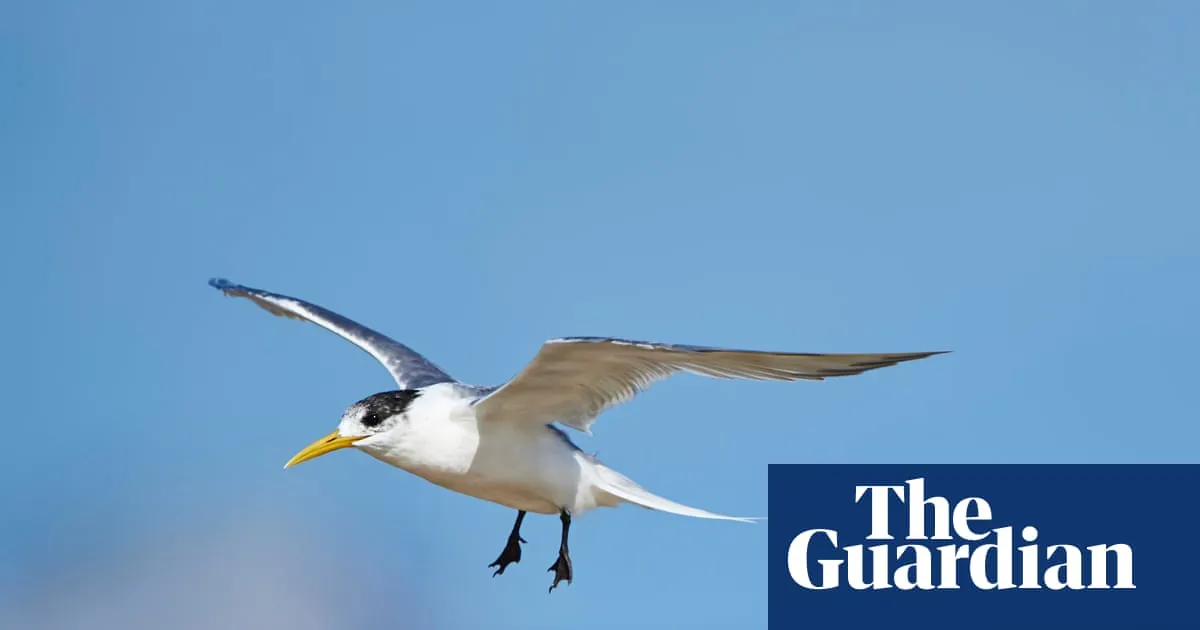
More than 80 dead and dying greater crested terns have been spotted off the South Australian coast in what is a suspected H5N1 bird flu mass mortality event. Photograph: imageBROKER/David & Micha Sheldon/Getty Images/imageBROKER RF View image in fullscreen More than 80 dead and dying greater crested terns have been spotted off the South Australian coast in what is a suspected H5N1 bird flu mass mortality event. Photograph: imageBROKER/David & Micha Sheldon/Getty Images/imageBROKER RF First Australian mass mortality event suspected as deadly bird flu virus rapidly escalates among native birds Helicopter surveillance finds dead and dying greater crested terns off South Australian coast as H5 virus spreads Get our breaking news email, free app or daily news podcast More than 80 dead and sick birds seen on rocks off the South Australian coast are suspected to be the first mass mortality event from the deadly H5N1 bird flu virus, only six weeks after the disease arrived in Australia. Authorities reported on Saturday that helicopter surveillance had revealed 49 dead greater crested terns on Baudin Rocks, near Robe, as well as 35 more sick terns. While some of the birds had been collected for testing, Australia" class="entity-link entity-location" data-entity-id="210" data-entity-type="location">South Australia’s chief vet Skye Freuan said it was likely the first mass mortality event from the disease. Australia" class="entity-link entity-location" data-entity-id="210" data-entity-type="location">South Australia also reported three suspected positive cases in other greater crested terns, including one inland at Monarto, suggesting the disease has begun moving away from the coast. The Monarto area is home to several poultry farms. Three Silver gulls were also suspected positive, SA authorities said, adding to the first Silver gull found a few days ago and confirmed positive by the CSIRO earlier on Saturday. Jack Gough, the chief executive of the Invasive Species Council, said it now appeared the disease was “starting to take off” and “mirroring the experience in South America of early detections, then rapid increases in numbers and spread leading to mass mortality events in wildlife.” “We are still at the very early stages of this devastating disease spreading, but the possible first mass mortality coming just days after the virus was declared not eradicable indicates how quickly this could escalate,” he said. Freuan said there was “nothing we can do” to stop the spread of the disease, but that surveillance was working. The news came at the end of a significant week in the development of the disease when numbers jumped by 20 in just a few days to the current total of 53. Australia was the last continent to have the unwelcome arrival of a disease that has killed millions of birds and mammals around the world. Victoria this week confirmed its first cases of the virulent strain in a greater crested tern found in Portland, with the state joining Western Australia, Australia" class="entity-link entity-location" data-entity-id="210" data-entity-type="location">South Australia, New South Wales and Queensland that have all recorded positive cases. On Saturday, Victorian authorities said samples from five crested terns had been sent to the CSIRO laboratory in Geelong, with preliminary testing suggesting more positive results. Five confirmed cases in birds at Seal Bay on Kangaroo Island also raised concerns for the welfare of the area’s Australian sea lions – an endangered species. Tens of thousands of seals have died worldwide from the disease. But it has been the cases among Silver gulls that has experts like Sean Dooley, the national affairs adviser at BirdLife Australia, concerned that the spread of the virus has now reached a critical new stage. “When people think of a seagull, they’re almost always thinking of the silver gull,” said Dooley. View image in fullscreen Australian sea lions, an endangered species, are at risk of contracting H5N1 bird flu. Photograph: Brad Leue/Alamy “They’re very common, and primarily they are coastal, but they do come inland and can turn up in Lake Eyre following floods,” said Dooley. Silver gulls are the second Australian native species to catch the disease, after dozens of detections in greater crested terns. But it is the silver gull’s behaviour and habits that have experts concerned because they scavenge from dead or dying animals, meaning they can easily pick up the disease from other sick birds. They also pick detritus from water bodies – lakes and flooded areas included – and these are known to be breeding grounds for the disease. “There is such a large population of Silver gulls, and they move into other habitats. They could be the vector that takes bird flu inland,” says Dooley. “They’re also really successful in urban areas and could bring the disease into those bird populations.” Because Australia has a high concentration of unique birds, the susceptibility of many native species isn’t known. But the fears are there is no reason to think they would manage any better than birds overseas. Birds that flock around water have tended to be the hardest hit. Examples include sandwich terns, black-headed gulls and northern gannets in Europe and, in Peru, pelicans. Dooley said the mood at BirdLife Australia this week had been one of “trying to suppress that sinking, gut-churning feeling”. The winter season for bird watchers along the coast had been one of the best in 10 years, said Dooley, with rare petrels turning up in numbers along the east coast. “Now that has been heavily tinged because probably among those were birds carrying H5N1.” Explore more on these topics Bird flu Wildlife Birds Marine life Animals news Share Reuse this content
SRCThe Guardian - World News
LANGEN
LEANCenter-Left
WORDS901
ENT12
SAT · 2026-08-01 · 06:12 GMTBRIEF NSR-2026-0801-98091
NSR-2026-0801-98091News Report·EN·Public Health
First Australian mass mortality event suspected as deadly bird flu virus rapidly escalates among native birds
Authorities in South Australia suspect the first mass mortality event of the H5N1 bird flu virus in Australia, with over 80 dead and dying greater crested terns observed on Baudin Rocks. This comes just six weeks after the virus first arrived in the country.
Graham Readfearn Environment and climate correspondentThe Guardian - World NewsFiled 2026-08-01 · 06:12 GMTLean · Center-LeftRead · 4 min
The Guardian - World NewsFIG 01
Reading time
4min
Word count
901words
Sources cited
3cited
Entities identified
12entities
Quality score
100%
§ 01
Briefing Summary
AI-generatedNEWSAR · AI
Authorities in South Australia suspect the first mass mortality event of the H5N1 bird flu virus in Australia, with over 80 dead and dying greater crested terns observed on Baudin Rocks. This comes just six weeks after the virus first arrived in the country. Helicopter surveillance confirmed 49 dead and 35 sick terns, with some collected for testing. The virus is also suspected in other greater crested terns inland and in silver gulls, raising concerns about its spread to poultry farms and unique native bird populations. Experts are worried that silver gulls, due to their scavenging habits and wide distribution, could act as vectors for the disease to move inland and into urban areas.
Confidence 0.90Sources 3Claims 5Entities 12
§ 02
Article analysis
Model · rule-basedFraming
Public Health
Environmental
Tone
Mixed Tone
AI-assessed
CalmNeutralAlarmist
Factuality
0.80 / 1.00
Factual
LowHigh
Sources cited
3
Well sourced
FewMany
§ 03
Key claims
5 extracted01
Helicopter surveillance revealed 49 dead and 35 sick greater crested terns on Baudin Rocks, near Robe.
factualSouth Australia's chief vet Skye Freuan
Confidence
0.95
02
Australia was the last continent to have the arrival of H5N1, which has killed millions of birds and mammals globally.
factual
Confidence
0.90
03
Over 80 dead and dying greater crested terns spotted off South Australian coast, suspected H5N1 bird flu mass mortality event.
factual
Confidence
0.90
04
The disease has begun moving away from the coast, with suspected positive cases inland at Monarto.
factualSouth Australia authorities
Confidence
0.85
05
The disease could quickly escalate, mirroring experiences in South America with rapid increases and mass mortality events.
predictionJack Gough, chief executive of the Invasive Species Council
Confidence
0.70
§ 04
Full report
4 min read · 901 words§ 05
Entities
12 identifiedKey playerOppositionContextPositiveNeutralNegative
Organizations2
Locations5
§ 06
Keywords & salience
10 termsh5n1
1.00
mass mortality event
1.00
bird flu
1.00
native birds
0.90
greater crested terns
0.80
south australia
0.70
disease spread
0.60
wildlife
0.50
surveillance
0.40
poultry farms
0.40
§ 07
Topic connections
Interactive graph No topic relationship data available yet. This graph will appear once topic relationships have been computed.