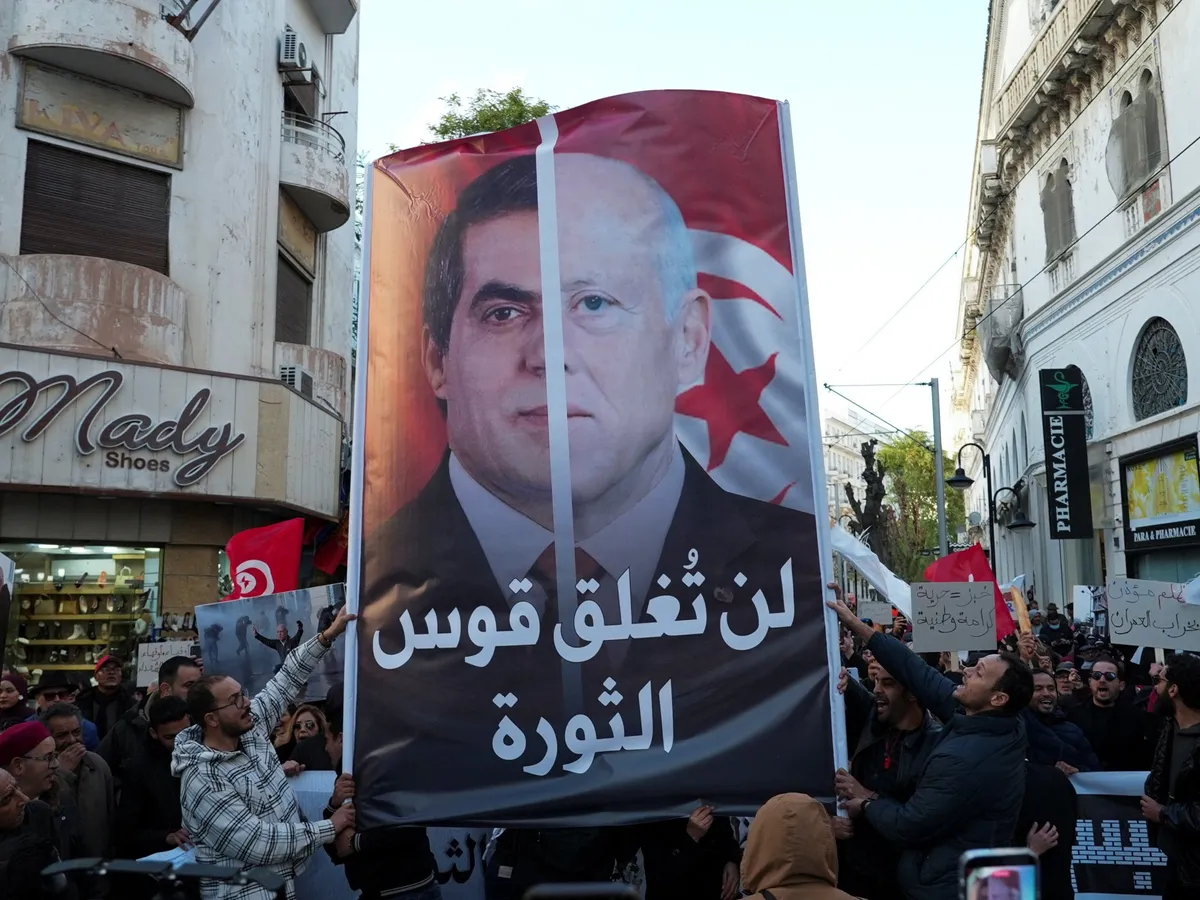
Behind Tunisia’s enforced calm, anger is growing over repression, economic decline and collapsing public services.Activists and political opponents protest against Tunisian President Kais Saied earlier this year, calling for an end to one-man rule and the restoration of democracy [File: Jihed Abidellaoui/Reuters]Published On 1 Aug 2026Five years after Tunisian President Kais Saied’s dramatic power grab, few of the hopes that charged the region following the country’s landmark 2011 revolution remain intact.The people’s sense of participation in forming a template for a new constitution and democratic order that followed the revolution has all but vanished.Recommended Stories list of 4 itemslist 1 of 4Tunisia grapples with five years of crisis since Saied’s power grablist 2 of 4Five years after Saied’s power grab, Tunisians are no better offlist 3 of 4Tunisia bars family, lawyers from seeing Ghannouchi after prison collapselist 4 of 4Tunisia’s body politic is in crisisend of listPolitical debates that dominated the airwaves following the 2011 uprising have given way to sports and entertainment shows.The economy – which served as both a springboard for the 2011 revolution and a pretext for Saied’s 2021 “self-coup” – has been left to deteriorate. As a heatwave and wildfires ravage the country, blackouts have become routine, kindling public anger.On Saturday, thousands took to the streets of the capital to protest against what demonstrators saw as Saied’s increasingly autocratic hold on power and worsening living conditions, competing with those supporting his rule, who waved flags and called for the “traitors” to be jailed.The country’s journalists, cowed by a sweeping crackdown on the media, shaped their coverage of the demonstrations accordingly.Salsabil Chellali, Tunisia director at Human Rights Watch, told Al Jazeera there is a growing sense that criticism of the government will not be tolerated.“Five years ago, Kais Saied buried Tunisia’s democratic transition and dragged the country back into authoritarianism,” Chellali said.“His record is one of human rights crisis: the dismantling of the rule of law, and the targeting of the opposition, civil society and the media in turn, to strip Tunisians of their civil and political rights and participation in public affairs. No critic is safe under his rule.”Heatwave exposes lack of planningThe wildfires that continue to tear through the country are estimated to have destroyed 4,400 hectares (10,900 acres, or about two-thirds the size of Paris) of land, despite help from Italy and Algeria.Staggered power cuts by state-owned electricity and gas company STEG, planned to offset the overwhelming demand for fans and air-conditioning amid the heatwave, are leading to the destruction of crops and damage to Tunisian industries.“There is no plan for anything,” one Tunisia-based analyst, who asked to be quoted anonymously, fearing repression, told Al Jazeera.“Typically, countries know that when summer comes, there will be increased demand for electricity and water, so they plan for it. In Tunisia, we have no money and no investment – and no plan.”The situation goes beyond decaying infrastructure to an absence of central planning for emergencies such as this.“It’s like we’re in a ship being captained by a man with no knowledge of sailing,” he said.Nevertheless, the analyst added, Saied has retained support from some corners of society, who remember the legislative logjams and factionalism that marked the pre-coup parliament.While ready to acknowledge the hardships caused by the power and water cuts, Saied’s supporters in parliament and the media have consistently framed the solution as one of reform rather than overhaul, contrasting the country’s present difficulties with those inflicted by the fractious pre-2022 parliament.People gather to protest against Tunisia’s President Kais Saied during a demonstration marking five years since his suspension of parliament and assumption of emergency powers, along Avenue Habib Bourguiba in Tunis on July 25, 2026 [AFP]In parliament earlier this week, speaker Ibrahim Bouderbala urged citizens not to allow anger about water and power shortages to escalate, pointing to other countries that had recovered from similar crises through sound governance.Saied has also said that power and water cuts “must end immediately” and he is closely monitoring the situation. He also warned that “the state will act firmly against anyone who tries to aggravate the situation in the country”.Nearly all of Tunisia’s government critics have either been jailed or are in exile. Much of the leadership of Ennahdha, the pre-coup parliament’s largest party, is in jail, including the group’s 85-year-old leader, Rached Ghannouchi. Since Ghannouchi collapsed in detention last month, presumably due to the heat, his whereabouts and condition remain unknown.Similarly, controversial legislation criminalising anything the state determines is “fake news” and a series of high-profile arrests have seen critical voices in the media silenced.Most recently, one of the country’s highest-profile political commentators and satirists, Heythem El Mekki, was forced to flee Tunisia after being sentenced to a year’s imprisonment for commenting on a social media posted three years ago criticising failings at a Sfax hospital morgue.Heythem El Mekki [Simon Speakman Cordall/Al Jazeera]“There’s censorship across the board,” said Hamza Meddeb, a Tunisian academic with the Carnegie Middle East Centre.Power cuts now continue for up to 12 hours, leading to extreme economic and physical hardship for Tunisians.“Livestock are dying. Restaurants are closing. Sick people are suffering and some of the old are actually dying,” Meddeb said.“That anger has to go somewhere and it’s being aimed at the state-owned electricity and water companies, sometimes it’s aimed at the government, but never at the one figure who has control: the president.”Meddeb, like many other Tunisian journalists and academics, has since left for France. But for those who remain behind, there is little option but to self-censor or deflect.Little hope of reformSaied’s entrenchment in Tunisia’s power structures appears to have been bolstered by the support of external actors.The European Union (EU), wary of migrant crossings from Tunisia’s coast, has quietly prioritised stability over democratic backsliding. It has entered into several deals to support the Tunisian government, despite concerns raised by migration and rights groups.Tunisia’s neighbours, Algeria and Libya, also have little appetite for a disorderly neighbour. Algerian President Abdelmadjid Tebboune pledged earlier this week to stand ready to defend Tunisia against “any threat” to its stability.Riccardo Fabiani, the Crisis Group’s North Africa director, said under Saied, Tunisia will remain “lost in his own delusions, worldview … where everything that goes wrong is the result of a conspiracy against him”.“Nearly all of Tunisia’s external partners have given up on reform entirely,” Fabiani said.“Those that cling on, such as Italy – which has a stake in working with Tunisia on migration – say that they’re routinely frustrated by a bureaucracy that’s terrified of being perceived from above of having made any mistake, so nothing gets done.”Al Jazeera reached out to the Tunisian Prime Minister’s Office for comment on this article but received no response.
SRCAl Jazeera
LANGEN
LEANCenter
WORDS1 111
ENT12
SAT · 2026-08-01 · 09:42 GMTBRIEF NSR-2026-0801-98120
NSR-2026-0801-98120News Report·EN·Political Strategy
Beneath Tunisia’s silence, public anger simmers
Five years after President Kais Saied's power grab, Tunisia faces growing public anger over repression, economic decline, and collapsing public services. Despite an enforced calm, citizens are protesting Saied's autocratic rule and worsening living conditions, while supporters rally behind him, citing the need for reform.
Simon Speakman CordallAl JazeeraFiled 2026-08-01 · 09:42 GMTLean · CenterRead · 5 min
Al JazeeraFIG 01
Reading time
5min
Word count
1 111words
Sources cited
2cited
Entities identified
12entities
Quality score
100%
§ 01
Briefing Summary
AI-generatedNEWSAR · AI
Five years after President Kais Saied's power grab, Tunisia faces growing public anger over repression, economic decline, and collapsing public services. Despite an enforced calm, citizens are protesting Saied's autocratic rule and worsening living conditions, while supporters rally behind him, citing the need for reform. Routine blackouts, exacerbated by a heatwave, are damaging crops and industries, highlighting a lack of planning and investment. Critics, including journalists and political opponents, face a crackdown, with many jailed or in exile. Saied has promised to address the power and water cuts and warned against those aggravating the situation, while his supporters argue for reform over overhaul.
Confidence 0.90Sources 2Claims 5Entities 12
§ 02
Article analysis
Model · rule-basedFraming
Political Strategy
Economic Impact
Tone
Mixed Tone
AI-assessed
CalmNeutralAlarmist
Factuality
0.60 / 1.00
Mixed
LowHigh
Sources cited
2
Limited
FewMany
§ 03
Key claims
5 extracted01
Salsabil Chellali states Saied has 'buried Tunisia’s democratic transition and dragged the country back into authoritarianism.'
quoteSalsabil Chellali
Confidence
1.00
02
Five years after President Kais Saied's power grab, hopes from the 2011 revolution have diminished.
factual
Confidence
0.90
03
Thousands protested Saied's autocratic rule and worsening living conditions, while supporters called for 'traitors' to be jailed.
factual
Confidence
0.85
04
Anger is growing in Tunisia over repression, economic decline, and collapsing public services.
factual
Confidence
0.80
05
Wildfires have destroyed an estimated 4,400 hectares of land, impacting crops and industries.
statistic
Confidence
0.70
§ 04
Full report
5 min read · 1 111 words§ 05
Entities
12 identifiedKey playerOppositionContextPositiveNeutralNegative
Locations1
§ 06
Keywords & salience
10 termspublic anger
1.00
authoritarianism
0.90
economic decline
0.90
kais saied
0.80
democratic transition
0.80
human rights crisis
0.70
repression
0.70
political opponents
0.60
public services
0.50
wildfires
0.40
§ 07
Topic connections
Interactive graph Network visualization showing 11 related topics
View Full Graph Person Organization Location Event|Click node to navigate|Edge numbers = shared articles