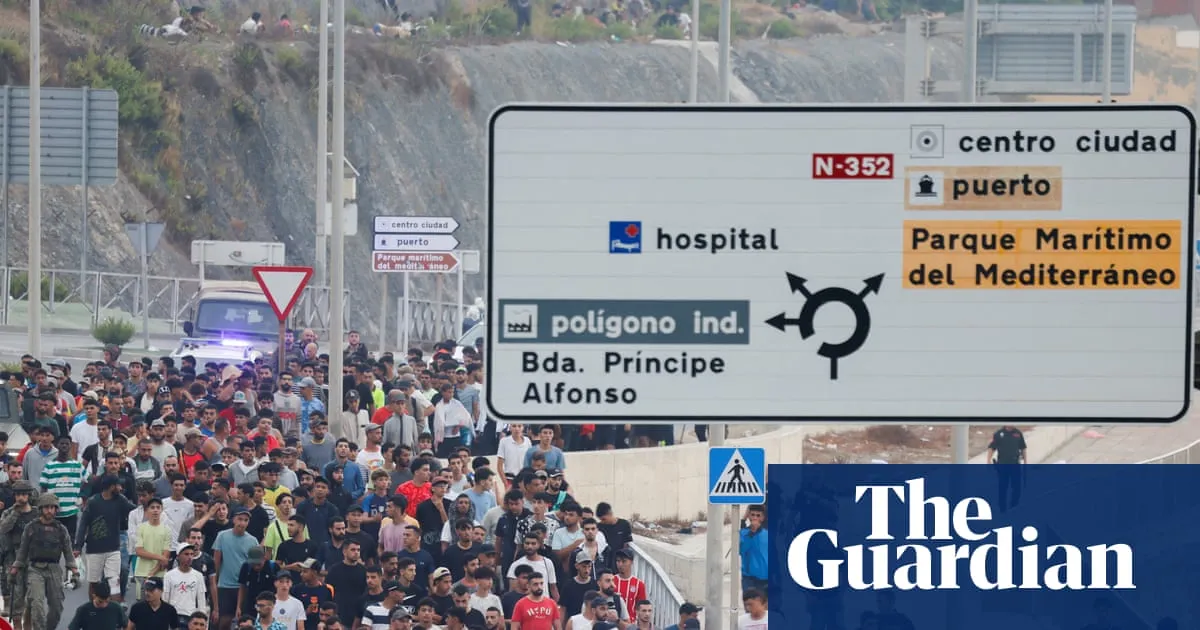
Spain’s prime minister, Pedro Sánchez, has called for an urgent meeting of EU interior ministers after what he called some member states’ “selfish, polarising and unlawful reaction” to this week’s mass border crossing into the Spanish enclave of Ceuta, in north Africa.It comes after he confirmed “virtually all” the irregular migrants had been returned, “preventing any unauthorised onward movement towards continental Europe”.However, he has asked for the meeting following what appears to be a breakdown of EU unity on external border policy, with Italy attacking Spain.More than 50,000 people crossed into the territory from Morocco on Thursday and Friday, with at least 67 people dying in the attempt. Some drowned, while others were crushed as they tried to cross a breakwater barrier.Although more than 48,000 people had voluntarily returned to Morocco by 6pm on Friday, the influx triggered a political crisis for the Madrid government and led some fellow EU countries to call for Spain to be suspended from the Schengen free-movement zone.Italy announced on Friday evening that it would suspend its Schengen arrangements with Spain, even though Ceuta – and Spain’s other north African enclave, Melilla – are subject to special Schengen rules that prevent onward movement within the zone.Italy’s foreign minister, Antonio Tajani, blamed the situation in Ceuta on the Sánchez government’s decision to offer a now-closed scheme to regularise the status of more than 1 million undocumented migrants and asylum seekers. He said the programme had incentivised human trafficking and was “profoundly wrong”.Tajani’s remarks prompted a sharp response from Spain’s foreign minister, José Manuel Albares, who said the comments were “unbecoming” and accused Italy of “partisan demagoguery”.Sánchez was equally forthright in a letter sent to the European Commission president, Ursula von der Leyen, the European Council president, António Costa, and Micheál Martin, the prime minister of Ireland, which holds the EU presidency.Pedro Sánchez speaking at a press conference in Ceuta on Friday. Photograph: Borja Puig de la Bellacasa/Moncloa handout/EPAIn the letter, the Spanish prime minister said he had been deeply concerned by the reaction some EU governments had shown to events in Ceuta.Sánchez said that while most had expressed support and solidarity, others had chosen to attack Spain and call for its temporary exclusion from the Schengen area.“Such an attitude – driven by prejudice, fake news, ignorance or political interest – is … contrary to European law, humanitarian law, and the principles of solidarity that bind us together,” he said.In a pointed rebuke to Italy, he noted that Spain was “according to Frontex, one of the least porous external borders of the European Union, with a number of irregular entries that is half that recorded, for example, in Italy in recent years (2021–2026)”.He concluded by saying the EU could not afford “this kind of selfish, polarising and unlawful reaction” and asked for an urgent video conference of EU interior ministers to address the issue.Senior EU officials are due to meet on Saturday in a “political crisis response team” convened by Ireland’s presidency. The meeting is designed to help member states make clear responses using expert opinion.Tens of thousands of migrants cross into Spanish enclave Ceuta from Morocco - videoIreland’s justice minister, Jim O’Callaghan, who is leading the meeting on behalf of the EU, said he had been in touch with Spain’s interior minister, Fernando Grande-Marlaska, to express his solidarity and support.“I will remain in close contact with the Spanish government, member states and the EU institutions as the situation evolves,” he said on Friday night.Many of the remaining people who crossed into Ceuta returned to Morocco on Saturday morning amid a reinforced Spanish police and military presence.“We hope to go to Europe to work and earn a living – that’s it,” Souleil Boyan, a 19-year-old from Senegal, told Agence France-Presse outside a migrant centre in Ceuta where dozens of other people from sub-Saharan Africa were waiting for officials.skip past newsletter promotionafter newsletter promotion“We all know that in Africa there isn’t much opportunity,” he added.The Spanish government said in a statement that the situation in Ceuta remained calm and quiet.“Friday night passed without incident,” it said. “Entries were completely halted, while departures to Morocco continued without any notable events.”It said containment barriers were being installed at the Tarajal beach breakwater, including a 500-metre-long inflatable barrier and a line of anchored buoys.This week’s mass crossing dwarfs the last similar event in May 2021, when Morocco loosened its border controls, allowing about 10,000 people to enter the territory over the course of two days.That crossing came amid heightened tensions between Madrid and Rabat over Spain’s decision to allow the leader of the Western Sahara independence movement, the Polisario Front, to be treated for Covid-19 in Spain. Morocco and the Polisario Front both lay claim to Western Sahara, which was under Spanish rule until 1975, when colonial authorities handed over the territory to Morocco and Mauritania.That diplomatic crisis ended in 2022 when Madrid reversed its longstanding policy of neutrality and backed Morocco’s plan for Western Sahara – a move that had caused a diplomatic rift between Spain and Algeria, which had supported the Polisario group.Sánchez visited Algiers on 20 July – the first visit by a Spanish head of government in four years – marking a thaw in relations with Algeria.The Spanish government has attributed the latest influx to “human trafficking mafias” that have taken advantage of a decision by Spain’s supreme court, which recently ruled that those intercepted at sea while trying to enter Ceuta, or Spain’s other north African enclave of Melilla, could not be summarily returned under special rules.But some migration experts have expressed doubts about that explanation. Mauricio Valiente, the director general of the Spanish Refugee Aid Commission, said the route into in Ceuta was very different from the Atlantic route from Africa to the Canary islands, which is often operated by people smugglers.“From what we’re seeing, these are people who buy a float and jump into the sea,” he told elDiario.es.“It makes no sense. It’s important to keep in mind – and this also explains the concentration of these incidents – that unlike what happens in the Canary Islands, these aren’t people who have to get into a small boat. This is a matter of being just metres from a land border, jumping into the sea and trying to get around a breakwater, which makes it much easier to do, even with all the risks.”Valiente also said there had been a steady increase in arrivals to Ceuta this year, even before the supreme court ruling.“The causes are complex, and there are surely many reasons,” he said. “But to simplify it by referencing the court ruling or organised crime – to say there’s a direct cause-and-effect relationship – is completely unfounded.”
SRCThe Guardian - World News
LANGEN
LEANCenter-Left
WORDS1 114
ENT12
SAT · 2026-08-01 · 11:49 GMTBRIEF NSR-2026-0801-98121
NSR-2026-0801-98121News Report·EN·Diplomatic
Spanish PM calls for urgent EU meeting after ‘selfish’ responses to Ceuta crisis
Spanish Prime Minister Pedro Sánchez has called for an urgent EU interior ministers' meeting following a mass border crossing into the Spanish enclave of Ceuta. Over 50,000 people entered Ceuta from Morocco, with many subsequently returned.
Sam Jones in Madrid and Lisa O’Carroll in LondonThe Guardian - World NewsFiled 2026-08-01 · 11:49 GMTLean · Center-LeftRead · 5 min
The Guardian - World NewsFIG 01
Reading time
5min
Word count
1 114words
Sources cited
5cited
Entities identified
12entities
Quality score
100%
§ 01
Briefing Summary
AI-generatedNEWSAR · AI
Spanish Prime Minister Pedro Sánchez has called for an urgent EU interior ministers' meeting following a mass border crossing into the Spanish enclave of Ceuta. Over 50,000 people entered Ceuta from Morocco, with many subsequently returned. Sánchez criticized some EU member states for "selfish, polarising and unlawful reactions," including Italy's suspension of Schengen arrangements and criticism of Spain's migrant policies. He argued these reactions were contrary to EU principles and humanitarian law. The call for a meeting comes amid a perceived breakdown in EU unity on external border policy, with senior EU officials also convening a crisis response team.
Confidence 0.90Sources 5Claims 5Entities 12
§ 02
Article analysis
Model · rule-basedFraming
Diplomatic
Political Strategy
Tone
Mixed Tone
AI-assessed
CalmNeutralAlarmist
Factuality
0.70 / 1.00
Factual
LowHigh
Sources cited
5
Well sourced
FewMany
§ 03
Key claims
5 extracted01
Sánchez stated that some EU governments' reactions were driven by 'prejudice, fake news, ignorance or political interest'.
quotePedro Sánchez
Confidence
1.00
02
Spanish PM Pedro Sánchez called for an urgent EU meeting after member states' 'selfish, polarising and unlawful reaction' to the Ceuta crisis.
quotePedro Sánchez
Confidence
1.00
03
Spain, according to Frontex, has one of the least porous external borders in the EU, with half the irregular entries of Italy.
statisticPedro Sánchez
Confidence
0.90
04
Italy announced it would suspend its Schengen arrangements with Spain, blaming the Ceuta situation on Spain's migrant regularization scheme.
factualItaly
Confidence
0.90
05
More than 50,000 people crossed into Ceuta from Morocco, with at least 67 deaths reported.
statistic
Confidence
0.90
§ 04
Full report
5 min read · 1 114 words§ 05
Entities
12 identifiedKey playerOppositionContextPositiveNeutralNegative
People6
Organizations1
Locations4
Topics1
§ 06
Keywords & salience
10 termsceuta crisis
1.00
eu border policy
0.90
schengen zone
0.80
irregular migrants
0.70
eu unity
0.60
human trafficking
0.50
pedro sánchez
0.40
antonio tajani
0.40
external border
0.40
asylum seekers
0.40
§ 07
Topic connections
Interactive graph Network visualization showing 29 related topics
View Full Graph Person Organization Location Event|Click node to navigate|Edge numbers = shared articles