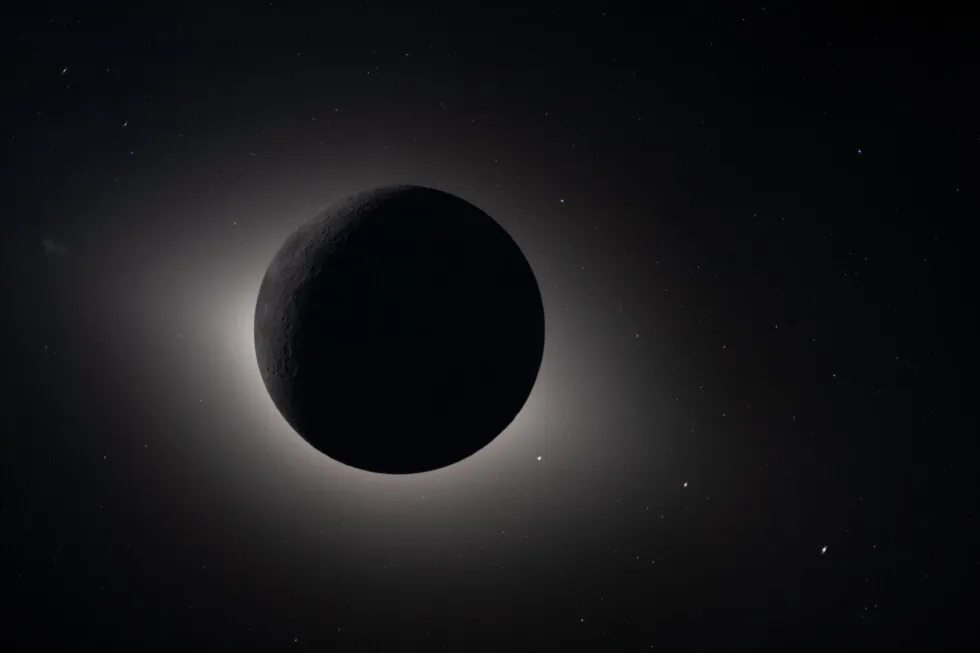
August’s total solar eclipse will sweep over Spain, Iceland and Greenland 1 of 3 | A total solar eclipse crosses over parts of Spain, Iceland and Greenland on Aug. 12. This animated map shows the path of totality. (AP animation: Panagiotis Mouzakis) 2 of 3 | This image provided by NASA and captured by the Artemis II crew from lunar orbit, April 6, 2026, shows the Moon eclipsing the Sun. (NASA via AP, File) 3 of 3 | In this image provided by NASA the Artemis II crew, counterclockwise from top left, Mission Specialist Christina Koch, Mission Specialist Jeremy Hansen, Commander Reid Wiseman and Pilot Victor Glover pose with eclipse viewers during a lunar flyby on April 6, 2026. (NASA via AP, File) 1 of 3 A total solar eclipse crosses over parts of Spain, Iceland and Greenland on Aug. 12. This animated map shows the path of totality. (AP animation: Panagiotis Mouzakis) Add AP News on Google Add AP News as your preferred source to see more of our stories on Google. Share 2 of 3 | This image provided by NASA and captured by the Artemis II crew from lunar orbit, April 6, 2026, shows the Moon eclipsing the Sun. (NASA via AP, File) 2 of 3 This image provided by NASA and captured by the Artemis II crew from lunar orbit, April 6, 2026, shows the Moon eclipsing the Sun. (NASA via AP, File) Add AP News on Google Add AP News as your preferred source to see more of our stories on Google. Share 3 of 3 | In this image provided by NASA the Artemis II crew, counterclockwise from top left, Mission Specialist Christina Koch, Mission Specialist Jeremy Hansen, Commander Reid Wiseman and Pilot Victor Glover pose with eclipse viewers during a lunar flyby on April 6, 2026. (NASA via AP, File) 3 of 3 In this image provided by NASA the Artemis II crew, counterclockwise from top left, Mission Specialist Christina Koch, Mission Specialist Jeremy Hansen, Commander Reid Wiseman and Pilot Victor Glover pose with eclipse viewers during a lunar flyby on April 6, 2026. (NASA via AP, File) Add AP News on Google Add AP News as your preferred source to see more of our stories on Google. Share Updated [hour]:[minute] [AMPM] [timezone], [monthFull] [day], [year] For the first time in more than a century, a total solar eclipse is coming to mainland Spain with an even longer encore next summer.Toss in a crescendoing meteor shower and a six-planet parade on the same day, and the heavens will be overflowing with awe.Daytime darkness will descend Aug. 12 across the Iberian Peninsula close to sunset — plus slivers of Greenland and Iceland — as the sun, moon and Earth align perfectly in the sky. Starting near the North Pole before tracking south, totality will last up to two minutes and 18 seconds, an appetizer for an even longer solar show next year — a 6 ½-minute extravaganza that will sweep from Spain to North Africa and the Middle East.It will take 1 ½ hours for the umbra, or moon’s sun-blocking shadow, to race along the 5,130-mile (8,260-kilometer) course, most of it over an empty Atlantic. Maximum totality will occur off Iceland’s west coast. By the time it reaches a small patch of Portugal and then Spain with its massive crowds, totality will have dwindled to a minute or so. The spectacle will end in the Mediterranean. Eclipse chasers gear up for the solar spectacle Hundreds of millions more on the sidelines are in for a treat as well.A partial eclipse will delight as far away as Alaska and Siberia, enveloping Canada, the northern U.S., and much of Europe and West Africa.The closer to totality’s course, the more the sun will vanish behind the moon – 94% coverage in Dublin and 83% in Oslo, Norway. Montreal will see an 18% bite out of the sun, tapering to 9% in New York and 2% in Norfolk, Virginia.Special eclipse glasses are crucial. even if a morsel of sun is showing. Adding to the cosmic wonder, the day begins with six of our neighboring planets forming an arc in the sky before dawn and end with the Perseid meteor shower peaking after nightfall under the new moon. Streaking meteors could photobomb totality, with some of the brighter planets and stars visible in the background. Eclipse mapmaker Michael Zeiler is chasing an even more elusive interloper: the northern lights. For his 13th total solar eclipse, Zeiler will be on a cruise ship in a Greenland fjord, sailing as a guest lecturer. He’ll point a video camera toward the north to capture any aurora forming during totality. A massive outburst from the sun would be the icing on his eclipse cake.“What gets me excited is viewing rare phenomena,” Zeiler said in an email.He’s not the only one revved up.See who’s hosting solar eclipse watch parties and science experiments The European Space Agency will host a live webcast from Spain’s Astrophysical Observatory of Javalambre and a public celebration in Leon. NASA will provide its own coverage, as will the Italian-based Virtual Telescope Project and others.“For me, it’s not just a scientific moment. It’s not just an incredible alignment of heavenly bodies. It’s also a very human moment,” said ESA’s director of science Carole Mundell. “It’s a real human connection between us with our feet planted on the Earth and the cosmos.”Two of ESA’s space telescopes will observe the eclipsed sun and its corona, or outer atmosphere. Proba-3, the space agency’s artificial eclipse-making satellite duo, will be in the wrong part of its orbit during totality as seen from Earth, but will try to sneak in some before-and-after shots.U.S. college research teams are also pitching in, launching more than 60 high-altitude balloons from Spain and Iceland to study Earth’s atmosphere and other changes during the eclipse when the temperature momentarily drops. They launched 10 times as many balloons during the 2024 total solar eclipse that captivated North America. “A couple of minutes isn’t a lot of time, but it’s still plenty to affect the atmosphere and to make that cold, dark shadow of the moon on Earth,” said Montana State University’s Angela Des Jardins, who leads the NASA-funded balloon project.Southwest Research Institute’s Amir Caspi also expects a scientific bonanza from his study aboard a NASA high-altitude plane. Four cameras will record the corona in nine wavelengths as the jet chases the eclipse at 460 mph (740 kph), extending totality to nearly three minutes in the air. Caspi anticipates thousands of images gathered from each camera during those precious 180 seconds.“It’s true the eclipse is short, but it’s still incredibly valuable,” he said. And there’s more to comeAn exceptionally long total solar eclipse is in store for 2027, yielding nearly three times more observation time.The southern tip of Spain will take center stage on Aug. 2, 2027, with up to six minutes and 23 seconds of totality extending into Morocco, Algeria, Libya, Egypt, Saudi Arabia, Yemen and Somalia. Then on Jan. 26, 2028, a ring-of-fire eclipse will round out Spain’s celestial trifecta — “a lucky coincidence,” according to ESA’s Mundell.It’s all the more extraordinary considering Spain’s last full solar eclipse — not counting the Canary Islands — occurred two days before the Titanic’s sinking in 1912. Because that rare hybrid eclipse toggled between a ring-of-fire and just a few seconds of totality for Spain, some consider 1905 for the country’s last pull-out-all-the-stops solar eclipse.The Royal Observatory of Belgium’s Andrei Zhukov can’t get enough of them regardless of their length or origin. His Proba-3 science mission has created more than 60 simulated total solar eclipses over the past two years, with the longest lasting five hours and 38 minutes from two satellites flying in formation. “We’re looking forward to more eclipses,” Zhukov said, “natural or artificial.”___The Associated Press Health and Science Department receives support from the Howard Hughes Medical Institute’s Department of Science Education and the Robert Wood Johnson Foundation. The AP is solely responsible for all content.
SRCAssociated Press (AP)
LANGEN
LEANCenter
WORDS1 334
ENT12
SAT · 2026-08-01 · 11:53 GMTBRIEF NSR-2026-0801-98129
NSR-2026-0801-98129News Report·EN·Human Interest
August’s total solar eclipse will sweep over Spain, Iceland and Greenland
On August 12th, a total solar eclipse will be visible across parts of Spain, Iceland, and Greenland. This rare event, the first for mainland Spain in over a century, will feature up to two minutes and 18 seconds of totality, beginning near the North Pole and tracking south.
By
MARCIA DUNNAssociated Press (AP)Filed 2026-08-01 · 11:53 GMTLean · CenterRead · 6 min
Associated Press (AP)FIG 01
Reading time
6min
Word count
1 334words
Sources cited
2cited
Entities identified
12entities
Quality score
100%
§ 01
Briefing Summary
AI-generatedNEWSAR · AI
On August 12th, a total solar eclipse will be visible across parts of Spain, Iceland, and Greenland. This rare event, the first for mainland Spain in over a century, will feature up to two minutes and 18 seconds of totality, beginning near the North Pole and tracking south. A partial eclipse will be observable much farther afield, including Canada, the northern U.S., and parts of Europe and West Africa. The celestial spectacle coincides with a six-planet alignment before dawn and the peak of the Perseid meteor shower after nightfall. Scientists are preparing to study the sun's corona and Earth's atmosphere during the eclipse using high-altitude balloons and a research plane. A more extensive total solar eclipse is anticipated for Spain in 2027.
Confidence 0.90Sources 2Claims 5Entities 12
§ 02
Article analysis
Model · rule-basedFraming
Human Interest
Tone
Measured
AI-assessed
CalmNeutralAlarmist
Factuality
0.80 / 1.00
Factual
LowHigh
Sources cited
2
Limited
FewMany
§ 03
Key claims
5 extracted01
An even longer solar eclipse, lasting 6.5 minutes, is expected next year, sweeping from Spain to North Africa and the Middle East.
prediction
Confidence
1.00
02
Totality during the August 12 eclipse will last up to two minutes and 18 seconds.
factual
Confidence
1.00
03
For the first time in over a century, a total solar eclipse is coming to mainland Spain.
factual
Confidence
1.00
04
A total solar eclipse will cross parts of Spain, Iceland, and Greenland on August 12.
factual
Confidence
1.00
05
The heavens will be overflowing with awe due to a total solar eclipse, a crescendoing meteor shower, and a six-planet parade on August 12.
factual
Confidence
0.90
§ 04
Full report
6 min read · 1 334 words§ 05
Entities
12 identifiedKey playerOppositionContextPositiveNeutralNegative
People4
Organizations2
Locations4
§ 06
Keywords & salience
10 termstotal solar eclipse
1.00
path of totality
0.90
spain
0.80
iceland
0.80
greenland
0.80
meteor shower
0.70
six-planet parade
0.60
lunar orbit
0.50
artemis ii crew
0.40
daytime darkness
0.40
§ 07
Topic connections
Interactive graph Network visualization showing 51 related topics
View Full Graph Person Organization Location Event|Click node to navigate|Edge numbers = shared articles