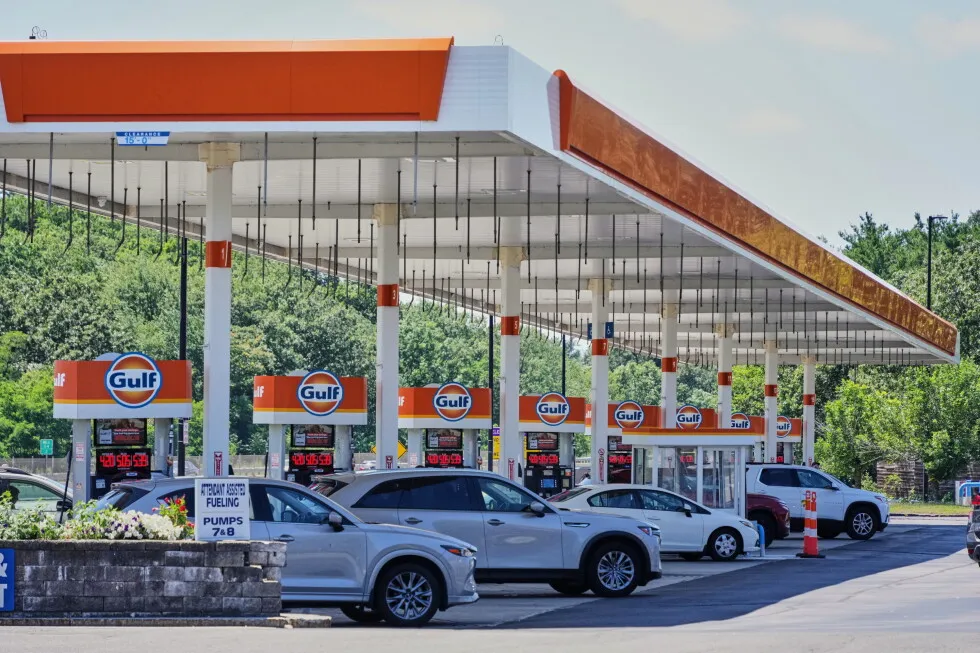
Gas, groceries and back-to-school items are where shoppers might see higher oil prices surface 0 seconds of 1 minute, 48 secondsVolume 0% Press shift question mark to access a list of keyboard shortcuts Keyboard ShortcutsEnabledDisabled Shortcuts Open/Close/ or ? Play/PauseSPACE Increase Volume↑ Decrease Volume↓ Seek Forward→ Seek Backward← Captions On/Offc Fullscreen/Exit Fullscreenf Mute/Unmutem Decrease Caption Size- Increase Caption Size+ or = Seek %0-9 Next Up David Jonsson is the new 'Black Panther' 01:00 Subtitle Settings OffEnglish(US)_v Font Color White Font Opacity 100% Font Size 100% Font Family Arial Character Edge None Edge Color Black Background Color Black Background Opacity 50% Window Color Black Window Opacity 0% Reset WhiteBlackRedGreenBlueYellowMagentaCyan 100%75%50%25% 200%175%150%125%100%75%50% ArialCourierGeorgiaImpactLucida ConsoleTahomaTimes New RomanTrebuchet MSVerdana NoneRaisedDepressedUniformDrop Shadow WhiteBlackRedGreenBlueYellowMagentaCyan WhiteBlackRedGreenBlueYellowMagentaCyan 100%75%50%25%0% WhiteBlackRedGreenBlueYellowMagentaCyan 100%75%50%25%0% 00:00 01:48 01:48 More Videos 01:00 David Jonsson is the new 'Black Panther' 02:01 Dr. Fauci invokes Fifth Amendment in Republican-led COVID-19 Senate hearing 00:26 Zelenskyy arrives in US to attend Sen. Lindsey Graham's funeral and meet with Trump 01:13 Dr. Fauci repeatedly invokes Fifth Amendment in Republican-led COVID-19 Senate hearing 01:00 Crowds of migrants swim around border from Morocco into Spanish territory of Ceuta 00:55 US stocks sink as Fed opts not to raise rates while oil prices soar 01:13 Iran war's global effects: In the US, one mom balances budget and family 00:58 Berlin's flagship Pride event, called Christopher Street Day, takes place in heart of the city Close 1 of 4 | Gas prices move up and down in response to disruptions in supply and spikes in demand. Many global events such as conflicts, sanctions or decisions by major oil producing countries can limit or create uncertainty about the supply of oil. 2 of 4 | Cars line up at the pumps of a Gulf Oil station on the Massachusetts Turnpike near Boston, Sunday, July 19, 2026. (AP Photo/Gene J. Puskar, File) 3 of 4 | A customer shops at a grocery store in Chicago, Thursday, June 25, 2026. (AP Photo/Nam Y. Huh) 4 of 4 | Cars line up at the pumps of a Gulf Oil station on the Massachusetts Turnpike near Boston, Sunday, July 19, 2026. (AP Photo/Gene J. Puskar, File) By Cathy Bussewitz, Mae Anderson and ANNE D’INNOCENZIO Updated 9:40 PM MESZ, July 23, 2026 Leer en español Add AP News on Google Add AP News as your preferred source to see more of our stories on Google. Share Share Facebook Copy Link copied Print Email X LinkedIn Bluesky Flipboard Pinterest Reddit NEW YORK (AP) — Already feeling pinched since the start of the Iran war, consumers are likely to feel more pain ahead as oil prices pushed past $100 a barrel Thursday amid renewed fighting and military strikes that have left global oil supplies stranded in the Middle East. The elevated price marked a turn from lower oil prices enjoyed briefly when hostilities between the U.S. and Iran waned in June. Brent crude, the international standard, last reached $100 a barrel in May. Companies that produce and sell fresh food, school supplies and anything that gets shipped using fuel reported cost impacts from an earlier spike in energy prices after the U.S. and Israel attacked Iran. They’re likely to continue passing some of their increased expenses to consumers. “Since everything relies on petroleum in our economy, for good or ill, if the cost of petroleum goes up, then everything else goes up as well,” said Joe Adamski, a managing director at procurement services company ProcureAbility. Here’s how higher oil prices could put more strain on the finances of U.S. consumers. Gasoline prices return to $4 or more in most states Volatility along the Strait of Hormuz and broader regional instability pushed up the price of crude oil, the main ingredient in gasoline, and could continue to make driving costlier during the second half of summer, according to motor club AAA. The U.S. price for regular gasoline averaged $4.09 a gallon Thursday, 15 cents more than a week ago, and drivers in most states were paying $4 or more, according to AAA. Major oil companies reap massive profits as US and Iran fighting drives energy prices higher 6 MIN READ 183 The tenuous state of a US-Iran ceasefire renews anxiety over high fuel prices 4 MIN READ 11 US gas prices back up to an average of $4 a gallon again as the US and Iran launch attacks 4 MIN READ 11 “Given the typical lag along the oil industry’s supply chain, prices at the pump are poised to keep rising at least into next week,” said Pavel Molchanov, an investment strategy analyst at investment bank Raymond James. Molchanov, noted that futures prices for oil delivered later this year and next year were lower, suggesting prices could fall once military action ends. For the most part, higher gasoline prices haven’t stopped Americans from driving. Gasoline demand rose 1% to 8.9 million barrels per day last week, according to the U.S. Energy Information Administration. Cars line up at the pumps of a Gulf Oil station on the Massachusetts Turnpike near Boston, Sunday, July 19, 2026. (AP Photo/Gene J. Puskar, File) Shoppers are paying more for a bag of groceries Grocery prices generally rise with oil because farmers use diesel fuel to power equipment, while many food products are transported by trucks that require fuel. “Oil at $100 doesn’t make food prices jump right away, but it does put upward pressure across the food supply chains, especially for categories that depend heavily on trucking, cold storage and packaging,” said Miguel Gomez, a Cornell University professor who directs the school’s Food Industry Management Program. Fresh produce and dairy could feel a larger impact because they require refrigeration during delivery. Imported goods are also vulnerable to higher shipping costs, Gomez said. “Things like olive oil that we produce very little here and are coming from mostly from Europe are going to be up.” Grocery chain Albertsons on Thursday lowered its 2026 fiscal outlook, citing pressure on its core grocery business and a pullback in consumer spending. A customer shops at a grocery store in Chicago, Thursday, June 25, 2026. (AP Photo/Nam Y. Huh) Every product that moves will have higher costs baked into the price Higher fuel costs for ships, trucks and air carriers can trickle down to consumers and businesses that depend on shipping. UPS, FedEx and other shipping services introduced fuel surcharges and other fees as fuel prices increased. According to an AFS Logistics and TD Cowen Freight Index released July 14, truckload pricing is at a four-year high because of rising fuel costs and capacity constraints. Andy Dyer, CEO of AFS Logistics, said diesel prices in the second quarter were about 51% higher than in January and February, while jet fuel prices rose 90% from a year earlier. “Beyond the direct impact of higher freight bills paid by shippers, these price movements also have second-order effects that squeeze rates higher,” he said. “Smaller truckload carriers working on tight margins may park trucks and wait for fuel prices to revert to more palatable levels before returning to operation.” Rural lifestyle retailer Tractor Supply Co. reduced its annual sales outlook on Thursday, citing in part higher fuel prices during its spring selling season that weighed on customer spending. ”Our customers often drive longer distances to shop frequently in pickup trucks, many of which are diesel-powered, making them especially sensitive to higher fuel costs,” CEO Hal Lawton told analysts. Lawton said customers are still investing in their pets, animals, farms and properties, but shopping has become “more deliberate.” Customers are consolidating trips, prioritizing needs-based purchases and taking a more measured approach to discretionary spending. Back to school and office supplies are on sale at a Target store, July 27, 2022, in North Miami, Fla. (AP Photo/Marta Lavandier, File) Back-to-school shoppers may face higher prices The Footwear Distributors and Retailers of America trade group warned in a report Wednesday that increasing freight and material costs, along with rising tariffs costs, were creating big challenges for the footwear industry as families prepare for back-to-school shopping and companies plan for the remainder of the year. Matt Priest, CEO and president of the trade group, said some of its members have cited 25% price increases for petroleum-based materials used in footwear manufacturing due to the Middle East conflict. Those costs could eventually translate into roughly a 5% increase in the cost of finished footwear products sold to consumers, Priest said in the report. Footwear companies have been front-loading inventory and accelerating imports before President Donald Trump imposes new tariffs on foreign products, putting additional pressure on shipping rates, he said. “Container rates are spiking right now,” Priest said. A plane lands at Ronald Reagan Washington National Airport in Arlington, Va., Dec. 30, 2022. (AP Photo/Carolyn Kaster, File) Higher jet fuel costs lead to costlier flights Since the war began, airlines have responded to the jump in fuel costs by raising fares and add-on fees, and trimming flights or routes that are no longer profitable at higher fuel prices. Those moves can help protect the airlines’ margins, but also leave travelers facing higher prices and fewer options, particularly in smaller or less competitive markets. In the latest sign that the conflict is driving up costs for the travel industry, American Airlines on Thursday reported a sharp decline in second-quarter net income despite record revenue and strong spring travel demand. American said higher fares helped offset nearly half of its higher fuel bill but not enough to prevent it from lowering its full-year outlook. Despite higher prices, jet fuel demand in the last four weeks increased 9% compared to the same time last year, according to EIA. Associated Press writers Rio Yamat in Las Vegas, Wyatte Grantham-Philips and Dee-Ann Durbin in Detroit contributed to this report. Cathy Bussewitz Bussewitz is a national business reporter for The Associated Press. She writes about the workplace, job issues and wellness. twitter mailto Mae Anderson Anderson reports for The Associated Press on a wide range of issues that small businesses face. She is based in New York. twitter mailto ANNE D’INNOCENZIO D’Innocenzio writes about retail, trends, the consumer economy and hourly workers for The Associated Press. twitter mailto
SRCAssociated Press (AP)
LANGEN
LEANCenter
WORDS1 692
ENT12
SAT · 2026-08-01 · 11:23 GMTBRIEF NSR-2026-0801-98133
NSR-2026-0801-98133News Report·EN·Economic Impact
Gas, groceries and back-to-school items are where shoppers might see higher oil prices surface
Renewed fighting in the Middle East has driven oil prices past $100 a barrel, impacting U.S. consumers through higher costs for gasoline, groceries, and back-to-school items.
Associated Press (AP)Filed 2026-08-01 · 11:23 GMTLean · CenterRead · 7 min
Associated Press (AP)FIG 01
Reading time
7min
Word count
1 692words
Sources cited
0cited
Entities identified
12entities
Quality score
100%
§ 01
Briefing Summary
AI-generatedNEWSAR · AI
Renewed fighting in the Middle East has driven oil prices past $100 a barrel, impacting U.S. consumers through higher costs for gasoline, groceries, and back-to-school items. Companies across various sectors, from food production to shipping, are passing on increased expenses related to fuel. Gasoline prices have risen, with the U.S. average nearing $4.09 per gallon, and are expected to continue climbing in the short term. The increased cost of transporting goods via ships and trucks is also contributing to higher prices for a wide range of products. Retailers are observing consumers becoming more deliberate in their spending due to these rising costs.
Confidence 0.90Claims 4Entities 12
§ 02
Article analysis
Model · rule-basedFraming
Economic Impact
Conflict
Tone
Measured
AI-assessed
CalmNeutralAlarmist
Factuality
0.70 / 1.00
Factual
LowHigh
Sources cited
0
No named sources
FewMany
§ 03
Key claims
4 extracted01
Gas prices move up and down in response to disruptions in supply and spikes in demand.
factual
Confidence
0.95
02
Many global events such as conflicts, sanctions or decisions by major oil producing countries can limit or create uncertainty about the supply of oil.
factual
Confidence
0.95
03
Higher oil prices can surface in gas, groceries, and back-to-school items.
factual
Confidence
0.90
04
Consumers are likely to feel more pain ahead as oil prices pushed past $100 a barrel amid renewed fighting and military strikes.
prediction
Confidence
0.80
§ 04
Full report
7 min read · 1 692 words§ 05
Entities
12 identifiedKey playerOppositionContextPositiveNeutralNegative
People3
Organizations1
Events1
§ 06
Keywords & salience
9 termsoil prices
1.00
inflation
0.90
consumer spending
0.80
supply chain
0.70
gas prices
0.60
grocery prices
0.60
economic impact
0.50
back-to-school shopping
0.50
oil supply
0.40
§ 07
Topic connections
Interactive graph Network visualization showing 34 related topics
View Full Graph Person Organization Location Event|Click node to navigate|Edge numbers = shared articles