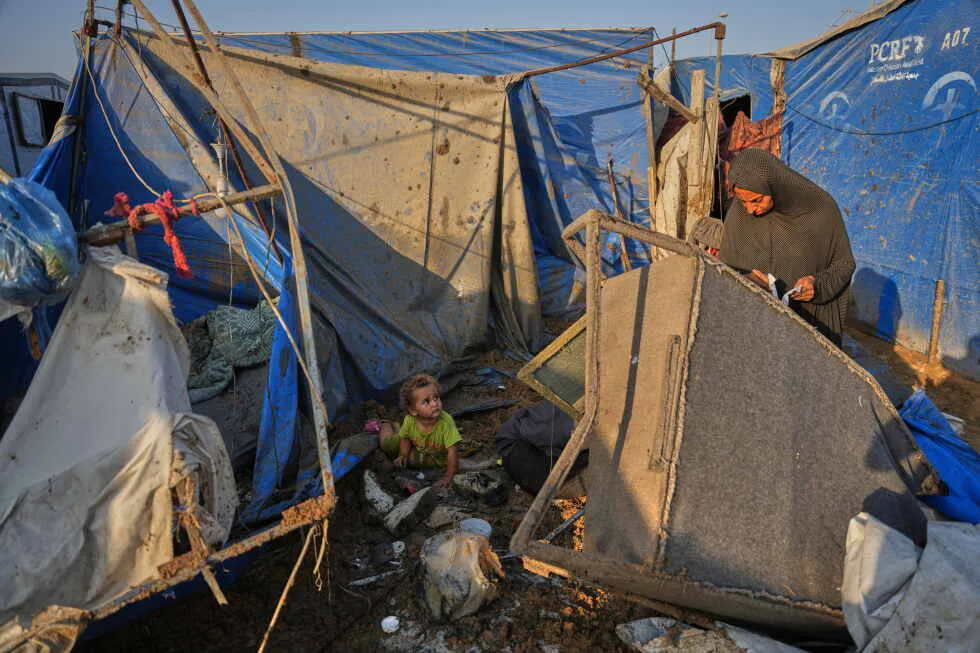
Palestinians in Gaza hope Hamas will disarm but fear Israeli forces won’t withdraw 0 seconds of 1 minute, 5 secondsVolume 0% Press shift question mark to access a list of keyboard shortcuts Keyboard ShortcutsEnabledDisabled Shortcuts Open/Close/ or ? Play/PauseSPACE Increase Volume↑ Decrease Volume↓ Seek Forward→ Seek Backward← Captions On/Offc Fullscreen/Exit Fullscreenf Mute/Unmutem Decrease Caption Size- Increase Caption Size+ or = Seek %0-9 Next Up What to know about Hamas agreeing to disarmament 01:28 00:00 01:05 01:05 More Videos 01:28 What to know about Hamas agreeing to disarmament 02:14 Why is the Spanish territory of Ceuta a flashpoint for migration from Africa? 01:47 Moroccans who crossed into Ceuta explain why they attempted to reach the Spanish territory 00:30 Crowd breaks through border from Spanish territory of Ceuta from Morocco 01:00 Crowds of migrants swim around border from Morocco into Spanish territory of Ceuta 01:25 People at the Tarajal border fence in Ceuta as migrants try to reach Spanish territory 01:04 AP top stories July 31 00:48 Remains of ancient mammoth emerge as Danube water levels fall in Bulgaria Close 1 of 5 | Some Palestinians expressed scant hope on Friday after U.S. President Donald Trump announced that a deal has been reached for the militant group Hamas to disarm and for Israel to withdraw its forces in Gaza. But many hurdles, conditions and long timelines remained to wind down the war in the Palestinian territory. 2 of 5 | A Palestinian woman inspects the scene of an Israeli airstrike near al-Aqsa Hospital in Deir al-Balah in the central Gaza Strip, Saturday, Aug. 1, 2026. (AP Photo/Abdel Kareem Hana) 3 of 5 | Palestinians inspect the scene of an Israeli airstrike near al-Aqsa Hospital in Deir al-Balah in the central Gaza Strip, Saturday, Aug. 1, 2026. (AP Photo/Abdel Kareem Hana) 4 of 5 | Palestinians inspect the scene of an Israeli airstrike near al-Aqsa Hospital in Deir al-Balah in the central Gaza Strip, Saturday, Aug. 1, 2026. (AP Photo/Abdel Kareem Hana) 5 of 5 | Palestinian women inspect the scene of an Israeli airstrike near al-Aqsa Hospital in Deir al-Balah in the central Gaza Strip, Saturday, Aug. 1, 2026. (AP Photo/Abdel Kareem Hana) By Toqa Ezzidin Updated 4:27 PM MESZ, August 1, 2026 Add AP News on Google Add AP News as your preferred source to see more of our stories on Google. Share Share Facebook Copy Link copied Print Email X LinkedIn Bluesky Flipboard Pinterest Reddit Cairo (AP) — For Palestinians in Gaza, President Donald Trump’s announcement that Hamas had agreed to disarm was a small sign of hope that Israel’s attacks might end, allowing them to rebuild their lives and what remains of their homes. But it also clashed with the reality on the ground, where Israeli strikes have continued since Trump first touted the deal late Thursday in Washington, and where few steps have been taken to advance a broader ceasefire agreement that went into effect in October. Most of Gaza’s 2 million Palestinians are still displaced or live in tent camps, where poor conditions and overcrowding have led to rodent infestations and outbreaks of infectious diseases such as chickenpox. “They can talk about withdrawal and disarmament,” said Abdel Moneim Aboul-Roos, 24, a tuk-tuk driver who lost his leg in an Israeli airstrike. “I don’t care about any of it as long as there is no food or medicine.” Israel and Hamas signed a U.S.-backed ceasefire plan last year that ended major combat operations, saw the return of Israeli hostages and allowed for an increase in humanitarian aid to the Palestinian enclave. It also called for the gradual withdrawal of Israeli troops, the creation of an international stabilization force and a program to decommission weapons held by Hamas. But as each side accused the other of violating the ceasefire, negotiations stalled. Hamas held onto its weapons and the Israeli military refused to withdraw. Since October, Israel has killed more than 1,200 Palestinians in Gaza and expanded the amount of territory it controls. Five Israeli soldiers have also been killed in militant attacks. The road map Trump announced — and that Hamas confirmed — addresses in more specific terms the type of weapons the militant group and its allies will be required to hand over to a new technocratic government. The document says Israel will not be involved in the decommission of Hamas’ weapons and that it should halt all military operations in Gaza so the transition can proceed and recovery can begin. Tracking the Gaza ceasefire Keep track of the status of President Donald Trump’s 20-point plan for a ceasefire that would end Hamas’ rule in Gaza and rebuilding the territory after a devastating war. But residents in Gaza say they have been repeatedly promised that the war will stop and their lives will improve. They see the road map as a positive development but remain skeptical that either Israel or Hamas will adhere to the terms. “This is enough. We need improvement in our lives,” said Ayman Ahmed, a displaced Palestinian living in southern Gaza. He said he hopes Hamas gives up its arms but does not see it happening anytime soon. “They don’t care about Palestinians’ lives,” he said. The war began when Hamas-led militants attacked southern Israel on Oct. 7, 2023, killing around 1,200 people and taking 251 others back to Gaza as hostages. Israel’s retaliatory offensive has killed more than 73,300 people, according to the Gaza Health Ministry, which was part of the Hamas-run government. The ministry maintains detailed records viewed as generally reliable by U.N. agencies and international organizations. It does not distinguish between civilians and militants, but says women and children make up around half of all fatalities. Because of the high death toll and ongoing attacks, other Palestinians say they believe Israel will refuse to make concessions. In southern Gaza, Ghazal Astal lives among the rubble. She said there is near-constant Israeli gunfire and that the territory has been transformed into an “indescribable battlefield.” Ammar Kaskeen, 30, said he doesn’t believe the road map will force Israeli troops to withdraw. For Israel, according to Kaskeen, the goal is not only to disarm Hamas but to also drive the Palestinian population out of Gaza. Even as Israel digs in, Palestinians dream of returning home Israel has not commented publicly on the road map but Israeli officials, speaking anonymously over the past two days, have signaled that the document does not align with the country’s interests. The officials also reiterated that Israel would not withdraw from the Yellow Line in Gaza, which divides Israeli-controlled territory in the east with the western part of the enclave. In recent months, the military has built a massive earthen barrier roughly along the same line, developing what it described as a “security zone” adjacent to the berm, equipped with intelligence and technological assets. Israel has also carried out controlled demolitions and clearing operations across much of the territory it controls. Palestinians who lived there have yet to return — and are unsure whether their homes are still standing. Anas Nakla was displaced from Rafah in southern Gaza during the war. He said he knows his house has been destroyed but still wants to return home with his wife and children. “It doesn’t exist anymore,” he said. “But we can return and rebuild.” Similarly, Mohamed Hamad, who had to leave his home behind in northern Gaza, hopes that the U.S.-backed road map will pressure Israel to leave some of the areas it controls. He believes that even if only a small number of people could go back to their homes, “it will give hope to the rest that some day they may also return.” Melanie Lidman and Sam Mednick contributed to this report from Tel Aviv, Israel.
SRCAssociated Press (AP)
LANGEN
LEANCenter
WORDS1 288
ENT11
SAT · 2026-08-01 · 14:53 GMTBRIEF NSR-2026-0801-98178
NSR-2026-0801-98178News Report·EN·Conflict
Palestinians in Gaza hope Hamas will disarm but fear Israeli forces won’t withdraw
Palestinians in Gaza have expressed a glimmer of hope following President Trump's announcement that Hamas has agreed to disarm, potentially leading to an end to Israeli attacks and enabling rebuilding. However, this hope is tempered by the ongoing reality of Israeli airstrikes and a lack of significant progress on a broader ceasefire agreement.
Associated Press (AP)Filed 2026-08-01 · 14:53 GMTLean · CenterRead · 6 min
Associated Press (AP)FIG 01
Reading time
6min
Word count
1 288words
Sources cited
1cited
Entities identified
11entities
Quality score
100%
§ 01
Briefing Summary
AI-generatedNEWSAR · AI
Palestinians in Gaza have expressed a glimmer of hope following President Trump's announcement that Hamas has agreed to disarm, potentially leading to an end to Israeli attacks and enabling rebuilding. However, this hope is tempered by the ongoing reality of Israeli airstrikes and a lack of significant progress on a broader ceasefire agreement. Many Gazans remain displaced in dire conditions, prioritizing basic needs like food and medicine over political developments. While a U.S.-backed plan includes Hamas disarmament, Israeli troop withdrawal, and humanitarian aid, past negotiations have stalled due to mutual accusations of violations. Palestinians are skeptical that either Hamas or Israel will fully adhere to the new road map, citing broken promises and a lack of trust. Israel has not publicly commented on the plan but anonymous officials suggest it may not align with their interests, with no indication of withdrawal from certain controlled territories.
Confidence 0.90Sources 1Claims 5Entities 11
§ 02
Article analysis
Model · rule-basedFraming
Conflict
Human Interest
Tone
Measured
AI-assessed
CalmNeutralAlarmist
Factuality
0.70 / 1.00
Factual
LowHigh
Sources cited
1
Limited
FewMany
§ 03
Key claims
5 extracted01
The article includes images of an Israeli airstrike near al-Aqsa Hospital in Deir al-Balah.
factual
Confidence
1.00
02
Israeli strikes have continued in Gaza since Trump's announcement.
factual
Confidence
0.90
03
U.S. President Donald Trump announced a deal for Hamas to disarm and Israel to withdraw its forces in Gaza.
factualDonald Trump
Confidence
0.90
04
Palestinians in Gaza hope Hamas will disarm and that Israeli forces will withdraw.
factual
Confidence
0.80
05
Few steps have been taken to advance a broader ceasefire agreement that went into effect in October.
factual
Confidence
0.70
§ 04
Full report
6 min read · 1 288 words§ 05
Entities
11 identifiedKey playerOppositionContextPositiveNeutralNegative
People3
§ 06
Keywords & salience
8 termsisraeli withdrawal
1.00
hamas disarmament
1.00
gaza
0.90
palestinian territory
0.80
militant group
0.70
war
0.60
israeli airstrike
0.50
donald trump
0.40
§ 07
Topic connections
Interactive graph Network visualization showing 51 related topics
View Full Graph Person Organization Location Event|Click node to navigate|Edge numbers = shared articles