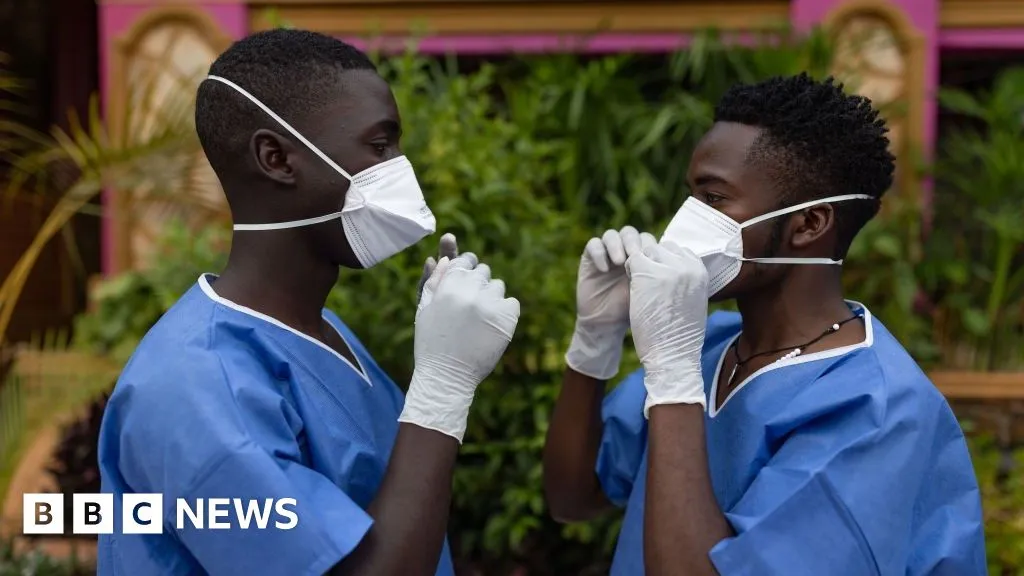
Why Uganda seems to be winning the battle against Ebola as virus spreads in DR CongoGetty ImagesUganda said previous outbreaks have taught the authorities how to respond efficiently to EbolaThe Ebola outbreak in the east of the Democratic Republic of Congo has become the second-worst on record, with the official death toll passing a grim milestone of 1,500.Experts believe the true number of fatalities during this outbreak, which was declared in May, is much higher. And in another alarming update, authorities in DR Congo confirmed on Thursday that the virus was spreading much faster than in previous outbreaks.Next door in Uganda, a country that also reported infections in May, the picture is entirely different.The country's health minister described a "moment of joy" as the last Ebola patient was released from hospital two weeks ago.Uganda only ever recorded 20 cases and two deaths from the virus.According to Dr Kasonde Mwinga, the World Health Organization's Uganda chief, the relatively low number of casualties was not "by luck or chance"."It's because people invested in preparedness," she told the BBC.This outbreak is the 17th to have emerged in DR Congo since Ebola was discovered 50 years ago. By comparison Uganda has had nine since 2000, with officials there saying lessons learnt from past tragedies have allowed them to stop the disease ripping through the country on various occasions.One example is the case of a 12-year-old girl who arrived at a hospital in the central district of Luwero in 2011. Her symptoms sparked caution: she was isolated, medics wore personal protective equipment when treating her and when she died three hours later her body was carefully sealed in a coffin. These precautions were able to halt the spread of what a blood sample later confirmed to be Ebola."We know Ebola. It's been here a few times, we know how to deal with it," government spokesperson Alan Kasujja told the BBC's Newsday programme.Uganda's first known case this time was a man from DR Congo who crossed the border for treatment.Once health authorities confirmed multiple cases had been imported from DR Congo, they activated a specialist Ebola treatment centre at Mulago hospital, in the capital city, Kampala. The facility, which was used during an outbreak of Ebola last year, held leftover medical supplies and had an "emergency medical team" on standby, Dr David Kaggwa, head of the facility, said."It was a matter of sorting and ordering a few more supplies, and then actually in one day we were ready to receive the patients. So, it is easy, it's not that we're starting from scratch," he said.Out of the 20 people who tested positive in Uganda, 15 came from DR Congo. The first two cases, it is thought, might not have known what condition they had. But after Uganda and DR Congo jointly declared the Ebola outbreak on 15 May, people with symptoms - which include headaches, fever and vomiting - "came direct to the treatment unit," Dr Kaggwa said.He suspects that because these patients did not pass through general hospitals, and come into contact with those patients and medics, there was little opportunity for community transmission.In a bid to stop the disease spreading, the authorities also closed the border between Uganda and DR Congo, despite the financial impact this would have on Ugandans who travel between the two countries to trade.Uganda acted fast, but it also had an advantage over DR Congo when it came to responding to the virus. Before the first cases were reported in DR Congo, Ebola had been spreading undetected for weeks. This was because health officials poised to pick up outbreaks had been testing for common species of Ebola, and not the rare species behind the current outbreak, named Bundibugyo.Uganda only detected its first case after DR Congo had identified and publicised multiple infections - knowledge of the outbreak was out in the open and Uganda could therefore act quickly to contain the virus.Getty ImagesAt-risk communities in Uganda have complied with prevention efforts, a government spokesperson says"Surveillance mechanisms were put in place then it was easy to identify all the patients quickly," Dr Kaggwa said.Comparatively, DR Congo has had a harder time with surveillance and contact tracing.One field investigator tasked with tracking the virus across Bunia, a city at the epicentre of the outbreak, told Reuters that surveillance had been hampered by poor planning, logistical bottlenecks and the recruitment of inexperienced staff."We discover the disease only after it has already spread," Dr Moubarack Kano said. "We're just chasing it."This is not helped by the insecurity that plagues eastern DR Congo. Ituri, the province at the centre of the outbreak, has been under military rule for several years as the army tries to crack down on dozens of armed groups there.Further south of Ituri there are large areas held by the M23 rebels, a powerful militia that says it has managed to contain the outbreak.Its Ebola response co-ordinator Dr Fred Kaniki attributed the achievement to early detection and contact tracing, telling the BBC: "In the course of a month we registered two more cases originating from those index cases and successfully followed up 400 people."But the M23 conflict and other pockets of violence have displaced millions of people in the region - and that makes surveillance difficult in DR Congo. Artisanal mining and cross-border trade also means Ebola has more chances to spread as people are constantly on the move.In contrast, Uganda managed to quarantine more than 6,000 contacts of people known to have Ebola during the outbreak. These contacts were isolated for an incubation period of 21 days."That is very, very important because usually cases come from those contacts," said Dr Kaggwa.Kasujja concurs. "I would say that our success is mainly due to our promptness and completeness of follow-up," he said.AFP via Getty ImagesOfficial data shows more than 1,500 people have died from Ebola in DR CongoThis is not the first time Uganda has impressed with its response to a health crisis. In the 1990s and 2000s, the country was widely praised for its successful campaign against HIV and Aids, which saw the prevalence of HIV drop from more than 10% to 6% in roughly a decade. A huge government programme had preached the "ABCs": abstinence, being faithful and condom use.The co-operation of the community is also critical in preventing infections during an outbreak, Kasujja adds."To this day, despite the fact that there are announcements that Uganda has no Ebola patients [members of the public] are still being careful, still taking the necessary precautions," he says.This co-operation is illustrated by one of its first cases of Ebola, a nurse who contracted the virus while working in an intensive care unit in Kampala.It was shortly before the outbreak was officially declared, and she had treated a patient who later died - unbeknownst to her - of Ebola. She told the BBC how she started feeling ill two weeks later, battling headaches, joint and muscle pains. Painkillers were not working and a hospital ran various tests including for malaria.She sought a second opinion and that is when she heard that two colleagues had been diagnosed with Ebola - and she immediately chose to go into isolation.Like many other patients, she co-operated fully with the guidelines even during the frightening time when her 11-month-old baby, whom she was still breastfeeding, was taken away from her and quarantined for 21 days.Uganda has since announced it is totally Ebola-free, going against the protocol of waiting 42 days from when the last patient recovers to declare an outbreak over.The health ministry said it was able to make this announcement because the first case of the virus was imported and there was never any "unexplained community transmission".But there is also the reality that a long, porous border with Ituri, the Congolese area with most infections, means that the virus could easily reach Uganda again. Thus, Uganda has sent dozens of healthcare workers to DR Congo to help their "brothers and sisters" tackle Ebola, Uganda's Health Minister Chris Baryomunsi said on X."We are going to where the problem is," Kasujja explained. "Uganda cannot win against Ebola if the Democratic Republic of Congo fails." Uganda has also increased screening at the border and continues to educate the public about measures for prevent or deal with the disease."We're always very prepared," Dr Kaggwa said.More BBC stories on the Ebola outbreak:Go to BBCAfrica.com for more news from the African continent.
SRCBBC News - World
LANGEN
LEANCenter
WORDS1 397
ENT11
SAT · 2026-08-01 · 23:03 GMTBRIEF NSR-2026-0802-98244
NSR-2026-0802-98244News Report·EN·Public Health
Why Uganda seems to be winning the battle against Ebola as virus spreads in DR Congo
Uganda has successfully contained its Ebola outbreak, discharging its last patient two weeks ago after recording 20 cases and two deaths. This success is attributed to the country's preparedness and lessons learned from previous outbreaks, allowing for efficient response mechanisms.
57 minutes agoShareSaveAdd as preferred on GoogleAnne Soy,BBC NewsdayandWedaeli ChibelushiBBC News - WorldFiled 2026-08-01 · 23:03 GMTLean · CenterRead · 6 min
BBC News - WorldFIG 01
Reading time
6min
Word count
1 397words
Sources cited
4cited
Entities identified
11entities
Quality score
100%
§ 01
Briefing Summary
AI-generatedNEWSAR · AI
Uganda has successfully contained its Ebola outbreak, discharging its last patient two weeks ago after recording 20 cases and two deaths. This success is attributed to the country's preparedness and lessons learned from previous outbreaks, allowing for efficient response mechanisms. In contrast, the Democratic Republic of Congo is experiencing its second-worst Ebola outbreak on record, with the virus spreading rapidly and exceeding 1,500 deaths. Uganda's swift action, including border closures and the activation of a specialist treatment center, prevented widespread community transmission, unlike in DR Congo where surveillance challenges and insecurity have hampered containment efforts.
Confidence 0.90Sources 4Claims 5Entities 11
§ 02
Article analysis
Model · rule-basedFraming
Public Health
Human Interest
Tone
Measured
AI-assessed
CalmNeutralAlarmist
Factuality
0.70 / 1.00
Factual
LowHigh
Sources cited
4
Well sourced
FewMany
§ 03
Key claims
5 extracted01
Out of 20 positive cases in Uganda, 15 were imported from DR Congo.
statisticarticle
Confidence
1.00
02
Uganda's health authorities were able to quickly activate an Ebola treatment center due to existing infrastructure and supplies from a previous outbreak.
quoteDr David Kaggwa (Head of Mulago hospital facility)
Confidence
1.00
03
Uganda's efficient response to Ebola is attributed to lessons learned from previous outbreaks and investment in preparedness.
quoteDr Kasonde Mwinga (WHO Uganda chief)
Confidence
1.00
04
Uganda reported 20 cases and 2 deaths from Ebola, with the last patient released two weeks ago.
statisticarticle
Confidence
1.00
05
The Ebola outbreak in DR Congo has become the second-worst on record, with over 1,500 official deaths.
statisticarticle
Confidence
1.00
§ 04
Full report
6 min read · 1 397 words§ 05
Entities
11 identifiedKey playerOppositionContextPositiveNeutralNegative
People3
Locations5
Events1
§ 06
Keywords & salience
10 termsebola
1.00
dr congo
0.90
uganda
0.90
outbreak response
0.80
preparedness
0.70
disease control
0.60
public health
0.60
lessons learned
0.50
case management
0.40
infection prevention
0.40
§ 07
Topic connections
Interactive graph Network visualization showing 51 related topics
View Full Graph Person Organization Location Event|Click node to navigate|Edge numbers = shared articles