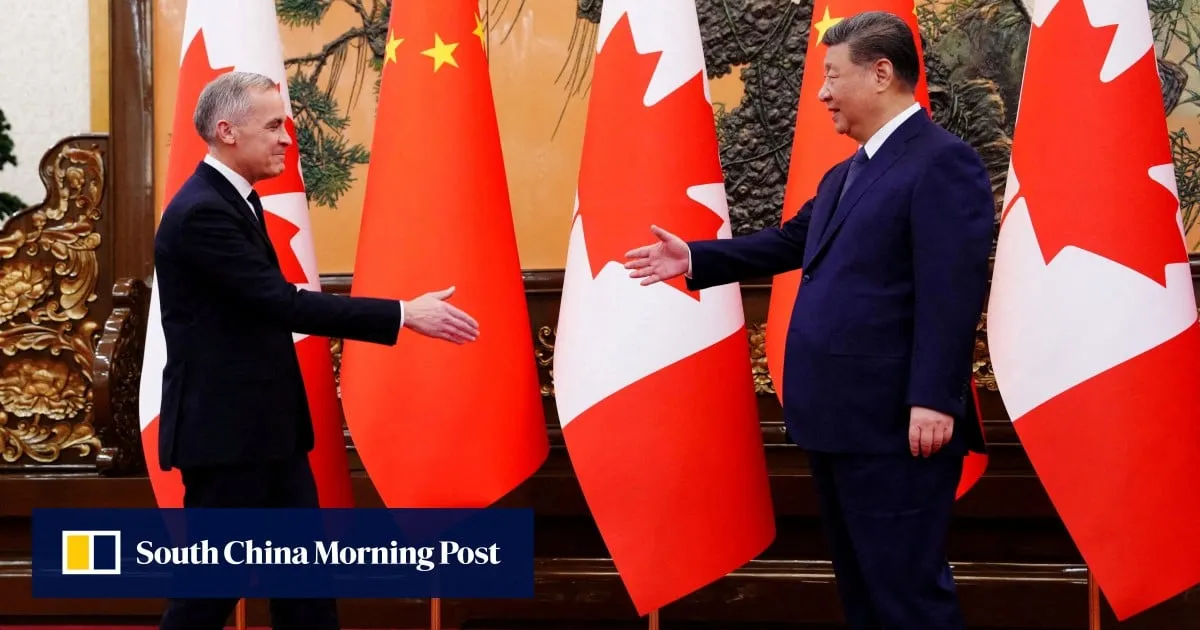
Look for the US and Canada to move farther apart on China policy, even in areas where they were previously aligned, analysts say, days after Canadian Prime Minister Mark Carney announced a multifaceted deal with Beijing.In recent years, Washington and Ottawa had drawn closer together when it came to dealing with Beijing, from electric vehicle tariffs and research security to investment screening.But that convergence is now fraying, analysts say, as Canada signals a greater willingness to pursue engagement with China even where it risks diverging from US preferences.“Clearly the message from Carney … is that we are going to try to put things in place for working with China directly, even when some of those seem to contradict American interests and perspectives,” said Paul Evans, professor emeritus at the University of British Columbia.Last Friday, Carney and Chinese President Xi Jinping announced a preliminary deal that paired trade concessions – including lower-tariff access for a quota of Chinese electric vehicles in exchange for relief on Canadian agricultural exports such as canola – with the restoration of previously suspended communication channels.It also set up a series of new dialogues, including on finance and energy, opened a pathway to future Chinese energy investment in Canada and loosened restrictions on people-to-people exchange.Speaking in Beijing last week on the first visit by a Canadian prime minister since 2017, Carney called China a more “predictable” partner than Washington and said that the two countries had entered a “new strategic partnership”.
SRCSouth China Morning Post
LANGEN
LEANCenter-Right
WORDS244
ENT7
THU · 2026-01-22 · 20:04 GMTBRIEF NSR-2026-0122-9829
NSR-2026-0122-9829News Report·EN·Diplomatic
US and Canada drift apart on China as Ottawa rethinks Beijing ties
Analysts suggest the US and Canada are diverging on China policy after Canadian Prime Minister Mark Carney announced a deal with Beijing. This follows a period of increased alignment between Washington and Ottawa on issues like electric vehicle tariffs and investment screening.
Bochen HanSouth China Morning PostFiled 2026-01-22 · 20:04 GMTLean · Center-RightRead · 1 min
South China Morning PostFIG 01
Reading time
1min
Word count
244words
Sources cited
1cited
Entities identified
7entities
Quality score
75%
§ 01
Briefing Summary
AI-generatedNEWSAR · AI
Analysts suggest the US and Canada are diverging on China policy after Canadian Prime Minister Mark Carney announced a deal with Beijing. This follows a period of increased alignment between Washington and Ottawa on issues like electric vehicle tariffs and investment screening. The new agreement between Canada and China includes trade concessions, restored communication channels, and new dialogues on finance and energy. Carney described China as a more "predictable" partner than the US and signaled a "new strategic partnership" during his visit to Beijing, the first by a Canadian prime minister since 2017. This signals Canada's willingness to engage with China, even if it contradicts US interests.
Confidence 0.90Sources 1Claims 5Entities 7
§ 02
Article analysis
Model · rule-basedFraming
Diplomatic
Economic Impact
Tone
Measured
AI-assessed
CalmNeutralAlarmist
Factuality
0.70 / 1.00
Factual
LowHigh
Sources cited
1
Limited
FewMany
§ 03
Key claims
5 extracted01
Carney said Canada and China have entered a “new strategic partnership”.
quoteMark Carney
Confidence
1.00
02
Carney called China a more “predictable” partner than Washington.
quoteMark Carney
Confidence
1.00
03
The deal includes lower-tariff access for Chinese EVs and relief on Canadian agricultural exports.
factual
Confidence
1.00
04
Canada and China announced a preliminary deal including trade concessions.
factual
Confidence
1.00
05
US and Canada are diverging on China policy.
predictionanalysts
Confidence
0.80
§ 04
Full report
1 min read · 244 words§ 05
Entities
7 identifiedKey playerOppositionContextPositiveNeutralNegative
Organizations1