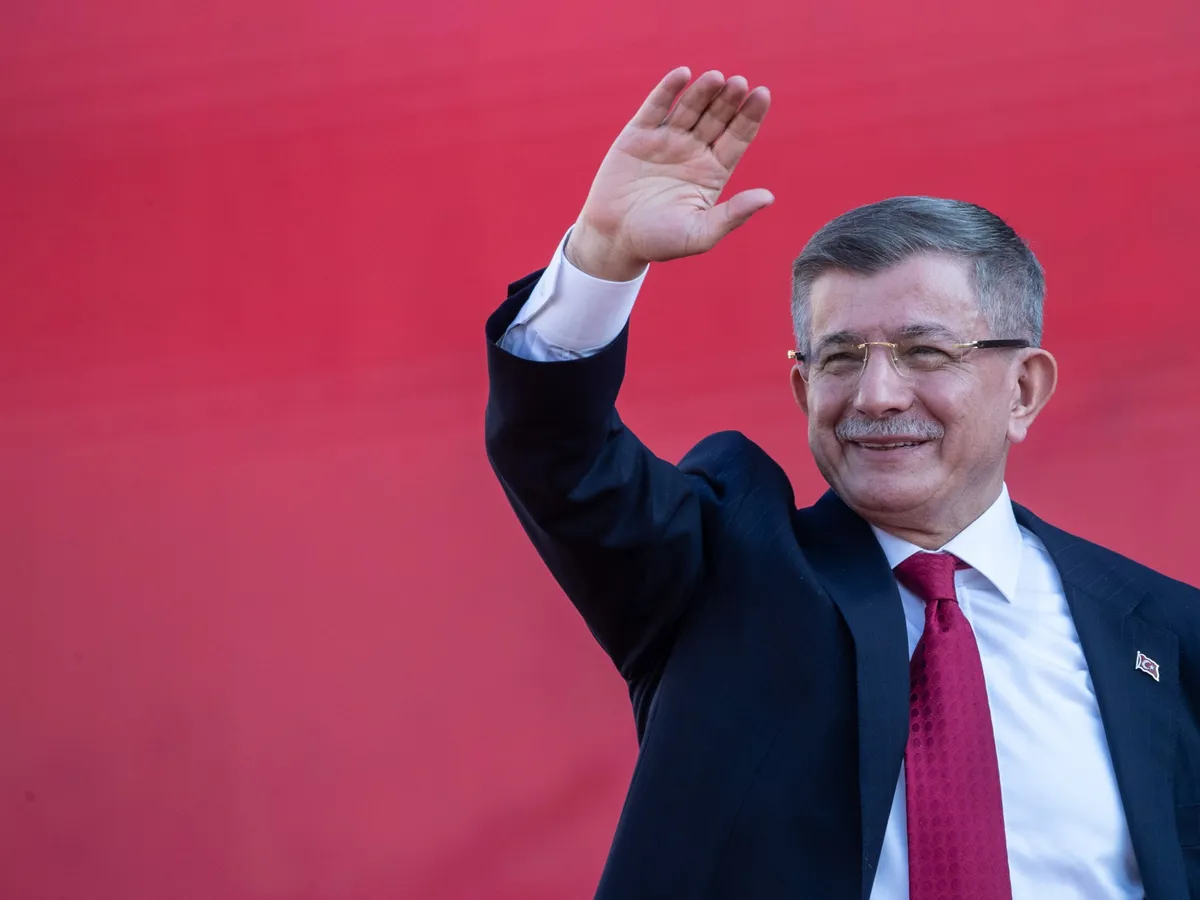
ANALYSISOnce Turkiye’s prime minister, Ahmet Davutoglu has stepped back from party politics.Ahmed Davutoglu has announced the dissolution of his Future Party and his decision to quit politics [File: Burak Kara/Getty Images]Published On 2 Aug 2026Ahmet Davutoglu was once one of Turkiye’s most powerful figures: The academic who helped shape the country’s ambitious foreign policy after the turn of the century, served as foreign minister and prime minister, and was chosen by President Recep Tayyip Erdogan to lead the governing Justice and Development Party, or AK Party.But later, he became a critic of the political system he had helped build.Recommended Stories list of 3 itemslist 1 of 3Sde Teiman walkout lays bare an Israeli military running out of trustlist 2 of 3Who are candidates to take on Infantino for FIFA presidency? All to knowlist 3 of 3Spain installs floating barrier off Ceuta after deadly migrant crossingsend of listNow, after announcing that his opposition Future Party would cease political activities, Davutoglu is withdrawing from party politics. He described the decision not as surrender but as an effort to distance himself from what he called Turkiye’s “polluted political climate”.His departure leaves a contested legacy – that of an intellectual who transformed Tukiye’s diplomatic outlook, but struggled to turn his ideas and prominence into an independent political movement.From professor to foreign ministerBorn in 1959 in Taskent, in the central province of Konya, Davutoglu studied economics and political science at Bogazici University before becoming an academic.He taught in Malaysia and at universities in Turkiye, with students calling him “Hoca”, or the professor – a title that followed him into government.Davutoglu became widely known for his so-called “strategic depth” doctrine, the argument that Turkiye’s geography, Ottoman history and connections across the Balkans, Middle East, Caucasus and Central Asia could make it a central diplomatic power rather than a country confined to Europe’s periphery.After the AK Party came to power in 2002, he became Erdogan’s chief foreign policy adviser. He was appointed foreign minister in 2009 and entered parliament in 2011.His early years in government coincided with an expansion of Turkish influence.Ankara opened embassies, strengthened its presence in Africa and the Middle East, mediated regional disputes and promoted trade and visa-free travel with neighbouring countries. The approach became known as “zero problems with neighbours”.Tarik Celenk, a writer and analyst familiar with Turkiye’s conservative intellectual tradition, said Davutoglu altered the country’s diplomatic culture.“Davutoglu brought a change of mentality to the Foreign Ministry cadres,” Celenk said, crediting him with opening diplomacy to businesses and civil society.Celenk noted that Davutoglu sought to position Turkiye as a country capable of communicating with otherwise incompatible actors. “Davutoglu was able to have good relations with Hamas, with Russia, and also to have good relations with the US,” he added.Davutoglu called this intensive and multidirectional engagement “rhythmic diplomacy” – an effort to maintain dialogue across competing regional and global power centres.But the Arab uprisings, particularly the war in Syria, exposed the limits of that vision, analysts said. Turkiye supported the Syrian opposition and anticipated that President Bashar al-Assad’s government would fall quickly. Instead, the conflict brought mass displacement, security threats and prolonged instability.“His principal mistake in foreign policy was that he was very emotional, very romantic,” said Celenk, arguing that Davutoglu struggled to establish boundaries between “idealism, romanticism and realism”.Davutoglu, right, greets Transport and Communication Minister Binali Yildirim during an AK Party congress on May 22, 2016 in Ankara [File: Gokhan Tan/Getty Images]Erdogan’s chosen successorWhen Erdogan moved from the prime minister’s office to the presidency in 2014, he selected Davutoglu to succeed him as AK Party leader and prime minister.The arrangement contained a fundamental contradiction. Under Turkiye’s parliamentary system at the time, Davutoglu formally headed the government. But Erdogan continued to dominate the governing party and exercise authority from the presidency while advocating an executive presidential system.Davutoglu led the AK Party through two elections in 2015. After losing its parliamentary majority in June, the party regained it in November with nearly half the national vote. Yet the victory did not give Davutoglu an independent power base.According to Celenk, Davutoglu entered politics imagining a forest without “wolves, foxes, jackals or snakes” – but discovered while prime minister “that this forest did not exist”.Amid disagreements over appointments, governance and Erdogan’s efforts to expand presidential authority, Davutoglu stepped down in 2016. He remained in the AK Party for another three years before resigning and establishing the Future Party in 2019.An opposition party without a baseThe party sought to attract conservative voters disillusioned with Erdogan while advocating parliamentary democracy, the rule of law and accountable government. It never developed substantial electoral support.Political scientist Berk Esen said opposition parties face structural disadvantages in Turkiye, where the governing party has extensive access to state resources and much of the media.But those conditions did not fully explain the failure of Davutoglu’s party, he added. “For one thing, the Future Party was already half stillborn by its very foundation,” argued Esen.Davutoglu and Ali Babacan, another former senior AK Party figure, established separate opposition parties, dividing an already limited pool of disaffected conservative voters. Both also struggled to confront the records of the governments in which they had served.In the 2023 elections, Future Party candidates entered parliament on the lists of the Republican People’s Party, or CHP, then Turkiye’s main opposition party. The arrangement delivered seats but exposed the party’s dependence on a larger organisation.Esen said pursuing guaranteed representation prevented the Future Party from fielding its own candidates across Turkiye and building local networks.“In order to achieve a small success in the short term, they squandered the party’s institutional identity in the medium term,” he said. “And that is already why this party closed.”Celenk offered a similar assessment: “You could say that the Future Party was never the party of the future. It became stuck in the past.”Yet he distinguished between Davutoglu, the unsuccessful party leader, and Davutoglu, the intellectual.“Let us criticise Ahmet Davutoglu the politician together, all the way to the end,” he said.“But Ahmet Davutoglu’s intellectual production capacity within the conservative community was belittled and not taken seriously,” added Celenk, referring to sections of Turkiye’s conservative political and religious establishment which, according to him, benefited from Davutoglu’s ideas and intellectual framework but did not sufficiently acknowledge his contribution.Esen said he doubts Davutoglu could exercise significant political influence while Erdogan remains in power. “But I think, in practice, his political career appears to be over,” he said.Yet the analysts found substance in Davutoglu’s explanation for withdrawing. Celenk said his four-page letter offered a serious diagnosis of “the state the country, its politics and its society have reached”, including the risk that Turkiye was “losing its character as a nation”. Esen agreed that “Turkish politics has become very polluted and authoritarian”, adding that some of Davutoglu’s criticisms were therefore well grounded.Davutoglu exits party politics without establishing the conservative democratic alternative he promised. But some of the ideas and diplomatic practices he introduced survived his loss of power, ensuring that debate over his legacy will outlast the party he founded.“At least as Davutoglu leaves politics and withdraws from institutional politics, this must be remembered,” said Celenk.
SRCAl Jazeera
LANGEN
LEANCenter
WORDS1 182
ENT12
SUN · 2026-08-02 · 09:07 GMTBRIEF NSR-2026-0802-98320
NSR-2026-0802-98320Analysis·EN·Political Strategy
How Davutoglu helped shape Erdogan’s Turkiye but failed to challenge it
Ahmet Davutoglu, once a key figure in Turkish politics, has announced the dissolution of his Future Party and his withdrawal from party politics. Davutoglu, an academic, served as foreign minister and prime minister under President Recep Tayyip Erdogan, significantly shaping Turkey's foreign policy with his "strategic depth" doctrine.
Sinem KoseogluAl JazeeraFiled 2026-08-02 · 09:07 GMTLean · CenterRead · 5 min
Al JazeeraFIG 01
Reading time
5min
Word count
1 182words
Sources cited
1cited
Entities identified
12entities
Quality score
100%
§ 01
Briefing Summary
AI-generatedNEWSAR · AI
Ahmet Davutoglu, once a key figure in Turkish politics, has announced the dissolution of his Future Party and his withdrawal from party politics. Davutoglu, an academic, served as foreign minister and prime minister under President Recep Tayyip Erdogan, significantly shaping Turkey's foreign policy with his "strategic depth" doctrine. He aimed to position Turkey as a central diplomatic power, fostering "zero problems with neighbours" and "rhythmic diplomacy." However, the Syrian war exposed limitations to this approach. Chosen by Erdogan as his successor in 2014, Davutoglu's premiership was marked by disagreements over governance and Erdogan's push for expanded presidential powers, leading to Davutoglu's resignation in 2016. His departure from politics is described as an effort to distance himself from a "polluted political climate."
Confidence 0.90Sources 1Claims 5Entities 12
§ 02
Article analysis
Model · rule-basedFraming
Political Strategy
Diplomatic
Tone
Measured
AI-assessed
CalmNeutralAlarmist
Factuality
0.60 / 1.00
Mixed
LowHigh
Sources cited
1
Limited
FewMany
§ 03
Key claims
5 extracted01
Davutoglu described his departure as an effort to distance himself from Turkiye’s 'polluted political climate'.
quoteAhmet Davutoglu
Confidence
1.00
02
Tarik Celenk stated Davutoglu altered Turkiye's diplomatic culture and opened diplomacy to businesses and civil society.
quoteTarik Celenk
Confidence
1.00
03
Davutoglu developed the 'strategic depth' doctrine, arguing Turkiye could be a central diplomatic power.
factual
Confidence
1.00
04
Davutoglu was once Turkiye’s prime minister and a key figure in shaping its foreign policy.
factual
Confidence
1.00
05
Ahmet Davutoglu announced the dissolution of his Future Party and his decision to quit politics.
factual
Confidence
1.00
§ 04
Full report
5 min read · 1 182 words§ 05
Entities
12 identifiedKey playerOppositionContextPositiveNeutralNegative
Organizations4
§ 06
Keywords & salience
9 termsahmet davutoglu
1.00
turkish foreign policy
0.90
recep tayyip erdogan
0.90
ak party
0.80
strategic depth doctrine
0.70
future party
0.70
turkish politics
0.60
political climate
0.50
diplomatic power
0.40
§ 07
Topic connections
Interactive graph No topic relationship data available yet. This graph will appear once topic relationships have been computed.