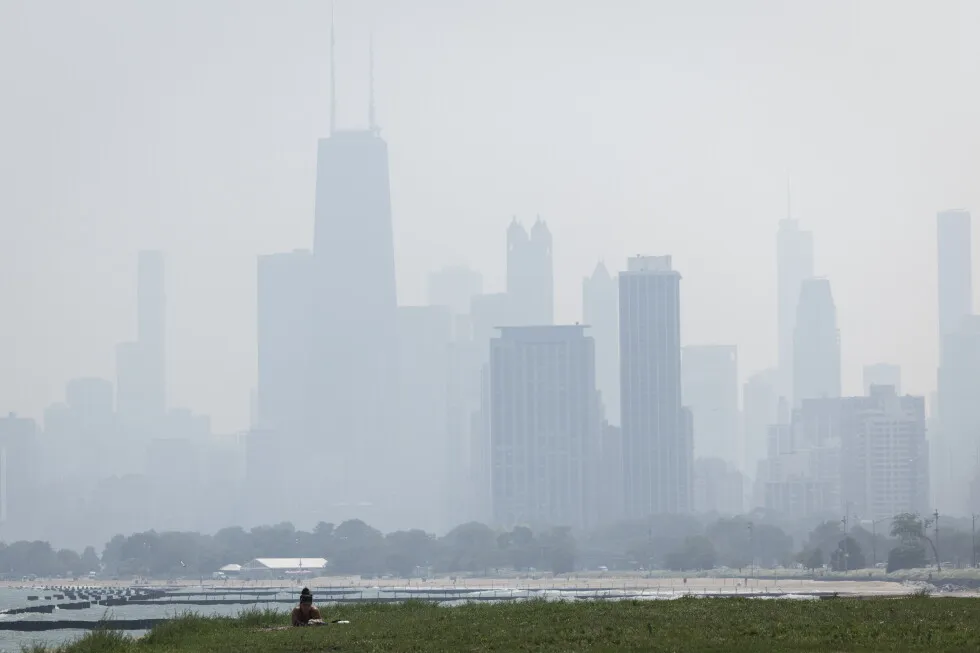
How to protect yourself from the bad air caused by wildfires 1 of 2 | Smoke from wildfires blanketed Toronto on Wednesday, creating hazy skies and prompting health concerns as residents faced poor air quality, according to CTV. 2 of 2 | People sun tan in grass off the Lakefront Trail on the North Side as a haze of Canadian Wildfire Smoke blankets the Chicago area and creates poor air quality, Thursday, July 31, 2025. (Ashlee Rezin/Chicago-sun-times" class="entity-link entity-organization" data-entity-id="177037" data-entity-type="organization">Chicago Sun-Times via AP) 1 of 2 Smoke from wildfires blanketed Toronto on Wednesday, creating hazy skies and prompting health concerns as residents faced poor air quality, according to CTV. Add AP News on Google Add AP News as your preferred source to see more of our stories on Google. Share 2 of 2 | People sun tan in grass off the Lakefront Trail on the North Side as a haze of Canadian Wildfire Smoke blankets the Chicago area and creates poor air quality, Thursday, July 31, 2025. (Ashlee Rezin/Chicago-sun-times" class="entity-link entity-organization" data-entity-id="177037" data-entity-type="organization">Chicago Sun-Times via AP) 2 of 2 People sun tan in grass off the Lakefront Trail on the North Side as a haze of Canadian Wildfire Smoke blankets the Chicago area and creates poor air quality, Thursday, July 31, 2025. (Ashlee Rezin/Chicago-sun-times" class="entity-link entity-organization" data-entity-id="177037" data-entity-type="organization">Chicago Sun-Times via AP) Add AP News on Google Add AP News as your preferred source to see more of our stories on Google. Share Updated [hour]:[minute] [AMPM] [timezone], [monthFull] [day], [year] When wildfires burn, the smoke can travel long distances and degrade air quality far away, which presents risks for those breathing it. Fires burning in one state can make air worse several states away, and wildfires in Canada can send smoke into U.S. cities.Here’s what to know about taking precautions against poor air quality due to wildfires.What counts as bad air?The EPA’s Air Quality Index converts all pollutant levels into a single number. The lower the number, the better.Anything below 50 is classified as “healthy.” Fifty to 100 is “moderate” while 100-150 is unhealthy for “sensitive groups,” and anything above 150 is bad for everyone. Sensitive groups include people with asthma, lung disease or chronic obstructive pulmonary disease, said Dr. Sanjay Sethi, chief of the division of pulmonary, critical care and sleep medicine at the University of Buffalo’s medical school.“If you have heart or lung problems, then you’ve got to be definitely more careful,” Sethi said. “I would either avoid going outside or wear an N95 (mask) or at least a dust mask.” Is my air unhealthy?Sometimes the air is bad enough to see or smell the smoke. Even if you don’t see the pollution, it can be unhealthy to breathe.The EPA maintains a website with up-to-date, regional air quality information. PurpleAir, a company that sells air quality sensors and publishes real-time air quality data, has a citizen scientist, air quality monitoring network with a more granular map of street-by-street air quality readings. The best way to get indoor air quality readings is to buy a monitor, said Joseph Allen, director of Harvard University’s Healthy Buildings Program.“You can find these low-cost, indoor air quality monitors just about everywhere online now. They don’t cost all that much anymore,” he said. What if I have to go outside?For most people, going outside for just a short time won’t have a negative long-term impact, said Sethi.Wearing an N95 mask, which became common during the coronavirus pandemic, will help filter out the pollution. “N95 is going to get rid of 90-95% of the particles,” said Jennifer Stowell, a research scientist at Boston University’s Center for Climate and Health. “If you have access to a mask that has a respirator-type attachment to it, then that’s the very best.”If you must be outside and you experience symptoms, experts say you should head indoors or somewhere else with better air quality. Even if you are healthy, it’s good to take precautions.“If you start wheezing, which is like this whistling sound of the chest, or if you’re feeling short of breath, that’s definitely more concerning,” Sethi said. How do I make my air cleaner?Close the windows and turn on the air conditioner, if you have one, setting it to circulate the indoor air. Use blankets to cover cracks that allow outside air into your home, such as under doors. Finally, swapping the air conditioner’s filter for a MERV 13 filter can help, though you should make sure it’s installed correctly.“If you happen to have access to an air purifier, even if it’s just a room air purifier, try to keep it running and in the room that you’re doing most of your activities in,” said Stowell. ___ The Associated Press’ climate and environmental coverage receives financial support from multiple private foundations. AP is solely responsible for all content. Find AP’s standards for working with philanthropies, a list of supporters and funded coverage areas at AP.org. Wells reports on how people’s choices impact the environment for The Associated Press. She is based in Cleveland.
SRCAssociated Press (AP)
LANGEN
LEANCenter
WORDS823
ENT12
MON · 2026-08-03 · 05:23 GMTBRIEF NSR-2026-0803-98527
NSR-2026-0803-98527News Report·EN·Public Health
How to protect yourself from the bad air caused by wildfires
Wildfire smoke can travel long distances, significantly degrading air quality in areas far from the fires, as seen with smoke from Canada affecting U.S. cities.
By
CALEIGH WELLSAssociated Press (AP)Filed 2026-08-03 · 05:23 GMTLean · CenterRead · 4 min
Associated Press (AP)FIG 01
Reading time
4min
Word count
823words
Sources cited
3cited
Entities identified
12entities
Quality score
100%
§ 01
Briefing Summary
AI-generatedNEWSAR · AI
Wildfire smoke can travel long distances, significantly degrading air quality in areas far from the fires, as seen with smoke from Canada affecting U.S. cities. The EPA's Air Quality Index (AQI) helps determine air quality, with levels above 150 considered unhealthy for everyone, and higher levels posing greater risks to sensitive groups like those with respiratory conditions. To check air quality, people can use the EPA's website, PurpleAir's network, or purchase indoor air quality monitors. When air quality is poor, individuals should limit outdoor exposure, and if they must go outside, wearing an N95 mask is recommended to filter particles. Indoors, closing windows, running air conditioners on recirculate, sealing drafts, and using air purifiers or MERV 13 filters can improve air quality.
Confidence 0.90Sources 3Claims 5Entities 12
§ 02
Article analysis
Model · rule-basedFraming
Public Health
Environmental
Tone
Measured
AI-assessed
CalmNeutralAlarmist
Factuality
0.80 / 1.00
Factual
LowHigh
Sources cited
3
Well sourced
FewMany
§ 03
Key claims
5 extracted01
The EPA maintains a website with up-to-date, regional air quality information.
factual
Confidence
1.00
02
To protect against poor air quality, individuals with heart or lung problems should avoid going outside or wear an N95 or dust mask.
factualDr. Sanjay Sethi
Confidence
1.00
03
People with asthma, lung disease, or COPD are considered 'sensitive groups' and should be more careful during poor air quality events.
factualDr. Sanjay Sethi
Confidence
1.00
04
The EPA's Air Quality Index classifies air quality from 'healthy' (below 50) to 'bad for everyone' (above 150).
factualEPA
Confidence
1.00
05
Smoke from wildfires can travel long distances and degrade air quality far away, presenting risks for those breathing it.
factual
Confidence
1.00
§ 04
Full report
4 min read · 823 words§ 05
Entities
12 identifiedKey playerOppositionContextPositiveNeutralNegative
Organizations5
Locations4
§ 06
Keywords & salience
9 termsair quality
1.00
wildfire smoke
1.00
health concerns
0.90
air pollution
0.80
protective measures
0.70
sensitive groups
0.60
epa air quality index
0.50
respiratory health
0.50
n95 mask
0.40
§ 07
Topic connections
Interactive graph No topic relationship data available yet. This graph will appear once topic relationships have been computed.