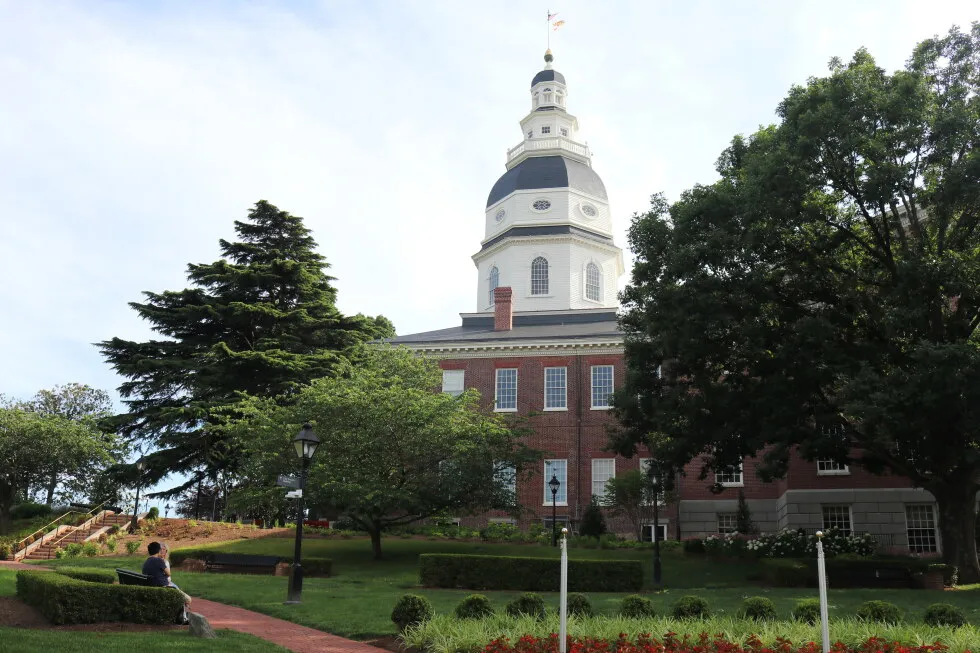
Maryland lawmakers to consider steps toward partisan redistricting for 2028 1 of 2 | The Maryland State House in Annapolis, Md., June 13, 2026. (AP Photo/Robert Yoon, File) 2 of 2 | Wes Moore, governor of Maryland, speaks during the National Action Network (NAN) Convention in New York, April 9, 2026. (AP Photo/Angelina Katsanis, File) By SARAH RANKIN Updated 6:27 AM MESZ, August 3, 2026 Add AP News on Google Add AP News as your preferred source to see more of our stories on Google. Share Share Facebook Copy Link copied Print Email X LinkedIn Bluesky Flipboard Pinterest Reddit Maryland lawmakers will kick off a special session Monday to consider a first step in a partisan redistricting initiative that could help Democrats pick up an additional U.S. House seat by 2028. The General Assembly will begin debate on a proposed constitutional amendment intended to give Democrats greater latitude to draw congressional maps favoring their party, which currently represents seven of the state’s eight House districts. The proposal would have to be approved by voters before lawmakers could begin considering new district lines. Deep blue Maryland’s move, which the state’s minority Republicans have called a blatant power grab, is the latest turn in the national battle over redistricting, which kicked off a year ago and has reshaped the U.S. House map ahead of this year’s midterms. Democratic state Senate President Bill Ferguson blocked a different redistricting initiative earlier this year that could have put new maps in place before the fall elections, worried the move could backfire upon judicial review. But he has said his views shifted after the U.S. Supreme Court weakened the Voting Rights Act in late April. That decision offered new grounds for Republicans to swiftly reconfigure districts in Southern states with large minority populations that have elected Democrats, moves that Ferguson called “painful” to watch. “It felt like the unwinding of any type of democratic norms in the blink of an eye,” Ferguson said in an interview. Maryland’s lone Republican representative in Congress is Rep. Andy Harris, chairperson of the House Freedom Caucus. Harris’ 1st District is centered on the mostly rural Eastern Shore, part of a scenic peninsula separated from the rest of the state by the Chesapeake Bay. In 2021, lawmakers tried to remake the maps in a way that made Harris’ district more competitive for a Democrat to win, drawing in communities across the bay. But a judge struck down those districts in 2022, calling them a “product of extreme partisan gerrymandering.” Maryland lawmakers to meet in August for special session on redistricting 2 MIN READ Louisiana Rep. Cleo Fields won’t seek reelection after Democrat’s seat was redrawn 1 MIN READ Federal judges allow new Tennessee congressional map that splits majority-Black district in Memphis 1 MIN READ In light of that decision and in hopes of avoiding future adverse legal rulings, lawmakers will consider legislation to amend the state constitution to make clear that the parameters the judge cited — including that districts be compact in form and have regard given to “natural boundaries” — apply only to General Assembly districts, not congressional ones. If approved by a three-fifths vote of both chambers, the amendment would go before voters in the Nov. 3 general election. If approved there, lawmakers could revisit the congressional maps for the 2028 election cycle under the constitution’s new guidance. In advance of the special session, Republicans criticized the move by Democrats and raised concerns about limits set on testimony for the special session. “We are very concerned with the significant limitations on witnesses, and the reality that any bill hearing is obviously intended to be a brief and meaningless formality,” House Minority Leader Jason Buckel said in a statement. Harris, in an interview, said the “gerrymandering that this constitutional amendment sets up” would break up areas of common interest into districts predominated by urban and suburban areas, disenfranchising rural voters. Such a move would “of course” face a court challenge, he said. Gov. Wes Moore, a Democrat who has expressed frustration over lawmakers’ refusal to redistrict earlier this year, cast the move as an urgent necessity in light of Republican moves elsewhere. The proposal currently before lawmakers will ultimately give voters, not “party bosses” the final say, he said. “And if the people determine that there’s nothing to do, then there’s nothing to do. But if the people determine that we move, we move,” he said in an interview as he became chair of the National Governors Association. Maryland’s special session is part of a new phase in a national redistricting battle that began a year ago, when President Donald Trump urged Republican-led states to redraw congressional districts to help the party hold on to its slim House majority in the midterm elections. Republicans think they could win as many as 16 additional seats from new House maps enacted in eight states — Texas, Missouri, North Carolina, Ohio, Florida, Tennessee, Louisiana and Alabama. Democrats, whose counterattack faced several setbacks, think they could win up to six additional seats from new districts in California and Utah. Now some states, such as Maryland and New York, are taking steps to redraw congressional districts ahead of the 2028 elections. New York’s Democratic-led Legislature has approved a proposed constitutional amendment to authorize mid-decade redistricting, repeal prohibitions on partisan gerrymandering and make it easier for lawmakers to bypass an independent redistricting commission in the future. The measure needs another round of legislative approval next year before it can appear on a statewide ballot. Associated Press reporters David A. Lieb in Jefferson City, Missouri, and Steven Sloan in Oklahoma City contributed to this report.
SRCAssociated Press (AP)
LANGEN
LEANCenter
WORDS939
ENT12
MON · 2026-08-03 · 04:53 GMTBRIEF NSR-2026-0803-98529
NSR-2026-0803-98529News Report·EN·Political Strategy
Maryland lawmakers to consider steps toward partisan redistricting for 2028
Maryland lawmakers are convening a special session to consider a constitutional amendment that would allow for partisan redistricting, potentially enabling Democrats to gain an additional U.S. House seat by 2028.
Associated Press (AP)Filed 2026-08-03 · 04:53 GMTLean · CenterRead · 4 min
Associated Press (AP)FIG 01
Reading time
4min
Word count
939words
Sources cited
3cited
Entities identified
12entities
Quality score
100%
§ 01
Briefing Summary
AI-generatedNEWSAR · AI
Maryland lawmakers are convening a special session to consider a constitutional amendment that would allow for partisan redistricting, potentially enabling Democrats to gain an additional U.S. House seat by 2028. This proposal aims to give Democrats more flexibility in drawing congressional maps to favor their party, which currently holds seven of the state's eight House districts. The amendment requires approval from voters in the November 3rd general election before new district lines can be drawn for the 2028 cycle. Republicans criticize the move as a power grab and express concerns about disenfranchising rural voters, anticipating legal challenges. Governor Wes Moore supports the initiative, viewing it as a necessary response to Republican redistricting efforts in other states.
Confidence 0.90Sources 3Claims 5Entities 12
§ 02
Article analysis
Model · rule-basedFraming
Political Strategy
Legal & Judicial
Tone
Measured
AI-assessed
CalmNeutralAlarmist
Factuality
0.70 / 1.00
Factual
LowHigh
Sources cited
3
Well sourced
FewMany
§ 03
Key claims
5 extracted01
A judge struck down previous redistricting efforts in 2022, calling them a 'product of extreme partisan gerrymandering'.
quotea judge
Confidence
1.00
02
Republicans called the initiative a 'blatant power grab'.
quoteminority Republicans
Confidence
1.00
03
The U.S. Supreme Court weakened the Voting Rights Act in late April, influencing state redistricting decisions.
factual
Confidence
0.90
04
Maryland lawmakers will consider a constitutional amendment to give Democrats greater latitude in drawing congressional maps.
factual
Confidence
0.90
05
The proposed amendment could help Democrats pick up an additional U.S. House seat by 2028.
prediction
Confidence
0.80
§ 04
Full report
4 min read · 939 words§ 05
Entities
12 identifiedKey playerOppositionContextPositiveNeutralNegative
People3
Organizations6
§ 06
Keywords & salience
8 termspartisan redistricting
1.00
congressional maps
0.90
constitutional amendment
0.80
gerrymandering
0.70
maryland general assembly
0.60
voting rights act
0.50
u.s. house seat
0.40
judicial review
0.40
§ 07
Topic connections
Interactive graph Network visualization showing 40 related topics
View Full Graph Person Organization Location Event|Click node to navigate|Edge numbers = shared articles