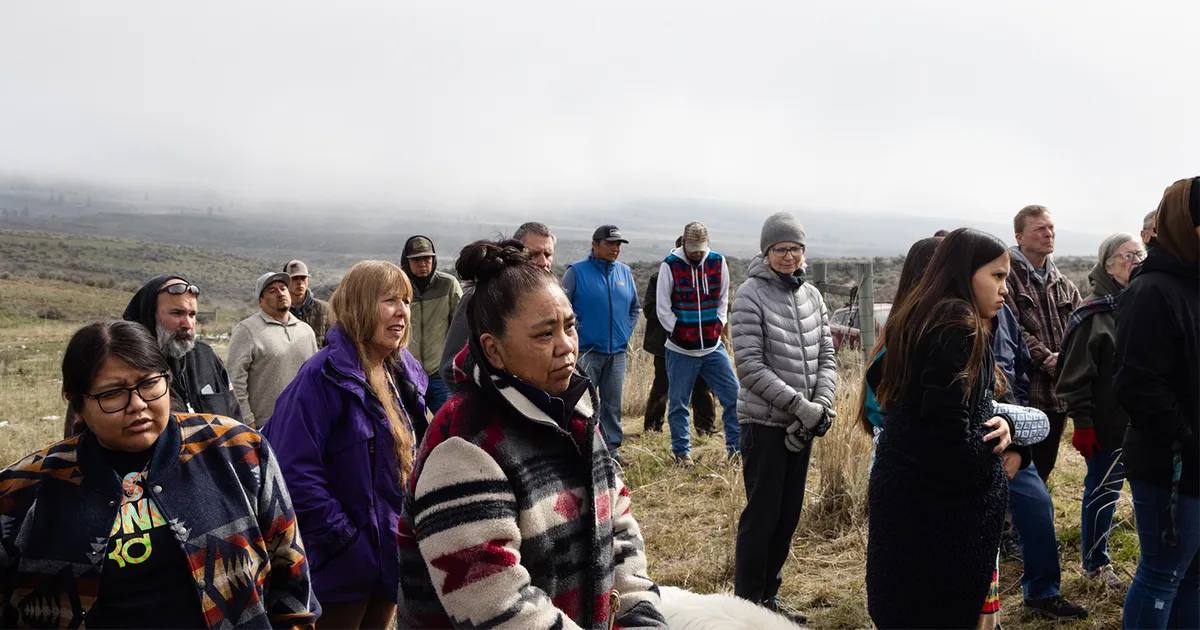
Members of the Wenatchi-P’squosa, one of the 12 Confederated Colville Tribes, and their supporters demonstrate in East Wenatchee, Washington, in 2024 against an Avangrid solar project on Badger Mountain. Emree Weaver A renewable energy developer has pulled its controversial permit application to build an industrial-scale solar facility on an Eastern Washington mountain sacred to Indigenous nations. Avangrid, a powerful player in the Northwest’s push for green energy development, sought for at least five years to build a solar plant on Badger Mountain. The project site straddled private as well as public lands. The Confederated Tribes of the Colville Reservation and the Confederated Tribes and Bands of the Yakama Nation have protected rights to practice cultural traditions, such as food gathering and ceremonies, on Badger Mountain and other ancestral public lands. A 2024 investigation by High Country News and ProPublica found that Avangrid and a consultant it retained, Tetra Tech, had omitted key archaeological and cultural information from a state-mandated review of the site, which would have been used for a solar farm. Avangrid continued pushing the project despite a state archaeologist’s warning that the planned development would threaten significant historic sites and current ceremonial activity. An elected member of the Colville Tribal Business Council told the newsrooms at the time that the project would destroy roughly half the root vegetable harvest in the area. An Avangrid spokesperson said then that the company had followed “all relevant law and regulation” with regard to the Badger Mountain solar project and had “taken additional steps to accommodate stakeholder feedback where possible.” It’s unclear whether the company’s decision to cancel the project had anything to do with Indigenous rights. Avangrid declined to clarify its reasoning to HCN. The Colville Tribes chair, Cindy Marchand, praised the decision in a statement last week. “While the Colville Tribes certainly appreciates the value of renewable energy such as solar power, sacred sites must remain pristine to pass down to future generations.” After the publication of HCN and ProPublica’s investigation, some members of the Wenatchi-P’squosa, one of the 12 Confederated Colville Tribes, held a demonstration on Badger Mountain , saying that while they support renewable energy, they’re against facilities being built on important cultural sites. Following the demonstration, Avangrid announced that it would pause development to reconsider tribal input and public response. The public comment process is one of the only avenues available for tribal nations to advocate for their rights regarding land development. At a meeting of the state’s permitting authority council in July, an Avangrid senior director sought a continued pause of the permitting work, pointing to anticipated construction delays affecting the power grid. At the same meeting, the council chair, Kurt Beckett, characterized concerns over the project’s environmental and cultural impacts as “noise,” but he also said tribal objections should be considered in the state’s permitting decision. Washington State Is Leaving Tribal Cultural Resources at the Mercy of Solar Developers Five days later, Avangrid filed a request to completely withdraw its proposal. And last week, the permitting council formally announced the withdrawal and said it was “closing out existing financial arrangements and notifying interested and agency partners.” It did not provide further comment, referring questions to the developer. The state Department of Natural Resources, which owns the public parcel on Badger Mountain, said it had not received any other requests to develop it for clean energy projects at this time, and a spokesperson did not have additional information about future plans for the site. No matter the reason for the project’s cancellation at Badger Mountain, the outcome is a good one, said Steven Wynecoop, vice chair of the Wenatchi Advisory Group, an independent body that advises the Colville Tribal Business Council and that organized the 2024 Badger Mountain demonstration. The mountain is a “very sacred site to us,” said Wynecoop, grandson of the Wenatchi Advisory Group founder Matthew Dick. “Generations, we’ve been going to that mountain for plenty of reasons: medicines, foods like roots and berries.” The post Solar Developer Cancels Washington State Project on Sacred Indigenous Land appeared first on ProPublica .
SRCProPublica
LANGEN
LEANCenter-Left
WORDS677
ENT12
MON · 2026-08-03 · 09:00 GMTBRIEF NSR-2026-0803-98606
NSR-2026-0803-98606News Report·EN·Social Justice
Solar Developer Cancels Washington State Project on Sacred Indigenous Land
Avangrid, a renewable energy developer, has withdrawn its permit application for a large solar facility on Badger Mountain in Eastern Washington. The mountain is considered sacred land by Indigenous nations, including the Confederated Tribes of the Colville Reservation and the Confederated Tribes and Bands of the Yakama Nation, who have rights to practice cultural traditions there.
B. “Toastie” OasterProPublicaFiled 2026-08-03 · 09:00 GMTLean · Center-LeftRead · 3 min
ProPublicaFIG 01
Reading time
3min
Word count
677words
Sources cited
4cited
Entities identified
12entities
Quality score
100%
§ 01
Briefing Summary
AI-generatedNEWSAR · AI
Avangrid, a renewable energy developer, has withdrawn its permit application for a large solar facility on Badger Mountain in Eastern Washington. The mountain is considered sacred land by Indigenous nations, including the Confederated Tribes of the Colville Reservation and the Confederated Tribes and Bands of the Yakama Nation, who have rights to practice cultural traditions there. A previous investigation revealed that Avangrid and its consultant omitted key cultural information from a state review, and the company proceeded despite warnings from a state archaeologist about threats to historic and ceremonial sites. Following protests and reconsideration of tribal input, Avangrid formally withdrew its proposal. The Colville Tribes chair praised the decision, emphasizing the importance of preserving sacred sites. The exact reason for Avangrid's cancellation was not clarified by the company.
Confidence 0.90Sources 4Claims 5Entities 12
§ 02
Article analysis
Model · rule-basedFraming
Social Justice
Human Rights
Tone
Mixed Tone
AI-assessed
CalmNeutralAlarmist
Factuality
0.80 / 1.00
Factual
LowHigh
Sources cited
4
Well sourced
FewMany
§ 03
Key claims
5 extracted01
Colville Tribes chair Cindy Marchand praised the decision, stating sacred sites must remain pristine for future generations.
quoteCindy Marchand
Confidence
1.00
02
A state archaeologist warned the development would threaten significant historic sites and current ceremonial activity.
factualstate archaeologist
Confidence
1.00
03
A 2024 investigation found Avangrid and Tetra Tech omitted key archaeological and cultural information from a state review.
factualHigh Country News and ProPublica
Confidence
1.00
04
Avangrid canceled its permit application for a solar facility on Badger Mountain, sacred to Indigenous nations.
factual
Confidence
1.00
05
The project would destroy roughly half the root vegetable harvest in the area, according to a Colville Tribal Business Council member.
factualColville Tribal Business Council member
Confidence
0.90
§ 04
Full report
3 min read · 677 words§ 05
Entities
12 identifiedKey playerOppositionContextPositiveNeutralNegative
Organizations8
A
Avangrid
CompanyOpposition
7x
100
CC
Confederated Colville Tribes
ReligiousKey Player
4x
90
WP
Wenatchi-P’squosa
ReligiousContext
2x
80
CT
Confederated Tribes of the Colville Reservation
ReligiousKey Player
80
CT
Confederated Tribes and Bands of the Yakama Nation
ReligiousKey Player
70
HC
High Country News
MediaContext
2x
60
P
ProPublica
MediaContext
2x
60
TT
Tetra Tech
CompanyContext
50
§ 06
Keywords & salience
10 termssacred sites
1.00
indigenous land
1.00
renewable energy
0.90
solar project
0.90
cultural traditions
0.80
confederated colville tribes
0.70
avangrid
0.70
archaeological information
0.60
badger mountain
0.50
yakama nation
0.40
§ 07
Topic connections
Interactive graph No topic relationship data available yet. This graph will appear once topic relationships have been computed.