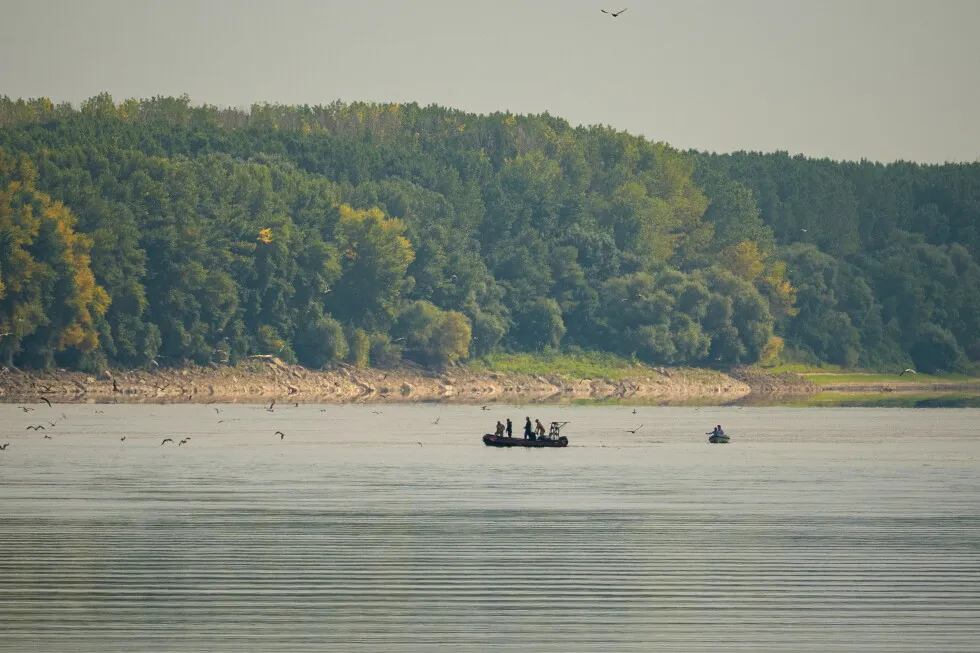
Record low Danube levels push some countries in Eastern Europe to the brink of energy emergency 1 of 5 | Romanian Navy EOD specialists survey the area before a controlled demolition of submerged rocks to improve water flow to the Cernavoda Nuclear Power Plant amid exceptionally low water levels on the Danube River, in Izvoarele, Romania, Monday, Aug. 3 2026. (AP Photo/ Vadim Ghirda) 2 of 5 | Birds fly after a controlled demolition by the Romanian Navy of submerged rocks to improve water flow to the Cernavoda Nuclear Power Plant amid exceptionally low water levels on the Danube River, in Izvoarele, Romania, Monday, Aug. 3, 2026. (AP Photo/Vadim Ghirda) 3 of 5 | The Romanian Navy detonates underwater explosives during a controlled demolition of submerged rocks to improve water flow to the Cernavoda Nuclear Power Plant amid exceptionally low water levels on the Danube River, in Izvoarele, Romania, Monday, Aug. 3, 2026. (AP Photo/Andreea Alexandru) 4 of 5 | People walk on a bank of sand on the Danube River as usually submerged areas are exposed due to extreme low levels of the water following an extended period of drought in Oltenita, Romania, Saturday, Aug.1, 2026. (AP Photo/ Vadim Ghirda) 5 of 5 | Boats sit on dry ground as water levels have dropped on the Danube River in Novi Sad, Serbia, Wednesday, July 29, 2026. (AP Photo/Darko Vojinovic) By JUSTIN SPIKE Updated 12:39 PM MESZ, August 3, 2026 Leer en español Add AP News on Google Add AP News as your preferred source to see more of our stories on Google. Share Share Facebook Copy Link copied Print Email X LinkedIn Bluesky Flipboard Pinterest Reddit Budapest, Hungary (AP) — Numerous governments across Central and Eastern Europe are taking steps to conserve electricity and avert an energy crisis as record low water levels on the Danube River have forced power plants to the brink of shutting down. Persistent drought and successive extreme heat waves have deprived one of Europe’s largest rivers of water, pushing the Danube’s levels in Hungary’s capital Budapest to around 10 centimeters (4 inches) on Monday, well below the previous all-time low of 33 centimeters (13 inches) set in 2018. Water levels are not expected to rise on the Danube in the coming days or even weeks as no significant rainfall is forecast, and as a renewed extreme heat wave bears down on the region with daytime highs topping 38 Celsius (100 Fahrenheit), electricity and water use are on the rise. The Danube’s record low levels have pushed Hungary’s only nuclear power plant, the Soviet-built, four-reactor plant at Paks, to the brink of powering down entirely for the first time in its 44 years in service. The Paks plant, which uses water from the Danube to cool its reactors, on Monday was producing only 240 megawatts of power rather than the usual 2,000 due to successive power-downs of its four reactors. Hungary braces for a full shutdown of the Paks nuclear plant as the Danube River hits record lows 2 MIN READ 20 Record-low Danube River affects tourism and industry as drought and heat grip Central Europe 4 MIN READ Los niveles récord del Danubio llevan a países de Europa oriental al borde de emergencia energética 4 MIN READ In video posted to Facebook on Monday, Hungarian Prime Minister Péter Magyar said engineers had managed to keep the plan’s final operating turbine temporarily running, averting an expected shutdown on the weekend. A full power-down will likely only happen on Tuesday or Wednesday, Magyar said. “This is very good news, because the complete shutdown of the Paks power plant can still be avoided, at least temporarily, on one of the biggest consumption days,” he said. The Paks plant, located around 90 kilometers (55 miles) south of Budapest, accounts for nearly half of Hungary’s electricity production and around a third of its consumption. Hungary has relied on regional electricity imports as well as renewable sources to try to make up for the deficit from the Paks plant. Hungary’s government last week asked major industrial users to curb their electricity consumption and sought voluntary savings from households in order to conserve supply, particularly in peak demand hours between 5 p.m. and 10 p.m. It also announced that electric-powered freight trains would not be permitted to run during peak hours beginning on Monday in order to conserve an estimated 70 to 90 megawatt-hours of electricity per day. While conservation measures were initially voluntary, Magyar’s government on Saturday issued a decree allowing for them to be made mandatory for large industrial or commercial consumers. He said Monday that the conservation push had resulted in 700 fewer megawatts of electricity being used the previous day, and thanked Hungarians for their efforts. Meanwhile, plants in neighboring countries have also seen dramatic drops in power generation, as well as disruptions to shipping and agriculture. Romania’s military on Monday used 180 kilograms (397 pounds) of explosives to blast rock near the lower Danube’s Bala Canal in an effort to redirect water into the river’s main channel and toward the state-owned Cernavoda Nuclear Power Plant. The Danube’s water flow has fallen to 1,500 cubic meters per second in Romania, less than a third of its July average. Authorities have already shut down one reactor unit at the Cernavoda plant, which is operating at about half its normal capacity. Acting Prime Minister Ilie Bolojan announced a nationwide state of alert in the energy sector on Friday, and warned that the Danube’s low water levels threatened the shutdown of Cernavoda’s second reactor. He appealed to citizens to voluntarily limit electricity usage in peak evening hours. In Serbia, record-low Danube levels have pushed the country’s key hydroelectric plant to operate with only 20% of its capacity, prompting Prime Minister Djuro Macut to preside over an emergency meeting on Monday focusing on energy problems. Macut appealed to residents to “minimize the use of big consumers of electricity in their homes, such as air conditioners.” He described the situation in a statement late on Sunday as “serious and demanding.” Associated Press writers Jovana Gec in Belgrade, Serbia, and Stephen McGrath in Leamington Spa, England, contributed to this report. JUSTIN SPIKE Spike is an Associated Press reporter based in Budapest, Hungary. twitter mailto
SRCAssociated Press (AP)
LANGEN
LEANCenter
WORDS1 041
ENT12
MON · 2026-08-03 · 10:53 GMTBRIEF NSR-2026-0803-98638
NSR-2026-0803-98638News Report·EN·Economic Impact
Record low Danube levels push some countries in Eastern Europe to the brink of energy emergency
Record low water levels on the Danube River, caused by persistent drought and heatwaves, are pushing Central and Eastern European countries towards an energy crisis. Hungary's Paks nuclear power plant, crucial for its electricity supply, is operating at significantly reduced capacity and faces potential shutdown due to insufficient cooling water.
Associated Press (AP)Filed 2026-08-03 · 10:53 GMTLean · CenterRead · 5 min
Associated Press (AP)FIG 01
Reading time
5min
Word count
1 041words
Sources cited
2cited
Entities identified
12entities
Quality score
100%
§ 01
Briefing Summary
AI-generatedNEWSAR · AI
Record low water levels on the Danube River, caused by persistent drought and heatwaves, are pushing Central and Eastern European countries towards an energy crisis. Hungary's Paks nuclear power plant, crucial for its electricity supply, is operating at significantly reduced capacity and faces potential shutdown due to insufficient cooling water. To avert a broader crisis, Hungary has implemented electricity conservation measures, including mandatory reductions for industrial users. Neighboring Romania and Serbia are also experiencing severe impacts, with their hydroelectric plants operating at a fraction of capacity and authorities taking steps to manage energy supply. Romania's military even conducted controlled demolitions to improve water flow to its Cernavoda nuclear plant.
Confidence 0.90Sources 2Claims 5Entities 12
§ 02
Article analysis
Model · rule-basedFraming
Economic Impact
Environmental
Tone
Mixed Tone
AI-assessed
CalmNeutralAlarmist
Factuality
0.80 / 1.00
Factual
LowHigh
Sources cited
2
Limited
FewMany
§ 03
Key claims
5 extracted01
The Romanian Navy conducted controlled demolitions of submerged rocks to improve water flow to the Cernavoda Nuclear Power Plant.
factualAP Photo/ Vadim Ghirda, AP Photo/Andreea Alexandru
Confidence
1.00
02
Hungary's Paks nuclear power plant is producing only 240 megawatts, down from its usual 2,000 megawatts, due to low Danube levels affecting cooling.
statistic
Confidence
1.00
03
The Danube's water level in Budapest is around 10 centimeters, significantly below the previous record low of 33 centimeters set in 2018.
statistic
Confidence
1.00
04
Record low water levels on the Danube River are forcing power plants to the brink of shutting down, impacting multiple Eastern European countries.
factual
Confidence
1.00
05
No significant rainfall is forecast for the region, and a renewed heat wave is expected, increasing electricity and water demand.
prediction
Confidence
0.90
§ 04
Full report
5 min read · 1 041 words§ 05
Entities
12 identifiedKey playerOppositionContextPositiveNeutralNegative
Locations7
§ 06
Keywords & salience
10 termsenergy emergency
1.00
low water levels
1.00
danube river
1.00
drought
0.90
heat waves
0.80
power plants
0.70
electricity conservation
0.60
eastern europe
0.50
cernavoda nuclear power plant
0.40
budapest
0.40
§ 07
Topic connections
Interactive graph Network visualization showing 8 related topics
View Full Graph Person Organization Location Event|Click node to navigate|Edge numbers = shared articles