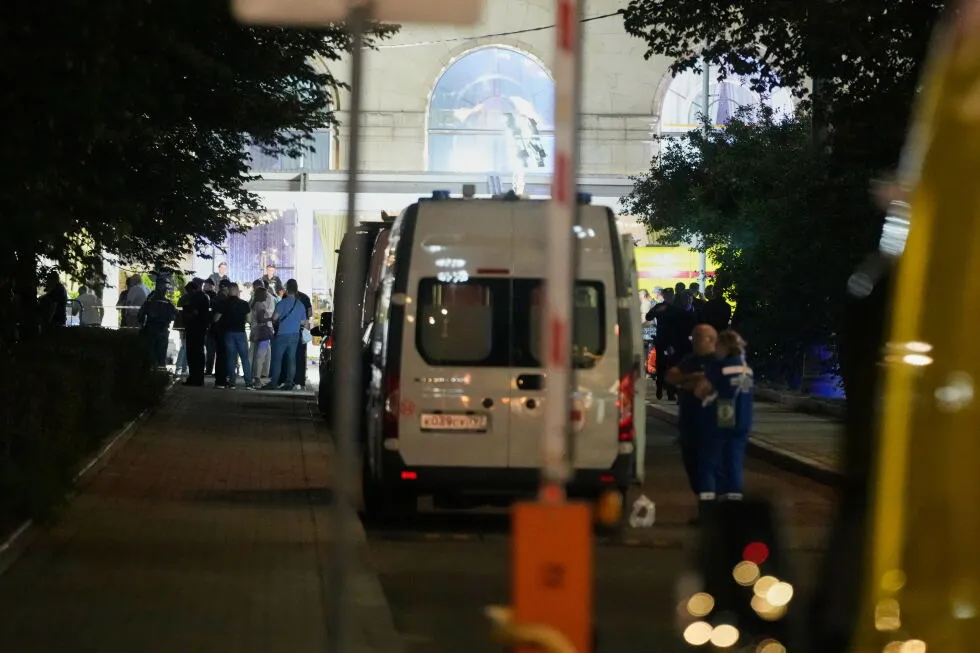
Rome" class="entity-link entity-organization" data-entity-id="177359" data-entity-type="organization">Russian Embassy in Rome blames Ukraine for deadly Italian restaurant bombing in Moscow 1 of 3 | Ambulances and special services vehicles are parked near the site where an improvised explosive device detonated at a restaurant in central Moscow, Saturday, Aug. 1, 2026. (AP Photo/Pavel Bednyakov) 2 of 3 | A policeman stands near the site where an improvised explosive device detonated at a restaurant in central Moscow, Saturday, Aug. 1, 2026. (AP Photo/Pavel Bednyakov) 3 of 3 | Emergency vehicles are parked in an area near a deadly explosion at a restaurant in Moscow, Saturday, Aug. 1, 2026. (Sergei Vedyashkin/Moscow News Agency via AP) Updated 3:21 PM MESZ, August 3, 2026 Add AP News on Google Add AP News as your preferred source to see more of our stories on Google. Share Share Facebook Copy Link copied Print Email X LinkedIn Bluesky Flipboard Pinterest Reddit Moscow (AP) — The Rome" class="entity-link entity-organization" data-entity-id="177359" data-entity-type="organization">Russian Embassy in Rome on Monday blamed Ukraine for a deadly weekend Moscow-restaurant" class="entity-link entity-event" data-entity-id="177361" data-entity-type="event">bombing at a Moscow restaurant, describing it as an attempt to intimidate the Italian community in Russia. The embassy said “Kyiv terrorists” wanted to “scare the Italians working in Russia and to show them that they too are in the crosshairs and could become the scoundrels’ next victims.” It said the Saturday night attack on the Balzi Rossi restaurant killed five and injured 19, adding that its Italian chef and his staff were unhurt only thanks to a Russian security guard’s “vigilance and selfless dedication to his professional duty.” There was no immediate comment from Ukrainian authorities. The National Anti-Terrorism Committee, which coordinates various security agencies, initially reported a lower death toll in a statement issued shortly after the attack. It said the bomb killed three people, including a woman who carried the explosive device into the restaurant, a guard who stopped her, and a guest inside. It said 21 others were injured when the bomb detonated near the restaurant’s entrance. The committee didn’t say who was the target or name the mastermind. Moscow Mayor Sergei Sobyanin on Sunday described the bombing as a “brutal terrorist act,” but did not say who was responsible for the blast at the upscale restaurant, which is located on the ground floor of a high-rise apartment building that is one of seven skyscrapers in the city that date to the era of Soviet dictator Josef Stalin. Moscow mayor calls a deadly bomb attack on a restaurant a ‘terrorist act’ 4 MIN READ Ukraine fires 400 drones toward Moscow as Zelenskyy grapples with protests 1 MIN READ Russia blasts southern Ukrainian city with glide bombs while Ukrainian drones reportedly kill 9 1 MIN READ The Russian Foreign Ministry did not respond to a request for comment on the embassy’s statement or explain the higher death toll. The ministry did not issue its own statement on the incident. Several Russian media outlets claimed the bombing targeted a Russian general who was celebrating his birthday at the restaurant. Some claimed that the general was Col.-Gen. Alexander Chaiko, who recently was appointed the chief of Russia’s aerospace forces. The claims could not be independently verified. Russia blamed Ukraine for past attacks on military officials Russian authorities have blamed Kyiv for a series of bombings and other attacks against senior military officials after Moscow sent troops into Ukraine in February 2022. Earlier this year, Russia’s Federal Security Service said authorities would tighten security around senior military and government officials following the attacks. In February, Lt. Gen. Vladimir Alexeyev, the deputy head of the GRU military intelligence service, was shot three times at a Moscow apartment building, but survived. Ukraine denied its involvement. In December, a car bomb killed Lt. Gen. Fanil Sarvarov, head of the Operational Training Directorate of the Russian Armed Forces’ General Staff, in southern Moscow. Ukraine refrained from comment. In April 2025, another car bomb that Moscow blamed on Kyiv killed Lt. Gen. Yaroslav Moskalik, a deputy head of the main operational department in Russia’s General Staff. Ukraine didn’t claim the attack but hinted at its involvement. And in December 2024, a bomb hidden in a scooter killed Lt. Gen. Igor Kirillov, who headed the Russian military’s nuclear, biological and chemical protection forces, one of the few attacks Ukraine openly acknowledged. Among other prominent victims of bombing attacks in Russia were Daria Dugina, the daughter of influential nationalist thinker Aleksandr Dugin, and Vladlen Tatarsky, a well-known pro-Kremlin military blogger. Kyiv denied involvement in the attack on Dugina, and remained coy about the attack on Tatarsky.
SRCAssociated Press (AP)
LANGEN
LEANCenter
WORDS751
ENT12
MON · 2026-08-03 · 13:23 GMTBRIEF NSR-2026-0803-98676
NSR-2026-0803-98676News Report·EN·Conflict
Russian Embassy in Rome blames Ukraine for deadly Italian restaurant bombing in Moscow
The Russian Embassy in Rome has blamed Ukraine for a deadly bombing at an Italian restaurant in Moscow on Saturday, August 1, 2026. The embassy stated the attack was intended to intimidate Italians working in Russia.
Associated Press (AP)Filed 2026-08-03 · 13:23 GMTLean · CenterRead · 4 min
Associated Press (AP)FIG 01
Reading time
4min
Word count
751words
Sources cited
4cited
Entities identified
12entities
Quality score
100%
§ 01
Briefing Summary
AI-generatedNEWSAR · AI
The Russian Embassy in Rome has blamed Ukraine for a deadly bombing at an Italian restaurant in Moscow on Saturday, August 1, 2026. The embassy stated the attack was intended to intimidate Italians working in Russia. The blast killed five people and injured 19, according to the embassy, though initial reports from the National Anti-Terrorism Committee indicated three deaths and 21 injuries. Moscow Mayor Sergei Sobyanin condemned the incident as a "brutal terrorist act" but did not assign blame. Russian media outlets have suggested the target may have been a Russian general, though this could not be independently verified. Ukraine has not yet commented on the accusations.
Confidence 0.90Sources 4Claims 5Entities 12
§ 02
Article analysis
Model · rule-basedFraming
Conflict
Diplomatic
Tone
Mixed Tone
AI-assessed
CalmNeutralAlarmist
Factuality
0.70 / 1.00
Factual
LowHigh
Sources cited
4
Well sourced
FewMany
§ 03
Key claims
5 extracted01
Moscow Mayor Sergei Sobyanin described the bombing as a 'brutal terrorist act'.
quoteSergei Sobyanin
Confidence
1.00
02
The embassy described the attack as an attempt to intimidate the Italian community in Russia.
factualRussian Embassy in Rome
Confidence
1.00
03
The Russian Embassy in Rome blamed Ukraine for a deadly weekend bombing at a Moscow restaurant.
factualRussian Embassy in Rome
Confidence
1.00
04
The National Anti-Terrorism Committee initially reported the bomb killed three people, including the woman carrying it.
factualNational Anti-Terrorism Committee
Confidence
0.90
05
The attack on the Balzi Rossi restaurant killed five and injured 19, according to the embassy.
factualRussian Embassy in Rome
Confidence
0.90
§ 04
Full report
4 min read · 751 words§ 05
Entities
12 identifiedKey playerOppositionContextPositiveNeutralNegative
Organizations2
Locations6
Topics1
§ 06
Keywords & salience
9 termsbombing
1.00
moscow
0.90
ukraine
0.90
russian embassy
0.80
restaurant attack
0.70
terrorism
0.70
explosive device
0.60
italian community
0.50
security guard
0.40
§ 07
Topic connections
Interactive graph Network visualization showing 51 related topics
View Full Graph Person Organization Location Event|Click node to navigate|Edge numbers = shared articles