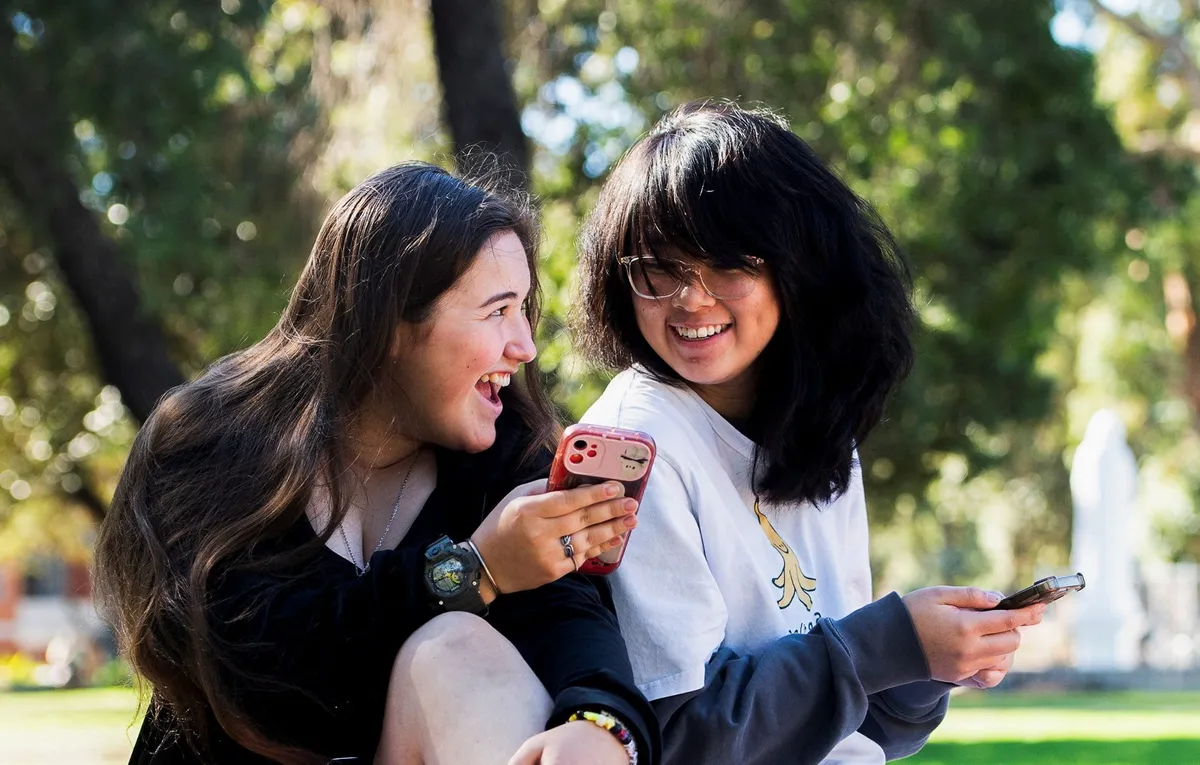
EXPLAINERAustralia’s internet regulator revealed in a recent study that teenagers are continuing to use social media despite the ban.Annie Wang, 15, and Novva Tolson, 15, pose as they scroll through their social media feeds, in Sydney, Australia on July 14, 2026 [Jeremy Piper/Reuters]Published On 3 Aug 2026A new study by Australia’s internet regulator has revealed that more than eight in 10 young Australian teens and preteens are continuing to use social media platforms despite the government’s prohibition for children under 16.The ban came into effect in December last year.Here is what we know about how it’s going.What did the latest report find?Australia’s internet regulator, eSafety, said it had found that more than eight in 10 Australian under-16s are continuing to use social media despite being banned from doing so.The report also found that most of those children aged 10 to 15 were using social media just as frequently in March as they had been before the ban came into force on December 10 last year.“Most under-16s who had social media accounts before commencement were able to either retain them or create new ones at the three-month mark, with social media platforms’ failure to implement effective age assurance measures cited as the main reason,” eSafety said in a statement.About half the children who retained their accounts said platforms had not checked their age, the most common reason they were able to stay on the services. Others said that their accounts listed them as aged 16 or older or that age-checking systems had incorrectly determined they were older.Prior to the ban, nearly 86 percent of children surveyed reported using at least one age-restricted platform. Three months later, that figure remained above 81 percent, the eSafety report said.Around 58 percent of teenagers reported using social media daily, the report found. Before the ban, the number was roughly 60 percent.The report showed minimal change in “sports and physical activity, arts and music, spending time with friends and family, and attendance at community events”.At the time the new rule was introduced, experts warned that enforcing it would be extremely difficult.Joanna Orlando, a researcher in digital wellbeing and the author of Generation Connected: How to Parent in a Digital World, told Al Jazeera in December last year: “Tech-savvy teens simply use VPNs, fake birth photos for face scans, or migrate to less regulated platforms like Lemon8, or to platforms not part of the ban like video games. Enforcement is proving to be difficult in the days leading up to the ban.”In December 2025, Australia prohibited children under 16 from using social media platforms, becoming the world’s first country to do so. Video game platforms are not included in the ban.The government said this was prompted by increasing concerns about the effects of cyberbullying, sexual exploitation and self-harm content on the mental and physical health of children and young people.Research commissioned by the Australian government in 2023 found four out of five children aged eight to 16 use social media, often beginning between the ages of 10 and 12. That report was led by former National Australia Bank CEO Andrew Thorburn, who recommended age restrictions.Under the law, 10 of the biggest social media platforms face $33m in fines if they fail to take “reasonable steps” to block Australian-based users younger than 16. Such steps include using age-verification tools to determine how old users are.As of January 16, social media companies had revoked access to about 4.7 million accounts identified as belonging to children in Australia, according to officials.“We stared down everybody who said it couldn’t be done, some of the most powerful and rich companies in the world and their supporters,” Australian Communications Minister Anika Wells told reporters in January.However, several months later, it now appears that youngsters have been able to open new accounts with relative ease.Days after Australia’s ban took effect, Reddit, one of the 10 platforms required to block minors, lodged a challenge to the ban in the High Court, while still complying with it. The case is still ongoing.How has the Australian government responded to the latest findings?On Saturday, Andrew Leigh, Australia’s assistant minister for productivity, competition, charities and treasury, defended the new law, arguing that the social media ban has already reshaped the “national debate” about the use of social media by children. The ban has been “an important game changer in the conversation among parents”, Leigh said in televised remarks.“We’ve had millions of accounts shut down,” he said.“We never expected that this would have 100 percent compliance. We don’t get 100 percent compliance out of minimum drinking age laws, but it’s still appropriate that we have that law on the books.”While social media has long provided easy access to unregulated and often harmful content, misinformation and hate speech, the recent explosion of AI‑generated material poses new risks to the wellbeing of children and young people, experts say.The American Psychological Association published an advisory last year warning that generative artificial intelligence (AI) systems can amplify harmful content such as violent or sexual videos.It also added that adolescents are less likely than adults to question the accuracy of AI-generated content. “They may also be unaware of the persuasive intent underlying an AI system’s advice or bias,” the advisory stated.AI can also amplify pre-existing societal prejudices, according to Ayo Tometi, co-creator of the US-based antiracist movement Black Lives Matter.Children worldwide are also worried about the misuse of AI for online child sexual exploitation and “deepfakes”, according to research by the United Nations Children’s Fund (UNICEF) on children’s perspectives and AI, which it published in October 2025.Following the introduction of Australia’s landmark law, some other countries are contemplating similar bans.In the United Kingdom, the government has announced that it also plans to introduce a ban on social media platforms such as TikTok, Snapchat and Instagram from spring 2027 onward. Messaging platforms such as WhatsApp and Signal, educational tools, and e-commerce and music streaming will be excluded.The government will announce the new regulations by the end of this year.In November 2025, Denmark’s government said it also plans to prohibit social media platforms for children under 15, saying it had secured majority support in parliament. The ban is due to come into effect later this year.Around the same time, Malaysia said it would ban social media accounts for people under 16 from this year.In April, Greek Prime Minister Kyriakos Mitsotakis formally announced plans to prohibit social media access for children under 15 from January 1, 2027, subject to parliamentary approval.
SRCAl Jazeera
LANGEN
LEANCenter
WORDS1 073
ENT12
MON · 2026-08-03 · 15:21 GMTBRIEF NSR-2026-0803-98686
NSR-2026-0803-98686News Report·EN·Public Health
Australia’s under-16 social media ban failing, study shows: What it means
A recent study by Australia's internet regulator, eSafety, found that over 80% of Australian children under 16 continue to use social media despite a ban implemented in December 2025. The report indicates that most of these children retained or created new accounts because social media platforms failed to implement effective age assurance measures.
Sarah ShamimAl JazeeraFiled 2026-08-03 · 15:21 GMTLean · CenterRead · 5 min
Al JazeeraFIG 01
Reading time
5min
Word count
1 073words
Sources cited
2cited
Entities identified
12entities
Quality score
100%
§ 01
Briefing Summary
AI-generatedNEWSAR · AI
A recent study by Australia's internet regulator, eSafety, found that over 80% of Australian children under 16 continue to use social media despite a ban implemented in December 2025. The report indicates that most of these children retained or created new accounts because social media platforms failed to implement effective age assurance measures. Approximately half of the children who kept their accounts stated that platforms did not check their age, or their accounts were listed as 16 or older. While the government acknowledges millions of accounts have been shut down, officials defend the law as a significant step in reshaping the national conversation around children's social media use, comparing its compliance to drinking age laws.
Confidence 0.90Sources 2Claims 5Entities 12
§ 02
Article analysis
Model · rule-basedFraming
Public Health
Technology
Tone
Measured
AI-assessed
CalmNeutralAlarmist
Factuality
0.80 / 1.00
Factual
LowHigh
Sources cited
2
Limited
FewMany
§ 03
Key claims
5 extracted01
Australia prohibited children under 16 from using social media platforms in December 2025, citing concerns about cyberbullying and mental health.
factualGovernment
Confidence
1.00
02
Nearly 86% of children surveyed used at least one age-restricted platform before the ban; three months later, it remained above 81%.
statisticeSafety
Confidence
1.00
03
More than eight in 10 Australian under-16s continue to use social media despite the government's prohibition.
statisticeSafety
Confidence
1.00
04
Social media platforms' failure to implement effective age assurance measures is the main reason teens can still use platforms.
factualeSafety
Confidence
0.90
05
Enforcing the ban is proving to be difficult, with teens using VPNs or migrating to less regulated platforms.
quoteJoanna Orlando
Confidence
0.80
§ 04
Full report
5 min read · 1 073 words§ 05
Entities
12 identifiedKey playerOppositionContextPositiveNeutralNegative
People4
Organizations4
§ 06
Keywords & salience
8 termssocial media ban
1.00
under-16s
0.90
internet regulator
0.80
age assurance
0.70
teenagers
0.60
esafety
0.50
digital wellbeing
0.40
vpns
0.40
§ 07
Topic connections
Interactive graph Network visualization showing 51 related topics
View Full Graph Person Organization Location Event|Click node to navigate|Edge numbers = shared articles