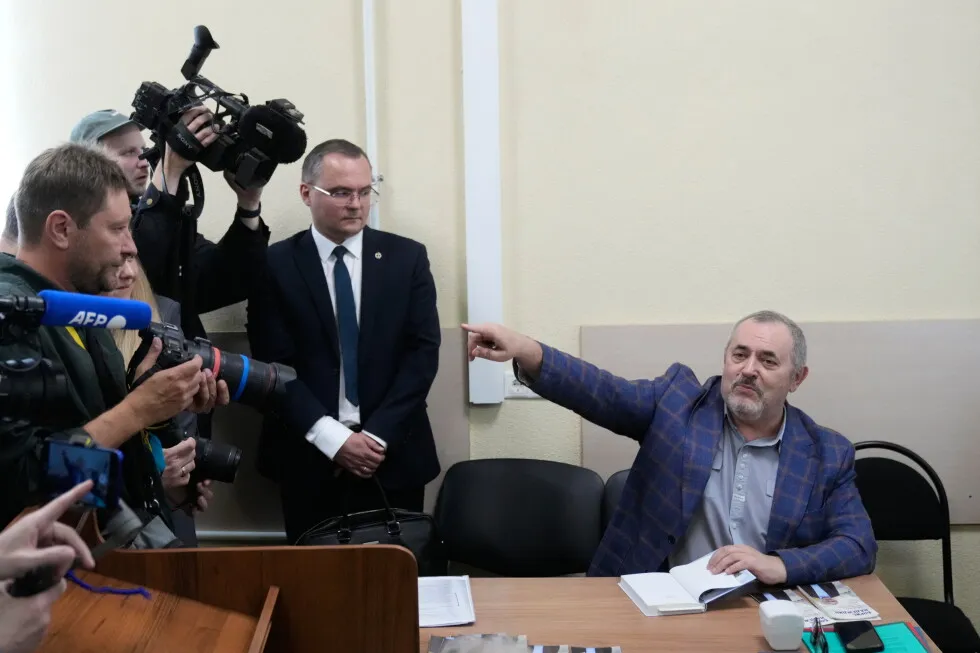
A Putin critic leaves Russia after he is barred him from running for parliament 1 of 4 | Russian politician Boris Nadezhdin, right, accused of displaying “extremist symbols,” gestures speaking at the courtroom in the town of Dolgoprudny outside Moscow, Russia, Friday, July 17, 2026. (AP Photo/Pavel Bednyakov) 2 of 4 | Russian politician Boris Nadezhdin, accused of displaying “extremist symbols,” attends a court session in the town of Dolgoprudny outside Moscow, Russia, Friday, July 17, 2026. (AP Photo/Pavel Bednyakov) 3 of 4 | Russian politician Boris Nadezhdin, accused of displaying “extremist symbols,” speaks to journalists as he arrives at the courtroom in the town of Dolgoprudny outside Moscow, Russia, Friday, July 17, 2026. (AP Photo/Pavel Bednyakov) 4 of 4 | Russian politician Boris Nadezhdin, center, accused of displaying “extremist symbols,” leaves a courtroom in the town of Dolgoprudny, outside Moscow, Russia, Friday, July 17, 2026. (AP Photo/Pavel Bednyakov) 1 of 4 | Russian politician Boris Nadezhdin, right, accused of displaying “extremist symbols,” gestures speaking at the courtroom in the town of Dolgoprudny outside Moscow, Russia, Friday, July 17, 2026. (AP Photo/Pavel Bednyakov) 1 of 4 Russian politician Boris Nadezhdin, right, accused of displaying “extremist symbols,” gestures speaking at the courtroom in the town of Dolgoprudny outside Moscow, Russia, Friday, July 17, 2026. (AP Photo/Pavel Bednyakov) Add AP News on Google Add AP News as your preferred source to see more of our stories on Google. Share 2 of 4 | Russian politician Boris Nadezhdin, accused of displaying “extremist symbols,” attends a court session in the town of Dolgoprudny outside Moscow, Russia, Friday, July 17, 2026. (AP Photo/Pavel Bednyakov) 2 of 4 Russian politician Boris Nadezhdin, accused of displaying “extremist symbols,” attends a court session in the town of Dolgoprudny outside Moscow, Russia, Friday, July 17, 2026. (AP Photo/Pavel Bednyakov) Add AP News on Google Add AP News as your preferred source to see more of our stories on Google. Share 3 of 4 | Russian politician Boris Nadezhdin, accused of displaying “extremist symbols,” speaks to journalists as he arrives at the courtroom in the town of Dolgoprudny outside Moscow, Russia, Friday, July 17, 2026. (AP Photo/Pavel Bednyakov) 3 of 4 Russian politician Boris Nadezhdin, accused of displaying “extremist symbols,” speaks to journalists as he arrives at the courtroom in the town of Dolgoprudny outside Moscow, Russia, Friday, July 17, 2026. (AP Photo/Pavel Bednyakov) Add AP News on Google Add AP News as your preferred source to see more of our stories on Google. Share 4 of 4 | Russian politician Boris Nadezhdin, center, accused of displaying “extremist symbols,” leaves a courtroom in the town of Dolgoprudny, outside Moscow, Russia, Friday, July 17, 2026. (AP Photo/Pavel Bednyakov) 4 of 4 Russian politician Boris Nadezhdin, center, accused of displaying “extremist symbols,” leaves a courtroom in the town of Dolgoprudny, outside Moscow, Russia, Friday, July 17, 2026. (AP Photo/Pavel Bednyakov) Add AP News on Google Add AP News as your preferred source to see more of our stories on Google. Share Updated [hour]:[minute] [AMPM] [timezone], [monthFull] [day], [year] Opposition politician Boris Nadezhdin, who criticized Russia’s war in Ukraine and tried to challenge President Vladimir Putin in the 2024 election, said Monday he has left Russia, a move that follows a crackdown that barred him from a race for parliament this year. Nadezhdin, 63, shared a video on Telegram, showing him standing in front of the Eiffel Tower in Paris.“Good news: I’m alive and free. Unfortunately, not in Russia for the time being,” he said, adding that he needs “to look around and figure out life going forward.” In July, a Russian court fined Nadezhdin about $13 for displaying “extremist symbols,” charges that he rejected as absurd. The accusations stemmed from a 2023 online video that briefly showed a picture of the late opposition leader Alexei Navalny, convicted of extremism in a case widely seen as politically motivated. Earlier that month, Nadezhdin also was designated a “foreign agent” — a label that brings additional government scrutiny as well as stigmatizing connotations in Russia.That and a fine on an extremism-related charge barred him from running in September’s parliamentary vote, which is expected to be tightly controlled by the Kremlin. The ruling United Russia party is seeking to preserve its dominance in the lower house of parliament in a race against the Communist Party and a couple of other parties that vote in sync with the Kremlin on key issues. The campaign comes amid signs of growing public fatigue with the war in Ukraine as fuel shortages and economic pain increase, an environment that reduces the authorities’ tolerance for even token opposition. 4 MIN READ 5 MIN READ 4 MIN READ In January 2024, Nadezhdin collected thousands of signatures in his run for president as he openly called for an end to the war in Ukraine. But he was kept off the March 2024 ballot after Russia’s Supreme Court ruled that more than 9,000 signatures submitted by his campaign were invalid — enough to disqualify him. Putin faced only token opposition in the election and easily gained a fifth term. A veteran politician, Nadezhdin worked in the government in the 1990s when he was an adviser to Sergei Kiriyenko, now a top Putin aide. He also served as a lawmaker and more recently became a member of a municipal council. He was one of the few high-profile Putin critics still living in Russia. Earlier this year, Nadezhdin declared his bid to run for the lower house of parliament, the State Duma, and vowed to continue his symbolic campaign even after the Justice Ministry branded him with the “foreign agent” designation.Another blow came when police briefly detained Nadezhdin and charged him with displaying “extremist symbols.” The politician said he was considering a move abroad but was barred from leaving Russia. It wasn’t clear from his Monday video statement whether the ban has since been lifted, or if he left the country despite it. After the Kremlin’s full-scale invasion of Ukraine in 2022, authorities ramped up their crackdown on dissent and free speech, relentlessly targeting rights organizations, independent media, members of civil society organizations and Kremlin critics. Hundreds of people have been jailed and thousands of others fled the country.
SRCAssociated Press (AP)
LANGEN
LEANCenter
WORDS1 033
ENT7
MON · 2026-08-03 · 14:53 GMTBRIEF NSR-2026-0803-98719
NSR-2026-0803-98719News Report·EN·Political Strategy
A Putin critic leaves Russia after he is barred him from running for parliament
Russian opposition politician Boris Nadezhdin has left Russia, stating he is "alive and free" in a video posted from Paris. This departure follows a series of actions by Russian authorities that barred him from running in the upcoming parliamentary elections.
By
THE ASSOCIATED PRESSAssociated Press (AP)Filed 2026-08-03 · 14:53 GMTLean · CenterRead · 5 min
Associated Press (AP)FIG 01
Reading time
5min
Word count
1 033words
Sources cited
0cited
Entities identified
7entities
Quality score
100%
§ 01
Briefing Summary
AI-generatedNEWSAR · AI
Russian opposition politician Boris Nadezhdin has left Russia, stating he is "alive and free" in a video posted from Paris. This departure follows a series of actions by Russian authorities that barred him from running in the upcoming parliamentary elections. In July, a court fined Nadezhdin for displaying "extremist symbols," stemming from a video that included a picture of Alexei Navalny. Earlier that month, he was designated a "foreign agent." These designations and the fine prevented him from participating in the September parliamentary vote. Nadezhdin had previously attempted to challenge President Vladimir Putin in the 2024 presidential election but was disqualified due to invalid signatures.
Confidence 0.90Claims 5Entities 7
§ 02
Article analysis
Model · rule-basedFraming
Political Strategy
Legal & Judicial
Tone
Measured
AI-assessed
CalmNeutralAlarmist
Factuality
0.80 / 1.00
Factual
LowHigh
Sources cited
0
No named sources
FewMany
§ 03
Key claims
5 extracted01
The court session took place in the town of Dolgoprudny outside Moscow.
factual
Confidence
1.00
02
Boris Nadezhdin left Russia.
factual
Confidence
1.00
03
Boris Nadezhdin was accused of displaying 'extremist symbols'.
factual
Confidence
1.00
04
Boris Nadezhdin is described as a Putin critic.
factual
Confidence
1.00
05
Russian politician Boris Nadezhdin was barred from running for parliament.
factual
Confidence
1.00
§ 04
Full report
5 min read · 1 033 words§ 05
Entities
7 identifiedKey playerOppositionContextPositiveNeutralNegative
People3
Organizations1
§ 06
Keywords & salience
8 termsbarred from parliament
1.00
putin critic
1.00
boris nadezhdin
0.90
leaves russia
0.80
extremist symbols
0.70
russian politician
0.60
court session
0.50
moscow
0.40
§ 07
Topic connections
Interactive graph No topic relationship data available yet. This graph will appear once topic relationships have been computed.