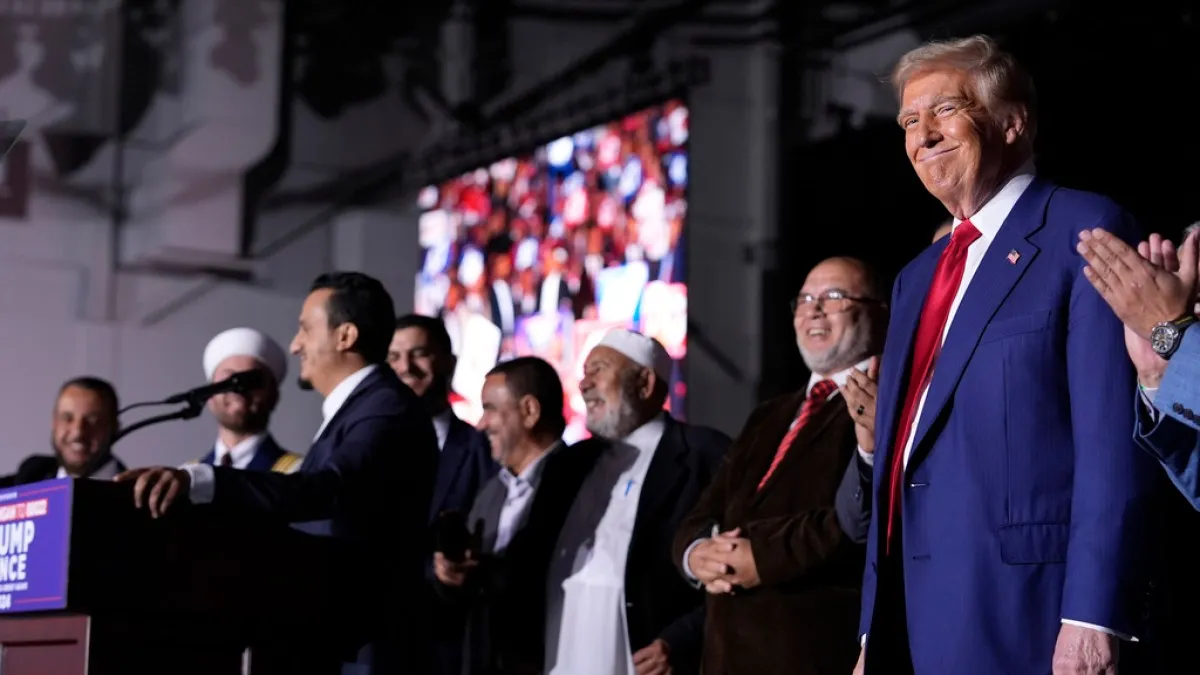
Arab Americans in Michigan who withheld support for Kamala Harris in 2024 say they will not back pro-Israel candidates.Then-Republican presidential nominee Donald Trump stands next to local Muslim leaders on stage during a campaign rally in Novi, Michigan, October 26, 2024 [Alex Brandon/AP Photo]Published On 3 Aug 2026Dearborn, Michigan – Yemeni-American activist Samraa Luqman has no regrets about voting for President Donald Trump in 2024.While the United States president has been a disappointment to Arab Americans in Michigan with his pro-war and anti-immigration policies, she stressed that it was untenable for the community to vote for Democrats as Israel’s genocide unfolded in Gaza.Recommended Stories list of 3 itemslist 1 of 3US Arabs eye ‘historic’ Senate win for Abdul El-Sayed despite AIPAC attackslist 2 of 3Israel’s influence industry in the USlist 3 of 3How much has AIPAC spent against Michigan’s Abdul El-Sayed? And why?end of list“There had to be accountability for the genocide. We’re OK with what we voted for,” Luqman told Al Jazeera.“I said from the beginning, I’m willing to live through another four years of Trump, that we expected him to be bad on our issues, but it was a pill we were willing to swallow in order to hold the Democratic Party accountable.”Luqman is not alone.Despite Trump’s staunchly pro-Israel policies and unpopular war on Iran, many say supporting Democratic nominee Kamala Harris in 2024 was out of the question, and it was the right choice for the community to break with the Democratic Party.“I could not – with a good heart, good conscience – tell someone to vote for Kamala Harris or Donald Trump”, but the approach of “lesser of two evils” no longer works to sway Arab voters, Hussein Dabajeh, a prominent political strategist in the Detroit area, home to large Arab and Muslim communities, told Al Jazeera.Democrats’ popularity amongst Arab Americans nosedived in 2024 as President Joe Biden ignored calls to compel a ceasefire in Gaza and continued to provide Israel with weapons and military aid as it killed tens of thousands in Palestine and Lebanon.Then, Vice President Harris refused even to consider an arms embargo against Israel.As a result of these policies, many Arab Americans, who had been reliable Democratic voters for years, ditched the party and refused to support Harris in her presidential bid.Trump swept in, presented himself as a “peace” candidate, and his campaign forged ties with Arab community advocates.Trump’s policiesAt a rally in Michigan ahead of the 2024 vote, Trump brought local Muslim imams to the stage and praised the community.The Republican leader also visited the predominantly Arab and Muslim Detroit suburb of Dearborn ahead of the election.Trump ended up winning Michigan as many Arab voters in the Dearborn area refused to back Harris. Some voted for him, while others voted for a third party, left the top of the ticket blank, or skipped the election altogether.According to an Al Jazeera analysis of election results in heavily Arab precincts in east Dearborn, about 45 percent of the votes went to Trump, 29 percent to Green Party candidate Jill Stein, and 16 percent to Harris.As president, Trump allowed Israel to continue its attacks on Gaza and Lebanon and launched an unprovoked war against Iran that has sent petrol prices soaring.He has also intensified the crackdown on Palestinian rights advocacy at home with a campaign to deport noncitizen student activists critical of Israel.In February, he also terminated immigration protections for Yemeni nationals, sowing fear and uncertainty in a community where many leaders had endorsed him in 2024.Asked how Arab Americans feel about Trump now, Dabajeh said: “They hate him. There’s no other way of putting it. I don’t think there is a single person I know that voted for Trump from the Arab and Muslim community specifically that looks at what Trump is doing and is happy with what he’s doing, or what he’s done.”‘The genocide matured us’Many Arab Americans stress that withholding support for Harris in 2024 was not out of love for Trump.“No one understands the horrors of Trump’s policy more than us. We were his first victims in 2017,” said Amer Zahr, a comedian and Dearborn Board of Education trustee.Shortly after starting his first term in 2017, Trump implemented a travel ban on several Muslim-majority countries.“No one is more aware of the harm that Trump can cause than we are,” Zahr added. “But the genocide matured us in a way that we finally got to the point where we were willing to tell politicians ‘no’.”As the election season returns to Michigan, Arab Americans once again find themselves at a political crossroads.The community is rallying behind Democratic Senate candidate Abdul El-Sayed – who had previously endorsed Harris – but some are keeping their political options open.Luqman, the Yemeni activist, said she will certainly vote for El-Sayed and Congresswoman Rashida Tlaib – who are outspoken critics of Israel – in the Democratic primary on Tuesday and in the general elections in November.Luqman said Democratic voters’ support for progressive candidates will help the party regain credibility with Arab voters.“Those are things that do bring the Democratic Party a little bit of relevance and credibility within our community,” Luqman told Al Jazeera.“It has kind of brought the community back to centre, whereas they were kind of swinging to the right by a large margin.”Political strategist Hussein Dabajeh says many Arab Americans in Michigan ‘hate’ Trump and his policies [Ali Harb/Al Jazeera]Palestine or bustWhile some political commentators have been questioning why US support for Israel has become a decisive issue in US politics, particularly Democratic primaries, the answer in the Arab community is clear.Advocates say domestic policy takes a backseat when their loved ones are being killed, and their hometowns are being wiped out by their own tax dollars via military aid to Israel.“Gaza and Palestine and Middle Eastern issues have now become the forefront, the top of everybody’s issues, and it’s become a red line for my community,” Luqman said.“So if you’re a Republican or Democrat and you hate AIPAC and you value Palestinians’ rights to self-determination, then you’re going to be getting our vote, regardless of what party you’re in,” she said, referencing the powerful American Israel Public Affairs Committee lobby group.Zahr echoed that message.“People want us not to be single-issue voters. In other words, they want us to forgo our main issue, get screwed on it, watch our families die because Trump’s bad, and accept all that,” he said.“Well, we said ‘no’. The blood of the children of Gaza had to mean something.”Zahr emphasised that Arab Americans are not alone in centring Palestine in their electoral choices, pointing to the defeats that pro-Israel incumbents have suffered across the map in this primary season.“You’ve gotten to a point where if somebody says, ‘Stop bombing hospitals’, everyone knows you’re talking about Israel. That’s because of Israel. That’s not because of us. That’s because of what Israel did,” he told Al Jazeera.“And so, people are keying into the truth. And when you learn the truth, something that comes along with that is you learn that you’ve been lied to, and you get angry. A lot of righteous anger is pushing a lot of this.”Dabajeh, the political strategist, said that while Arab voters care about the economy, affordability and infrastructure – like all Americans – they cannot overlook US policy on Israel.“Are we supposed to call our family members overseas and be like, ‘Listen, khalto [auntie], this guy over here that’s running for office might kill some of your neighbours, might kill some of your kids, but don’t worry about it, he’s going to take care of the flooding in our homes’?”
SRCAl Jazeera
LANGEN
LEANCenter
WORDS1 265
ENT11
MON · 2026-08-03 · 22:35 GMTBRIEF NSR-2026-0804-98824
NSR-2026-0804-98824News Report·EN·Political Strategy
From Trump to El-Sayed: US Arabs in Michigan centre Palestine in politics
Arab Americans in Michigan are centering Palestine in their political decisions, with many withholding support from pro-Israel candidates. In the 2024 election, a significant portion of this community declined to back Democratic nominee Kamala Harris due to the Biden administration's continued support for Israel amidst the conflict in Gaza.
Ali HarbAl JazeeraFiled 2026-08-03 · 22:35 GMTLean · CenterRead · 6 min
Al JazeeraFIG 01
Reading time
6min
Word count
1 265words
Sources cited
2cited
Entities identified
11entities
Quality score
100%
§ 01
Briefing Summary
AI-generatedNEWSAR · AI
Arab Americans in Michigan are centering Palestine in their political decisions, with many withholding support from pro-Israel candidates. In the 2024 election, a significant portion of this community declined to back Democratic nominee Kamala Harris due to the Biden administration's continued support for Israel amidst the conflict in Gaza. Some Arab voters in Michigan opted for Donald Trump, while others supported third-party candidates or abstained from voting, aiming to hold the Democratic Party accountable. Despite Trump's own pro-Israel policies and negative impacts on the community, such as the travel ban and termination of protections for Yemeni nationals, Arab Americans emphasize that their decision was a strategic move to express dissatisfaction with Democratic inaction on the Gaza crisis. As the political landscape evolves, the community is now rallying behind candidates like Abdul El-Sayed and Rashida Tlaib, who are vocal critics of Israel.
Confidence 0.90Sources 2Claims 5Entities 11
§ 02
Article analysis
Model · rule-basedFraming
Political Strategy
Social Justice
Tone
Measured
AI-assessed
CalmNeutralAlarmist
Factuality
0.40 / 1.00
Mixed
LowHigh
Sources cited
2
Limited
FewMany
§ 03
Key claims
5 extracted01
The 'lesser of two evils' approach is no longer effective in swaying Arab voters, according to Detroit-area political strategist Hussein Dabajeh.
quoteHussein Dabajeh
Confidence
1.00
02
Yemeni-American activist Samraa Luqman voted for Donald Trump in 2024, prioritizing accountability for the 'genocide' in Gaza over Trump's policies.
quoteSamraa Luqman
Confidence
1.00
03
Democrats' popularity among Arab Americans declined in 2024 because President Biden ignored calls for a ceasefire and continued military aid to Israel.
factualArticle
Confidence
0.90
04
Arab Americans in Michigan withheld support for Kamala Harris in 2024 due to her pro-Israel stance and the ongoing conflict in Gaza.
factualArticle
Confidence
0.90
05
Donald Trump forged ties with Arab community advocates and presented himself as a 'peace' candidate during his 2024 campaign.
factualArticle
Confidence
0.80
§ 04
Full report
6 min read · 1 265 words§ 05
Entities
11 identifiedKey playerOppositionContextPositiveNeutralNegative
People6
§ 06
Keywords & salience
10 termsarab americans
1.00
palestine politics
1.00
michigan
0.90
donald trump
0.80
kamala harris
0.80
democratic party
0.70
gaza
0.70
accountability
0.60
pro-israel
0.50
ceasefire
0.40
§ 07
Topic connections
Interactive graph Network visualization showing 51 related topics
View Full Graph Person Organization Location Event|Click node to navigate|Edge numbers = shared articles