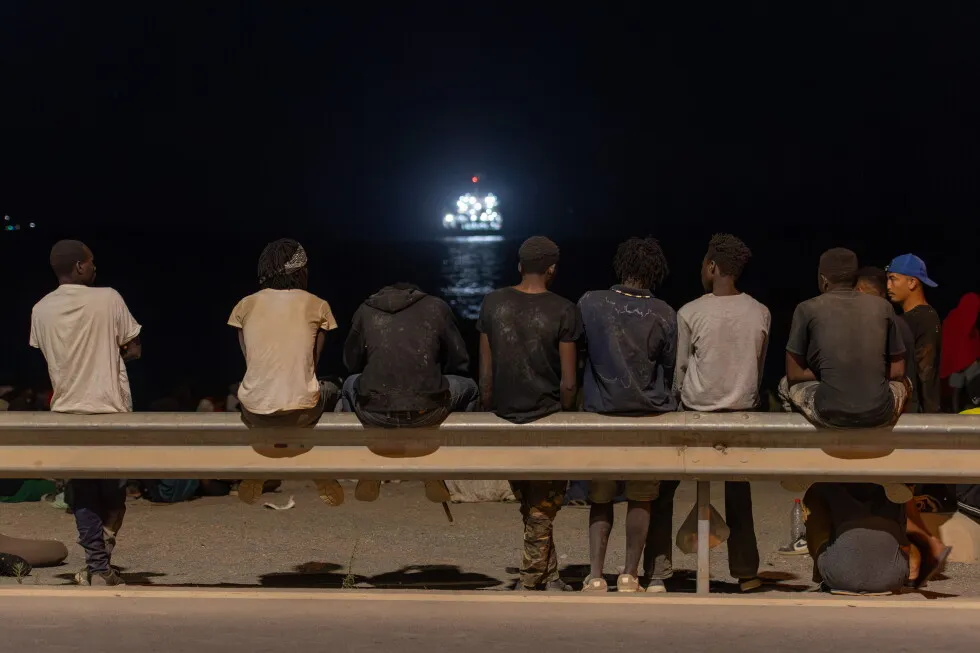
Spanish Prime Minister Sanchez fends off blistering criticism within the EU over Ceuta crisis 1 of 4 | Migrants who crossed into Spain from Morocco gather on a beach in the Spanish enclave of Ceuta, Sunday, Aug. 2, 2026. (AP Photo/Antonio Sempere) 2 of 4 | Migrants who crossed into Spain are escorted by Spanish soldiers towards the Spanish-Moroccan border for their return to Morocco from the Spanish enclave of Ceuta, Sunday, Aug. 2, 2026. (AP Photo/Antonio Sempere) 3 of 4 | Migrants who crossed into Spain are escorted by Spanish soldiers towards the Spanish-Moroccan border for their return to Morocco from the Spanish enclave of Ceuta, Sunday, Aug. 2, 2026. (AP Photo/Bernat Armangue) 4 of 4 | Migrants who crossed into Spain from Morocco sit outside the temporary immigrant stay center (CETI) in the Spanish enclave of Ceuta, Sunday, Aug. 2, 2026. (AP Photo/Bernat Armangue) By SAM McNEIL, JOSEPH WILSON and COLLEEN BARRY Updated 7:04 AM MESZ, August 4, 2026 Leer en español Add AP News on Google Add AP News as your preferred source to see more of our stories on Google. Share Share Facebook Copy Link copied Print Email X LinkedIn Bluesky Flipboard Pinterest Reddit BRUSSELS (AP) — Spanish Prime Minister Pedro Sanchez’s Migration policies have come under withering criticism as leaders from across the European Union meet Tuesday following last week’s rush of migrants to the Spanish territory of Ceuta in North Africa. The sudden arrival of 50,000 to 60,000 migrants on Thursday and Friday sparked a humanitarian crisis in Ceuta and reignited the Immigration debate in the 27-nation bloc, though most of the migrants soon went back. More than 80 migrants died, including some who drowned or were trampled in a stampede to cross a breakwater barrier, according to Spanish and Moroccan authorities. Open letters from 22 EU leaders, and a quick retort from Sanchez, have exposed a roiling debate inside the EU pitting Migration hawks against the progressive Spanish leader who has challenged consensus within the bloc on Migration as well as NATO spending, Gaza and Israel. Sanchez’s government has fended off the attacks as politically motivated, saying most of the migrants were pushed back from Ceuta within hours in “close coordination with the Moroccan authorities and with very little support from other European states.” Regardless of Tuesday meeting’s outcome, Europe is displaying a deeply damaging disunity as it faces security threats from Moscow, instability with Washington and economic tension with Beijing, said Alicia García-Herrero, chief economist for Asia Pacific and Middle East for the financial firm Natixis. “Europe has shown weakness again,” she said. “Massive weakness.” Spain installs sea barrier on Ceuta’s border with Morocco after frontier rush that killed 67 3 MIN READ 170 FACT FOCUS: Migrant crossing in Spain’s Ceuta breeds unsubstantiated claims 3 MIN READ 39 Tens of thousands of migrants voluntarily leave after crossing into Spanish territory of Ceuta 3 MIN READ 39 Sanchez rattled by withering criticism from fellow EU leaders over Ceuta EU leaders quickly pounced on Sanchez once videos from Ceuta went viral. Many blamed the incident on his government’s progressive policies and publicly rallied for new border checks at sea, air and land ports of entry. They blamed a recent Spanish court ruling for triggering “this attack on our Migration and asylum system,” according to an open letter signed from the leaders of 22 EU countries, from Finland to Malta. Spain’s Supreme Court had ruled that migrants arriving by sea could not be summarily deported without due process, unlike those who cross by land or climb Ceuta’s border fence because they had not crossed a physical barrier. Sanchez said that the ruling had been intentionally misconstrued by migrant smugglers to convince thousands of people to cross by swimming around the border fence. The Socialist leader replied in his own letter by recalling that Spain had, in solidarity with the EU, taken in migrants who arrived to eastern European nations from Belarus in 2021 and to the southern Italian island of Lampedusa in 2023. Right-wing coalition had led Migration policy overhaul in Brussels Many right-wing politicians have won elections across the EU by promising to crackdown on Migration — and they claim to have done so with the European Migration and Asylum Pact. Newer, stricter regulations for asylum seekers and migrants largely replaced the previous Migration system, which was widely considered a failure. EU capitals now boast greater abilities to surveil, detain and deport migrants to so-called “safe countries” like Morocco or “return hubs” outside the bloc. These new provisions have been met with skepticism from human rights groups, including fears that deportation centers hosted abroad could morph into long-term holding facilities overflowing with asylum seekers stuck in legal limbo. “On Ceuta, political games are being played over the lives of people on both sides of the border,” said Michele LeVoy, director of the Brussels-based Platform for International Cooperation on Undocumented Migrants. She criticized “Europe’s inaction” in tackling the root causes of Migration that she said led to the Ceuta crisis. “We need regular pathways for people to move in safety and dignity,” LeVoy said. Italy slams Sanchez and calls for fast-tracking controversial migrant detention center Italian Premier Giorgia Meloni issued the most blunt criticism of Sanchez, as well as announcing that Italy would enforce air and sea border controls with Spain. Yet Cueta’s remote geographical position meant “there was almost zero risk that people (would) really arrive in Spain and then move on to Italy,” said analyst Matteo Villa at the Italian Institute for Political Studies in Milan. He said that just 2% of migrants arriving in Europe make it to Italy. Italy has also pointed to Ceuta to push forward a controversial plan, forged in Italy’s partnership with Albania, to move migrant screenings outside of the EU. Sanchez fired back by calling the Italian leader’s position on Ceuta “contrary to European law, humanitarian law, and the principles of solidarity that bind us together.” In a post on X, Sánchez also claimed that Italy has allowed in twice the number of migrants as Spain since 2021, with Spain receiving 234,000 to Italy’s 478,000. Migration dynamics and policies have changed in Europe Data from the EU’s border agency Frontex shows Migration to the EU peaked in 2015 with 1.8 million people, the majority of whom crossed via the Balkans or the eastern Mediterranean. Since then numbers have dramatically fallen: In the first half of 2026, crossings fell by 37% to around 49,000 people. “Fewer boats are setting out towards Europe, and that is the result of sustained cooperation with our partners in the region,” said Frontex Executive Director Hans Leijtens. European Commission President Ursula von der Leyen had at first expressed shock over Ceuta while calling for a doubling down on the bloc’s hard line on Migration. But she sent a letter Monday to Sanchez praising his handling of the crisis. “We need a lessons-learned process to improve our European resilience, preparedness and response,” said Arianna Podesta, a spokesperson for the commission, reflecting the contents of the letter. “What happened in Ceuta has made it clear that we must do more to further strengthen external borders, for example with vigilant monitoring and where needed the use of physical barriers.” Wilson reported from Barcelona, Spain, and Barry from Rome. Associated Press writer Renata Brio in Barcelona contributed to this report. SAM McNEIL McNeil covers Europe and beyond with a focus on conflict and the environment. twitter instagram facebook mailto JOSEPH WILSON Wilson covers Spanish news and sports for The Associated Press. He is based in Barcelona. twitter mailto COLLEEN BARRY Barry covers all things Italy for The Associated Press. Her focus includes fashion and design, overtourism and the environment, politics and sometimes the Vatican. twitter instagram mailto
SRCAssociated Press (AP)
LANGEN
LEANCenter
WORDS1 290
ENT12
TUE · 2026-08-04 · 05:23 GMTBRIEF NSR-2026-0804-98882
NSR-2026-0804-98882News Report·EN·Diplomatic
Spanish Prime Minister Sanchez fends off blistering criticism within the EU over Ceuta crisis
Spanish Prime Minister Pedro Sanchez is facing significant criticism from other EU leaders following a large influx of migrants to the Spanish enclave of Ceuta from Morocco. The event, which resulted in a humanitarian crisis and over 80 deaths, has reignited the immigration debate within the bloc.
Associated Press (AP)Filed 2026-08-04 · 05:23 GMTLean · CenterRead · 6 min
Associated Press (AP)FIG 01
Reading time
6min
Word count
1 290words
Sources cited
2cited
Entities identified
12entities
Quality score
100%
§ 01
Briefing Summary
AI-generatedNEWSAR · AI
Spanish Prime Minister Pedro Sanchez is facing significant criticism from other EU leaders following a large influx of migrants to the Spanish enclave of Ceuta from Morocco. The event, which resulted in a humanitarian crisis and over 80 deaths, has reignited the immigration debate within the bloc. Twenty-two EU leaders sent open letters blaming Sanchez's progressive policies and a recent Spanish court ruling for the incident. Sanchez's government contends the attacks are politically motivated and highlights close coordination with Moroccan authorities in managing the situation. The crisis has exposed deep divisions within the EU regarding migration policies, with some leaders advocating for stricter border controls and others, like Sanchez, emphasizing solidarity and humanitarian principles.
Confidence 0.90Sources 2Claims 5Entities 12
§ 02
Article analysis
Model · rule-basedFraming
Diplomatic
Political Strategy
Tone
Mixed Tone
AI-assessed
CalmNeutralAlarmist
Factuality
0.70 / 1.00
Factual
LowHigh
Sources cited
2
Limited
FewMany
§ 03
Key claims
5 extracted01
Europe is displaying deeply damaging disunity, showing weakness in the face of global threats.
quoteAlicia García-Herrero
Confidence
1.00
02
More than 80 migrants died during the crossing, including some who drowned or were trampled.
statisticSpanish and Moroccan authorities
Confidence
0.90
03
Spanish Prime Minister Sanchez's migration policies have come under withering criticism from EU leaders.
factualAP News
Confidence
0.90
04
Sanchez's government claims most migrants were pushed back within hours in coordination with Moroccan authorities.
factualSanchez's government
Confidence
0.80
05
50,000 to 60,000 migrants rushed to Ceuta in North Africa on Thursday and Friday, sparking a humanitarian crisis.
statisticAP News
Confidence
0.80
§ 04
Full report
6 min read · 1 290 words§ 05
Entities
12 identifiedKey playerOppositionContextPositiveNeutralNegative
Locations7
Events1
§ 06
Keywords & salience
9 termsceuta crisis
1.00
migration policies
0.90
european union
0.80
pedro sanchez
0.70
migrants
0.70
humanitarian crisis
0.60
moroccan authorities
0.50
eu leaders
0.50
eu disunity
0.40
§ 07
Topic connections
Interactive graph Network visualization showing 12 related topics
View Full Graph Person Organization Location Event|Click node to navigate|Edge numbers = shared articles