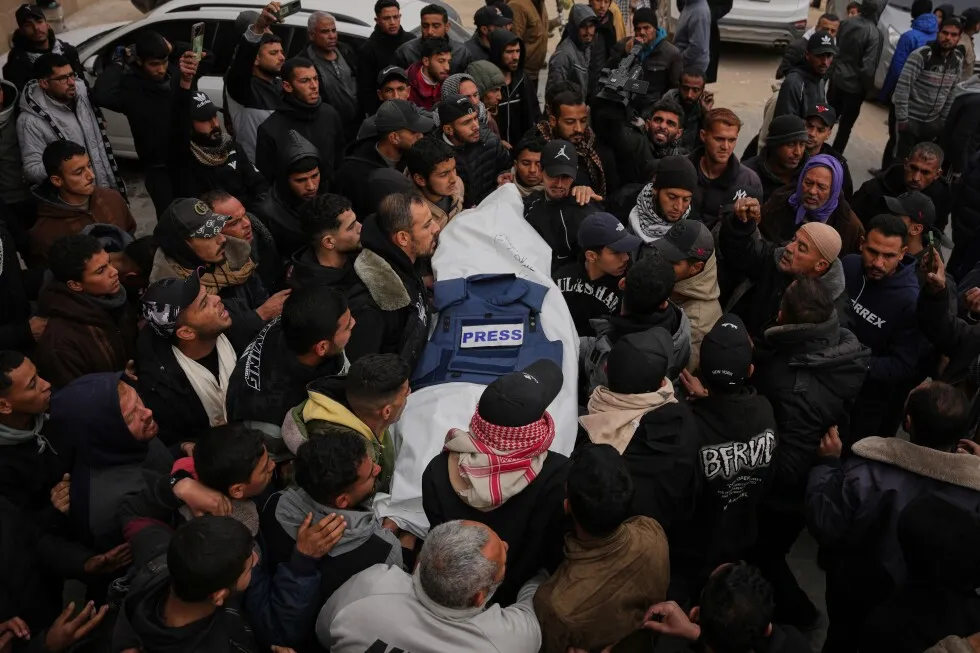
People in Gaza dig through garbage for things to burn to keep warm — a far cry from Trump’s vision 1 of 7 | In a garbage dump in Khan Younis’s Muwasi area, many Palestinians gather to dig with their bare hands in the garbage in search of plastics and paper to help start a fire to cook and keep warm in the bitter cold of January. For many of them, buying firewood is not possible. 2 of 7 | Dozens of Palestinians gathered on Thursday at Nasser hospital in southern Gaza to mourn three Palestinian journalists, who were killed the previous day when an Israeli strike hit their vehicle. 3 of 7 | Mourners carry the body of Anas Ghoneim, one of the three Palestinian journalists who were killed in an Israeli strike on an Egyptian committee’s vehicle, during his funeral in Khan Younis, southern Gaza Strip, Thursday, Jan. 22, 2026. (AP Photo/Abdel Kareem Hana) 4 of 7 | Palestinian children sort through trash at a landfill in al-Bureij camp, in the central Gaza Strip, Wednesday, Dec. 24, 2025. (AP Photo/Abdel Kareem Hana) 5 of 7 | A Palestinian man walks past a wedding dress displayed on a street next to a bridal shop in Khan Younis, southern Gaza Strip, Thursday, Jan. 22, 2026. (AP Photo/Abdel Kareem Hana) 6 of 7 | A Palestinian resident of Ras Ein al-Auja village, West Bank burns trash, Sunday, Jan. 11, 2026. (AP Photo/Mahmoud Illean) 7 of 7 | Mourners pray over the bodies of the Palestinian journalists Abd Shaat and Anas Ghoneim who were killed in an Israeli strike on an Egyptian committee’s vehicle, during their funeral in Khan Younis, southern Gaza Strip, Thursday, Jan. 22, 2026. (AP Photo/Abdel Kareem Hana) 1 of 7 In a garbage dump in Khan Younis’s Muwasi area, many Palestinians gather to dig with their bare hands in the garbage in search of plastics and paper to help start a fire to cook and keep warm in the bitter cold of January. For many of them, buying firewood is not possible. Add AP News on Google Add AP News as your preferred source to see more of our stories on Google. 2 of 7 Dozens of Palestinians gathered on Thursday at Nasser hospital in southern Gaza to mourn three Palestinian journalists, who were killed the previous day when an Israeli strike hit their vehicle. Add AP News on Google Add AP News as your preferred source to see more of our stories on Google. 3 of 7 Mourners carry the body of Anas Ghoneim, one of the three Palestinian journalists who were killed in an Israeli strike on an Egyptian committee’s vehicle, during his funeral in Khan Younis, southern Gaza Strip, Thursday, Jan. 22, 2026. (AP Photo/Abdel Kareem Hana) Add AP News on Google Add AP News as your preferred source to see more of our stories on Google. 4 of 7 Palestinian children sort through trash at a landfill in al-Bureij camp, in the central Gaza Strip, Wednesday, Dec. 24, 2025. (AP Photo/Abdel Kareem Hana) Add AP News on Google Add AP News as your preferred source to see more of our stories on Google. 5 of 7 A Palestinian man walks past a wedding dress displayed on a street next to a bridal shop in Khan Younis, southern Gaza Strip, Thursday, Jan. 22, 2026. (AP Photo/Abdel Kareem Hana) Add AP News on Google Add AP News as your preferred source to see more of our stories on Google. 6 of 7 A Palestinian resident of Ras Ein al-Auja village, West Bank burns trash, Sunday, Jan. 11, 2026. (AP Photo/Mahmoud Illean) Add AP News on Google Add AP News as your preferred source to see more of our stories on Google. 7 of 7 Mourners pray over the bodies of the Palestinian journalists Abd Shaat and Anas Ghoneim who were killed in an Israeli strike on an Egyptian committee’s vehicle, during their funeral in Khan Younis, southern Gaza Strip, Thursday, Jan. 22, 2026. (AP Photo/Abdel Kareem Hana) Add AP News on Google Add AP News as your preferred source to see more of our stories on Google. Updated [hour]:[minute] [AMPM] [timezone], [monthFull] [day], [year] CAIRO (AP) — Desperate Palestinians at a garbage dump in a Gaza neighborhood dug with their bare hands for plastic items to burn to fend off the cold and damp winter in the enclave, battered by two years of the Israel-Hamas war. The scene in the Muwasi area of the city of Khan Younis contrasted starkly with the vision of the territory projected by world leaders gathered in Davos, Switzerland, where they inaugurated U.S. President Donald Trump’s Board of Peace that will oversee Gaza.At the World Economic Forum in Davos, Trump claimed that “record levels” of humanitarian aid had entered Gaza since the October start of a U.S.-brokered ceasefire deal. His son-in law, Jared Kushner, and envoy Steve Witkoff triumphantly touted the devastated territory’s development potential. Palestinians doubt that Board of Peace will end misery In Gaza, months into the truce, hundreds of thousands of Palestinians still languish in displacement camps, sheltering in tents and war-ravaged buildings, unable to protect them from the chilly nighttime temperatures. Despite the ceasefire, there are still recurring deadly strikes. Israeli tank shelling on Thursday killed four Palestinians east of Gaza City, according to Mohamed Abu Selmiya, director of the Shifa Hospital, where the bodies were taken. The Israeli military did not immediately comment.Some in Gaza expressed skepticism about Trump’s Board of Peace and whether it will change their grim lives. “This committee includes Israelis. I don’t understand, as citizens, how can we understand this situation?” Rami Ghalban, who was displaced from Khan Younis, said Thursday. “The Israelis that inflicted suffering upon us.” But grappling with what’s ahead seemed futile for others.“We are in a position where there are no alternatives,” said Fathi Abu Sultan. “Our situation is miserable.”Aid flow into Gaza has significantly increased since the ceasefire, but residents say fuel and firewood are in short supply. Prices are exorbitant and searching for firewood is dangerous. Two 13-year-old boys were shot and killed by Israeli forces on Wednesday as they tried to collect firewood, hospital officials said. United Nations partners managing displacement camps say they now are able to provide support to about 40% of the existing 970 sites across the Gaza Strip because of capacity and funding constraints, U.N. spokesperson Stephane Dujarric said Thursday.They continue to distribute tents, mattresses, sleeping bags, blankets, warm clothes, cooking utensils as well as solar lights, Dujarric said.Survival in Gaza means digging through garbage For Sanaa Salah, who lives in a tent with her husband and six kids, starting a fire is a critical daily chore so they can cook and keep warm. Her family has barely has enough clothes to keep them warm. She said the family cannot afford to buy firewood or gas, and that they are aware of the dangers of burning plastic but have no other choice. “Life is very hard,” she said as her family members threw plastic and paper into a fire to keep it burning. “We cannot even have a cup of tea.”“This is our life,” she said. “We do not sleep at night from the cold.” Firewood is too expensive, said Aziz Akel. His family has no income and they can’t pay the 7 or 8 shekels (about $2.5) it would cost. “My house is gone and my kids were wounded,” he said. His daughter, Lina Akel, said he leaves the family’s tent early each morning to look for plastic in the garbage to burn — “the basics of life.”Deaths of 3 Palestinian journalists adds to grim toll Dozens of Palestinians gathered Thursday to mourn three Palestinian journalists — including a frequent contributor to Agence France-Presse — killed the day before when an Israeli strike hit their vehicle, according to Gaza health officials. The Israeli military said the strike came after it spotted suspects who were operating a drone that posed a threat to its troops.The journalists were filming near a displacement camp in central Gaza, managed by an Egyptian government committee, said Mohammed Mansour, the committee’s spokesperson. One of them, Abdul Raouf Shaat, a regular contributor to AFP, was not on assignment for the news agency at the time, it said. A statement from AFP demanded a full investigation. Mourners wept over the journalists’ bodies, which were in body bags and had press vests placed on their chests.News organizations rely largely on Palestinian journalists and residents in Gaza to show what is happening on the ground because Israel has barred international journalists from entering to cover the war, aside from rare guided tours. More than 470 people have been killed by Israeli fire in Gaza since the ceasefire began in October, according to Gaza’s health ministry. At least 77 have been killed by Israeli gunfire near a ceasefire line that splits the territory between Israeli-held areas and most of Gaza’s Palestinian population, the ministry says.The ministry, which is part of the Hamas-led government, maintains detailed casualty records that are seen as generally reliable by U.N. agencies and independent experts. Opening of key border crossing is one next steps in GazaWhile Trump tries to build support for his Board of Peace by mapping out a future for Gaza, more details about what’s ahead emerged Thursday. Ali Shaath, the head of a new, future technocratic government in Gaza, said the Rafah border crossing will open in both directions next week on the Gaza-Egypt border. Israel said in early December it would open the Gaza side of the crossing but has yet to do so.Reopening the crossing would make it easier for Palestinians in Gaza to seek medical treatment or visit family in Egypt. Russian President Vladimir Putin wants to send $1 billion to the Board of Peace for humanitarian purposes in Gaza if the U.S. unblocks the money. He met with Palestinian President Mahmoud Abbas in Moscow.“We believe that only forming and proper functioning of the Palestinian state can lead to a final settlement of the Middle East conflict,” Putin said.___Frankel reported from Jerusalem. Frankel, based in Jerusalem, has reported from across Israel and the Israeli-occupied West Bank. Her reporting focuses on war, human rights, displacement and criminal justice.
SRCAssociated Press (AP)
LANGEN
LEANCenter
WORDS1 706
ENT8
FRI · 2026-01-23 · 07:53 GMTBRIEF NSR-2026-0123-9911
NSR-2026-0123-9911News Report·EN·Human Interest
People in Gaza dig through garbage for things to burn to keep warm — a far cry from Trump’s vision
In January 2026, Palestinians in Gaza, particularly in the Khan Younis area, are resorting to digging through garbage for plastic and paper to burn for warmth and cooking fuel due to the unaffordable cost of firewood. The dire situation highlights the difficult living conditions in the region.
By
TOQA EZZIDIN and JULIA FRANKELAssociated Press (AP)Filed 2026-01-23 · 07:53 GMTLean · CenterRead · 7 min
Associated Press (AP)FIG 01
Reading time
7min
Word count
1 706words
Sources cited
0cited
Entities identified
8entities
Quality score
100%
§ 01
Briefing Summary
AI-generatedNEWSAR · AI
In January 2026, Palestinians in Gaza, particularly in the Khan Younis area, are resorting to digging through garbage for plastic and paper to burn for warmth and cooking fuel due to the unaffordable cost of firewood. The dire situation highlights the difficult living conditions in the region. Separately, dozens of Palestinians gathered at Nasser hospital to mourn three Palestinian journalists, Anas Ghoneim and Abd Shaat, who were killed on Wednesday when an Israeli strike hit their vehicle. Funerals were held in Khan Younis for the journalists. The images from Gaza depict a stark contrast to previous visions for the region.
Confidence 0.90Claims 4Entities 8
§ 02
Article analysis
Model · rule-basedFraming
Human Interest
Conflict
Tone
Mixed Tone
AI-assessed
CalmNeutralAlarmist
Factuality
0.80 / 1.00
Factual
LowHigh
Sources cited
0
No named sources
FewMany
§ 03
Key claims
4 extracted01
The journalists were killed when an Israeli strike hit their vehicle.
factualnull
Confidence
1.00
02
Three Palestinian journalists were killed in an Israeli strike.
factualnull
Confidence
1.00
03
People in Gaza dig through garbage for things to burn to keep warm.
factualnull
Confidence
1.00
04
Buying firewood is not possible for many Palestinians in Gaza.
factualnull
Confidence
0.90
§ 04
Full report
7 min read · 1 706 words§ 05
Entities
8 identifiedKey playerOppositionContextPositiveNeutralNegative
§ 06
Keywords & salience
8 termsgaza
1.00
poverty
0.90
garbage
0.80
fuel shortage
0.70
israeli strike
0.70
palestinian journalists
0.60
khan younis
0.50
west bank
0.40
§ 07
Topic connections
Interactive graph Network visualization showing 51 related topics
View Full Graph Person Organization Location Event|Click node to navigate|Edge numbers = shared articles