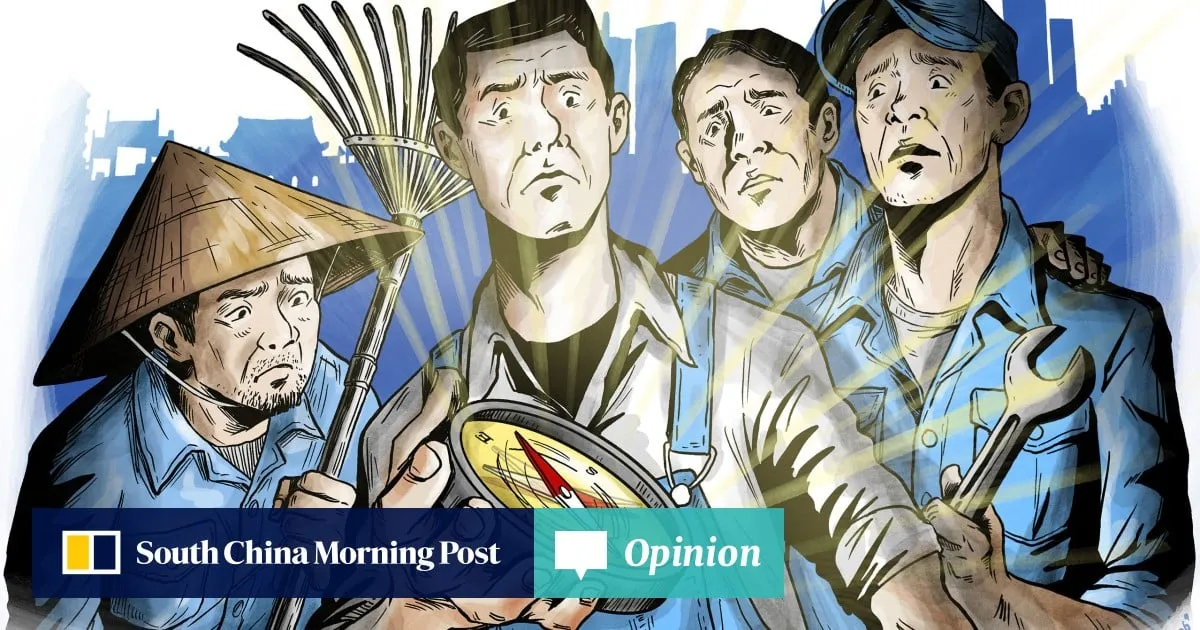
Zongshuai Fan is a senior policy analyst at Cambridge Industrial Innovation Policy, University of Cambridge, whose expertise spans manufacturing and intellectual property.China’s Politburo has just set the country’s economic priorities for the second half of the year. The meeting took place against the backdrop of gross domestic product growth slowing to 4.3 per cent in the second quarter, its weakest since late 2022, and an increasingly K-shaped economy: strong exports and fast-growing hi-tech industries on one side, with weak domestic consumption, softening investment and slower growth elsewhere on the other.The official readout did not describe the economy as K-shaped or echo the central bank’s language of structural divergence. Instead, it emphasised new growth momentum and an improving economic structure, while calling for faster infrastructure development, a deeper push of the AI Plus strategy, the expansion of emerging and future industries, and continued upgrading of traditional sectors.This reinforces an official narrative in which the divergence is interpreted as part of China’s transition from old growth drivers to new ones, with artificial intelligence and other advanced technologies expected to raise productivity across the economy.But this framing makes China’s productivity challenge look mainly technological. A more fundamental test lies in what happens to its more than 301 million migrant workers. Under the urban-rural household registration system, migrant workers remain registered as rural residents while taking up non-agricultural jobs. Where they go next will shape whether productivity gains reach beyond China’s most advanced sectors.China remains the world’s largest agricultural economy by output, about US$1.3 trillion last year. The sector employed 22 per cent of the workforce, while its labour productivity was only about one third of the economy-wide average.Reducing the concentration of low-productivity labour in agriculture is therefore central to Beijing’s ambition of becoming a “moderately developed” country by 2035. Doubling GDP per capita from its 2020 level will depend heavily on raising output per worker.
SRCSouth China Morning Post
LANGEN
LEANCenter-Right
WORDS312
ENT10
WED · 2026-08-05 · 01:30 GMTBRIEF NSR-2026-0805-99186
NSR-2026-0805-99186Analysis·EN·Economic Impact
China’s economic shift may hinge on what migrant workers do next
China's Politburo has outlined economic priorities for the second half of the year amidst slowing GDP growth and a K-shaped economy characterized by strong exports and high-tech sectors alongside weak domestic consumption. The government emphasizes new growth drivers like AI and advanced technologies, framing economic divergence as a transition from old to new growth models.
Zongshuai FanSouth China Morning PostFiled 2026-08-05 · 01:30 GMTLean · Center-RightRead · 2 min
South China Morning PostFIG 01
Reading time
2min
Word count
312words
Sources cited
1cited
Entities identified
10entities
Quality score
100%
§ 01
Briefing Summary
AI-generatedNEWSAR · AI
China's Politburo has outlined economic priorities for the second half of the year amidst slowing GDP growth and a K-shaped economy characterized by strong exports and high-tech sectors alongside weak domestic consumption. The government emphasizes new growth drivers like AI and advanced technologies, framing economic divergence as a transition from old to new growth models. However, a critical factor for future productivity gains, extending beyond advanced sectors, lies with China's over 301 million migrant workers. Their future employment decisions will significantly impact Beijing's goal of becoming a "moderately developed" country by 2035, as raising output per worker is crucial for doubling GDP per capita.
Confidence 0.90Sources 1Claims 4Entities 10
§ 02
Article analysis
Model · rule-basedFraming
Economic Impact
Political Strategy
Tone
Measured
AI-assessed
CalmNeutralAlarmist
Factuality
0.70 / 1.00
Factual
LowHigh
Sources cited
1
Limited
FewMany
§ 03
Key claims
4 extracted01
China's GDP growth slowed to 4.3% in Q2, its weakest since late 2022.
statistic
Confidence
1.00
02
Raising labor productivity in agriculture is crucial for China's goal of becoming a 'moderately developed' country by 2035.
factual
Confidence
0.90
03
China's economic transition hinges on the future actions of over 301 million migrant workers.
factual
Confidence
0.90
04
China's economy exhibits a K-shaped divergence: strong exports/hi-tech vs. weak domestic consumption/investment.
factual
Confidence
0.90
§ 04
Full report
2 min read · 312 words§ 05
Entities
10 identifiedKey playerOppositionContextPositiveNeutralNegative
Organizations3
§ 06
Keywords & salience
8 termsmigrant workers
1.00
economic shift
0.90
productivity challenge
0.80
economic priorities
0.70
k-shaped economy
0.60
agricultural economy
0.50
ai plus strategy
0.50
household registration system
0.40
§ 07
Topic connections
Interactive graph Network visualization showing 51 related topics
View Full Graph Person Organization Location Event|Click node to navigate|Edge numbers = shared articles