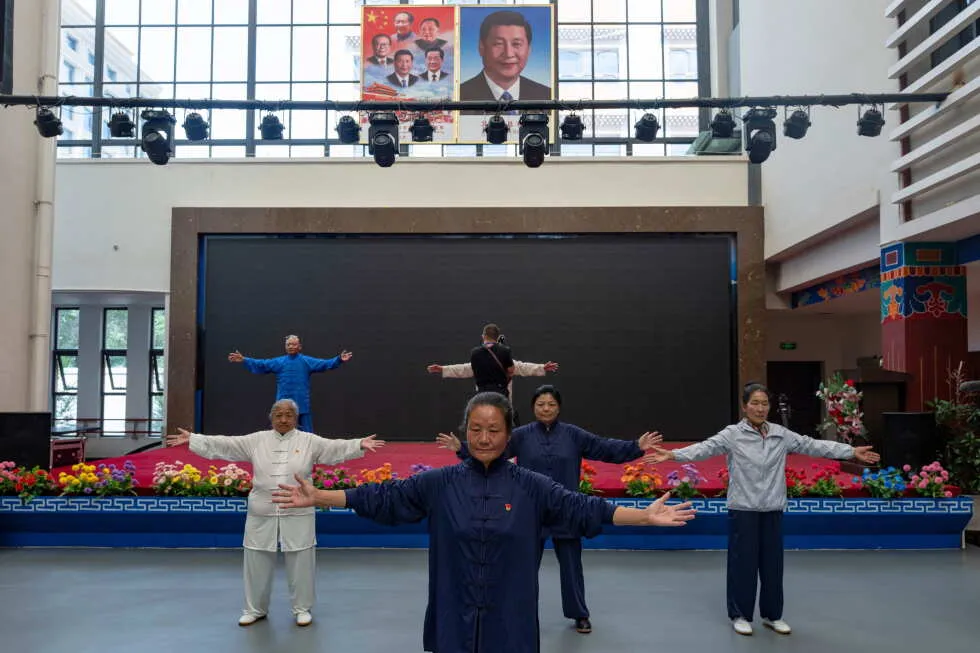
In Tibet, some embrace their native language even under China’s sweeping new ‘ethnic unity’ law 0 seconds of 1 minute, 32 secondsVolume 0% Press shift question mark to access a list of keyboard shortcuts Keyboard ShortcutsEnabledDisabled Shortcuts Open/Close/ or ? Play/PauseSPACE Increase Volume↑ Decrease Volume↓ Seek Forward→ Seek Backward← Captions On/Offc Fullscreen/Exit Fullscreenf Mute/Unmutem Decrease Caption Size- Increase Caption Size+ or = Seek %0-9 Next Up Tibetans protest in Mumbai against China's new 'ethnic unity' law 00:42 00:00 01:32 01:32 More Videos 00:42 Tibetans protest in Mumbai against China's new 'ethnic unity' law 01:04 AP top stories July 31 01:41 Business basics: Making sense of the government's economic reports 01:38 Some progressive Democrats foregrounding faith in inequality fight 00:54 AP explains questions Musk likely to face during SpaceX's first earnings call as a public company 02:06 Michigan Democrats weigh in on a high-stakes Senate primary test of progressive influence 01:25 Why we still want to scratch an itch even if we shouldn't 00:42 Protest outside Moroccan Embassy in Madrid after Ceuta crisis Close 1 of 6 | A 73-year-old retired nurse spoke her native Tibetan all her life but never learned to write it — until now. Her decision offers a glimpse into how some embrace their language and cultural identity in Tibet, a region that is autonomous but tightly controlled by Beijing. China’s new “ethnic unity” law mandates Mandarin as the primary language for schools and government. The AP last month joined a government-organized trip to Tibet. Government officials accompanied the foreign journalists throughout the visit, and AP journalists were not free to move around or conduct reporting independently. The AP retained full editorial control of its content.(AP video shot by Olivia Zhang) 2 of 6 | Elderly residents perform tai chi near the portrait of Chinese President Xi Jinping and other Chinese leaders at the Chengguan District Day Care Center for the Elderly in western China’s Tibet autonomous region on July 20, 2026, as seen during a government-organized visit for foreign journalists. (AP Photo/Ng Han Guan) 3 of 6 | Kalsang Lhamo, a 73-year-old retired nurse, practices Tibetan calligraphy at the Chengguan District Day Care Center for the Elderly in western China’s Tibet autonomous region on July 20, 2026, during a government-organized visit for foreign journalists.(AP Photo/Ng Han Guan) 4 of 6 | Qongqiu Quco, a 19-year-old student, sits with her relatives outside Jokhang Temple in Lhasa in western China’s Tibet autonomous region on July 21, 2026, during a government- organized visit for foreign journalists. (AP Photo/Ng Han Guan) 5 of 6 | A soldier walks on a public square where a Chinese national flag hangs in front of the Potala Palace in western China’s Tibet autonomous region on July 21, 2026, during a government-organized visit for foreign journalists.(AP Photo/Ng Han Guan) 6 of 6 | Tourists rest near a portrait of Chinese President Xi Jinping at a public square at the base of the Potala Palace in western China’s Tibet autonomous region on July 21, 2026, during a government-organized visit for foreign journalists. (AP Photo/Ng Han Guan) By E. EDUARDO CASTILLO Updated 3:04 AM MESZ, August 5, 2026 Add AP News on Google Add AP News as your preferred source to see more of our stories on Google. Share Share Facebook Copy Link copied Print Email X LinkedIn Bluesky Flipboard Pinterest Reddit LHASA, Tibet (AP) — Kalsang Lhamo traces a series of vertical strokes, slow but firm, practicing Tibetan calligraphy. A 73-year-old retired nurse, she has spoken Tibetan all her life but never learned to write it. Now, in classes at a center for older adults, she immerses herself in the script. Lhamo also speaks and writes Chinese, which China mandated as its primary language for schools and government agencies in a sweeping new “ethnic unity” law implemented July 1. Under the new regulations, acts deemed to incite division among China’s 56 ethnic groups are prohibited, and schools, families and other institutions are expected to foster patriotism, national unity and a strong sense of community for the Chinese nation. The law has been widely criticized as a way to further erode the rights of Tibetans and other minorities, and for the authority it gives Beijing to target activities it considers separatist, even outside China. The Chinese government has dismissed foreign criticism as “ideological bias.” In Tibet — a remote Himalayan region officially designated autonomous but tightly controlled by Beijing — the stakes are particularly high. This year, China is marking the 75th anniversary of what it calls the “peaceful liberation” of Xizang — the Chinese name for Tibet — an event many Tibetans in exile and other critics regard as an invasion. Some Tibetan activists say the new law represents more forced cultural assimilation and extended control over ethnic minorities. Rights groups say language policies have already been implemented in other minority regions, including expanded Mandarin education for Uyghurs in Xinjiang and the replacement of some Mongolian-language instruction with Mandarin in Inner Mongolia. How a 2,300-mile Walk for Peace thrust a Texas monk and his rescue dog into the spotlight 5 MIN READ 20 Germany has deported a Uyghur man to China, his mother says 1 MIN READ 12 UN human rights chief wins second term despite opposition from US, Israel and Russia 1 MIN READ 12 “Minority communities that seek to maintain their culture will be pushed toward a double life of public conformity and private reservations,” wrote James Leibold from La Trobe University and Tenzin Dorjee from the advocacy group Tibet Action Institute in Foreign Affairs magazine. The Associated Press last month joined a government-organized trip to Tibet, including stops in the regional capital, Lhasa, and the city of Shannan, where authorities arranged visits to palaces, Buddhist temples, tourist sites, local businesses and the eldercare center where Lhamo studies. Government officials accompanied the foreign journalists throughout the visit, and AP journalists were not free to move around or conduct reporting independently. The AP retained full editorial control of its content. Reminders that Tibet is part of China are everywhere, from Chinese airport welcome messages and billboards promoting ethnic unity to Chinese national flags and President Xi Jinping portraits in public squares and buildings. Some Tibetans, like Lhamo, have found ways to embrace their language and identity, even as critics say the new law pushes China’s majority Han culture. In Tibet, that can mean studying the Tibetan script, speaking it at home and with family members, preserving traditional weaving and attending Buddhist rituals. At these religious sites in Tibet, no signs or references to the Dalai Lama At the Jokhang Temple, one of Tibet’s holiest religious sites, Tibetans and Han Chinese visited. Some rested outside. Most people in Tibet practice Tibetan Buddhism. “As a Tibetan, I think it’s important to preserve our language and our culture,” said Qongqiu Quco, a 19-year-old student who came with her aunts, some of them Buddhist nuns. “Everyone in our ethnic group hopes that our culture can be passed down to future generations,” said Quco, an aspiring teacher who speaks Tibetan much of the time. But at school, she noted, students speak different Tibetan dialects, so they use Mandarin. For Tibetan Buddhists, the Dalai Lama is their spiritual leader. But at Jokhang Temple, there are no signs or references to the current Dalai Lama, who has lived in exile since fleeing to India after a failed 1959 uprising against Chinese rule. The succession of the 14th Dalai Lama, who established a government-in-exile unrecognized by Beijing, has become one of the most contentious issues surrounding Tibet. The Dalai Lama has said his successor could be born outside China and that only his office has the authority to recognize his reincarnation. Beijing says the selection must comply with Chinese law and receive government approval. China has long accused the Dalai Lama of promoting separatism. The Potala Palace, one of Tibet’s most revered sites and once the winter residence of the Dalai Lamas, also had no public reference to the current leader. Thousands visit daily — tourists from across China and local Buddhist believers who pray and leave offerings, including money. China’s unity law ‘codifies’ policy that’s already playing out, an expert says Benno Weiner, a professor and historian on modern China and Tibet at Carnegie Mellon University in Pittsburgh, said many effects of the policy shift have already been visible for years — particularly stripped-away education and language rights. “I don’t think the law itself changes things,” he said. “I think it sort of codifies and sort of summarizes a trend that’s been going on.” Beijing says the policies improve educational opportunities and ensure equal access for ethnic minorities. The same week as AP’s government-organized trip, China’s No. 4-ranked Communist Party leader, Wang Huning, toured Tibet, where he said the priority in governing the region was maintaining stability. He called for the implementation of the unity law and urged authorities to “guide Tibetan Buddhism to adapt to socialist society,” according to a report by state news agency Xinhua. On its trip, AP visited a traditional Tibetan medicine facility; artisan workshops and cultural centers with traditional crafts, including ceramic making and textile weaving; and a Tibetan opera performance, where workers and performers spoke about the importance of preserving local traditions. Weiner noted that the Chinese government’s approach to cultural preservation often emphasizes elements seen as less politically sensitive and suitable for tourism. “The parts of culture that they want to protect and maybe even enhance are the sort of anodyne or nondangerous clothing, certain celebrations that are not religious in many cases,” he said. “Things that maybe not that coincidentally also attract tourists.” At the Tibet Museum, an exhibit highlights Tibet’s historical links with Chinese dynasties over centuries, a narrative Beijing uses to argue that Tibet has long been part of China. Many Tibetans in exile dispute that, arguing that Tibet was independent for much of its history. Laba Ciren, the Communist Party’s official in charge of the museum, spoke to journalists about the new law. “It only brings benefits and does not have any negative effects,” he said. Billboards carry the law’s message: Promote integration Access to Tibet is tightly restricted for foreigners. But for those who do arrive, a first observation — after the thinner air, with Lhasa Gonggar International Airport at 3,600 meters (11,800 feet) elevation — might be the official welcome messages. Some signs are written in Chinese and Tibetan. But outside the terminal, a large sign, in Chinese, says simply: “Xizang welcomes you.” From highways to city streets in Lhasa and Shannan, billboards promoting ethnic unity are a constant presence. In part, one reads, in Mandarin and then Tibetan: “Forge a strong sense of community for the Chinese nation.” In Lhasa, Lhamo retired 22 years ago. With her children grown, she tries to make it to classes at the center every day — writing, grammar, poetry — in part because she wasn’t able to attend school as a child. “Our mother tongue is the Tibetan language,” she said proudly. Associated Press video producer Olivia Zhang contributed.
SRCAssociated Press (AP)
LANGEN
LEANCenter
WORDS1 837
ENT11
WED · 2026-08-05 · 01:23 GMTBRIEF NSR-2026-0805-99192
NSR-2026-0805-99192News Report·EN·Human Interest
In Tibet, some embrace their native language even under China’s sweeping new ‘ethnic unity’ law
China's new "ethnic unity" law, implemented July 1, mandates Mandarin as the primary language for schools and government in Tibet, aiming to foster patriotism and national unity. While critics view the law as a means to erode minority rights and promote cultural assimilation, some Tibetans, like 73-year-old Kalsang Lhamo, are actively embracing their native language by learning Tibetan calligraphy.
Associated Press (AP)Filed 2026-08-05 · 01:23 GMTLean · CenterRead · 8 min
Associated Press (AP)FIG 01
Reading time
8min
Word count
1 837words
Sources cited
0cited
Entities identified
11entities
Quality score
100%
§ 01
Briefing Summary
AI-generatedNEWSAR · AI
China's new "ethnic unity" law, implemented July 1, mandates Mandarin as the primary language for schools and government in Tibet, aiming to foster patriotism and national unity. While critics view the law as a means to erode minority rights and promote cultural assimilation, some Tibetans, like 73-year-old Kalsang Lhamo, are actively embracing their native language by learning Tibetan calligraphy. The law prohibits acts inciting division among ethnic groups and grants Beijing authority to target separatist activities. Despite tight control by Beijing, some Tibetans are finding ways to preserve their language and culture through private study and traditional practices. The article notes that access to Tibet for foreign journalists is restricted, with government officials accompanying them during a recent visit.
Confidence 0.90Claims 4Entities 11
§ 02
Article analysis
Model · rule-basedFraming
Human Interest
Social Justice
Tone
Measured
AI-assessed
CalmNeutralAlarmist
Factuality
0.70 / 1.00
Factual
LowHigh
Sources cited
0
No named sources
FewMany
§ 03
Key claims
4 extracted01
A 73-year-old retired nurse decided to learn to write her native Tibetan language.
factualarticle
Confidence
1.00
02
China's 'ethnic unity' law mandates Mandarin as the primary language for schools and government.
factual
Confidence
0.95
03
AP journalists were not free to move around or conduct reporting independently during a government-organized trip to Tibet.
factualAP
Confidence
0.90
04
Some Tibetans are embracing their native language despite China's new 'ethnic unity' law.
factual
Confidence
0.90
§ 04
Full report
8 min read · 1 837 words§ 05
Entities
11 identifiedKey playerOppositionContextPositiveNeutralNegative
Organizations2
Locations5
§ 06
Keywords & salience
8 termsethnic unity law
1.00
tibetan language
1.00
cultural identity
0.90
tibet
0.80
mandarin language
0.70
beijing control
0.60
language preservation
0.50
government-organized trip
0.40
§ 07
Topic connections
Interactive graph Network visualization showing 51 related topics
View Full Graph Person Organization Location Event|Click node to navigate|Edge numbers = shared articles