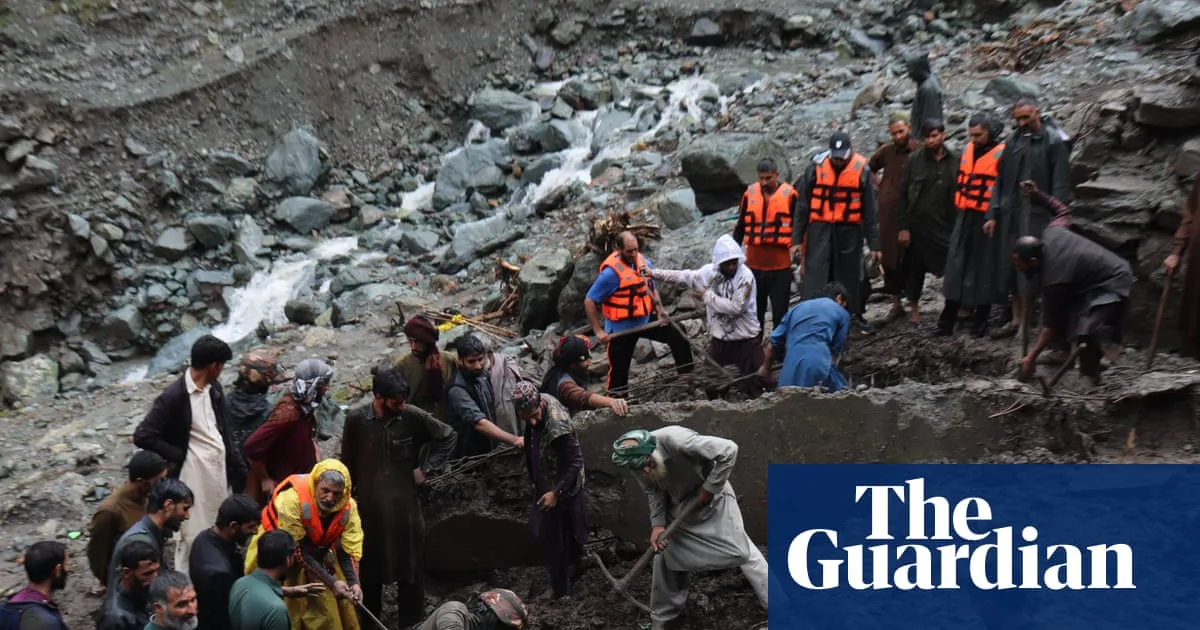
As rain lashed the Pir Panjal mountains before dawn on 19 July, Haji Mohammad Latief stepped outside his home in Murrah, a remote mountain village in Indian-administered Kashmir. His daughter had asked him to move the family’s car to a safer place as the rain got heavier.“I had only just parked it,” Latief recalled. “When I turned around, I saw the water coming.” Minutes later, a cloudburst sent mud, boulders and water crashing down the hillside.Latief, 48, had spent years building the house, where five generations of his Gujjar family lived together. Within minutes, the torrent swallowed it, trapping eight family members inside. He survived only because he had stepped outside. By dawn, everything he had built lay in rubble.When The Guardian reached Murrah four days later, electricity, roads and mobile networks were cut off. Floodwaters had washed away roads and footbridges, leaving the only way into the village a 90-minute walk through rain and landslide debris. Residents carried sacks of flour, cooking gas cylinders and medicines across the broken crossing.Murrah is perched high in the Pir Panjal range above the town of Bafliaz, in Poonch district, about 125 miles (200km) south-west of Srinagar, Kashmir’s main city. The village is home to mostly Gujjars, one of the largest pastoralist communities in the Himalayas, whose livelihoods have long depended on livestock, farming and seasonal migration through the mountains.The hillside remained too unstable for excavators to reach. Soldiers, disaster response teams and local volunteers searched the debris by hand while others combed the swollen Suran River for the missing.Rescue teams search for missing people in Murrah village after the cloudburst-triggered landslide. Photograph: Ishtayaq RasoolLatief now lives in the house of his brother, Mohd Bashir, just above the landslide. Inside, women gathered to mourn while men quietly received visitors offering condolences. Verses from the Qur’an echoed through the house.“I built that house for my family,” Latief said, holding up pictures of his 16-year-old son Sajjad Ahmed, an aspiring cricketer, whose body was still missing. Days before the disaster, the family recorded videos together.A photograph on a phone of 16-year-old Sajjad Ahmed, whose body remains missing Photograph: Ishtayaq RasoolAs mourners gathered, news spread that another body had been found several miles down the river; the room fell silent as another funeral procession passed through the village.Among those searching was Mohammad Razak, 45, who had spent four days combing the river with a team of volunteers. “We’ve been searching every bend of the river,” he said. “We’re still hoping we’ll find them.”Murrah was among the worst-hit places after a series of cloudbursts, flash floods and landslides swept Jammu and Kashmir this month, killing at least 28 people. Scientists say rising temperatures are increasing the likelihood of short, intense rainfall events across the western Himalayas. In steep mountainous terrain, these rains can trigger rapid flooding and landslides, putting remote communities at increased risk. For mountain communities, the climate crisis is also exacerbating longstanding geographical and social vulnerabilities.Women gather on a rooftop as the funeral procession of the fourth recovered victim arrives in Murrah village Photograph: Ishtayaq RasoolThe destruction stretched far beyond Murrah. About 30 miles away in Rajouri, the Manawar Tawi River burst its banks, washing away roads, dozens of vehicles and the town’s main Bela bus station.Low-lying settlements along the riverbank were submerged in mud and debris. Several houses collapsed across the Pir Panjal mountains, livestock were swept away and hundreds of families were displaced.About 180 miles north, in Gurez Valley near the line of control with Pakistan-administered Kashmir, residents say they are seeing the same pattern. A cloudburst in Achoora village on 20 July damaged the crops of 11 families and blocked the valley’s only road.Residents say increasingly erratic rainfall is disrupting farming and making traditional livelihoods more precarious. It followed a series of cloudbursts that hit Gurez and neighbouring Tulail over the past month, damaging homes, farmland, bridges, and roads.“People knew when the snow would come and when to plant crops,” said Aamir Asghar Khan, 26, a resident of Achoora. “Nothing seems predictable any more. The rain is getting more intense every year, and the frequent cloudbursts are threatening our livelihoods.”Heavy rainfall also triggered devastating floods and landslides in Ladakh and across the border in Pakistan-administered Gilgit-Baltistan, reinforcing concerns that increasingly erratic weather is affecting communities across the western Himalayas.The International Centre for Integrated Mountain Development (Icimod) said the western Himalayas were experiencing frequent bursts of intense rainfall capable of triggering floods, landslides and cloudbursts. Accelerating glacier melt is likely to increase flood risks in the short term before reducing water availability in coming decades.“The challenge our mountain communities face is twofold – too much water at times and too little at others,” an expert from Icimod said. “Adaptation requires work on both fronts, managing flood risk and water scarcity together.”ICIMOD said priorities included expanding community-based early warning systems, installing more weather stations in high-altitude areas, restoring damaged watersheds and designing roads and other infrastructure for future weather conditions rather than historical weather patterns.Lower Murrah village in Poonch district. Photograph: Ishtayaq RasoolDr Suheel Rasool Mir, a Kashmir-based sociologist who studies Indigenous communities in Jammu, Kashmir and Ladakh, said pastoral communities were among the first to bear the consequences of erratic weather as their livelihoods relied directly on forests, rivers, grazing lands and seasonal migration.“For Gujjar, Bakarwal and Dard-Shin communities, these disasters are not simply natural hazards,” he said. “As climate extremes become more frequent, they lose not only homes and livestock but also the ecological knowledge and ancestral livelihoods that have sustained them for generations.”For Latief back in Murrah, only one hope remained. “I just want to find them,” he said. “Then we can bury our family together.”
SRCThe Guardian - World News
LANGEN
LEANCenter-Left
WORDS945
ENT12
WED · 2026-08-05 · 04:00 GMTBRIEF NSR-2026-0805-99251
NSR-2026-0805-99251News Report·EN·Human Interest
‘I just want to find them’: deadly cloudbursts devastate Kashmir’s mountain communities
Deadly cloudbursts and landslides devastated mountain communities in Indian-administered Kashmir on July 19th, destroying homes and livelihoods. In Murrah village, a cloudburst swept away Haji Mohammad Latief's home, trapping eight family members, and killing at least 28 people across Jammu and Kashmir.
Ishtayaq Rasool in Indian-administered KashmirThe Guardian - World NewsFiled 2026-08-05 · 04:00 GMTLean · Center-LeftRead · 4 min
The Guardian - World NewsFIG 01
Reading time
4min
Word count
945words
Sources cited
2cited
Entities identified
12entities
Quality score
100%
§ 01
Briefing Summary
AI-generatedNEWSAR · AI
Deadly cloudbursts and landslides devastated mountain communities in Indian-administered Kashmir on July 19th, destroying homes and livelihoods. In Murrah village, a cloudburst swept away Haji Mohammad Latief's home, trapping eight family members, and killing at least 28 people across Jammu and Kashmir. These extreme weather events, linked to climate change and rising temperatures, are causing increasingly erratic rainfall in the western Himalayas, triggering floods and landslides. Remote communities, like the pastoralist Gujjars, are particularly vulnerable, facing loss of homes, crops, and livestock. Similar incidents have occurred in other areas of Kashmir and Ladakh, highlighting a growing regional threat to traditional livelihoods and safety.
Confidence 0.90Sources 2Claims 5Entities 12
§ 02
Article analysis
Model · rule-basedFraming
Human Interest
Environmental
Tone
Mixed Tone
AI-assessed
CalmNeutralAlarmist
Factuality
0.70 / 1.00
Factual
LowHigh
Sources cited
2
Limited
FewMany
§ 03
Key claims
5 extracted01
Cloudbursts, flash floods, and landslides swept Jammu and Kashmir this month, killing at least 28 people.
statistic
Confidence
1.00
02
Murrah village experienced a cutoff of electricity, roads, and mobile networks due to the cloudburst and subsequent flooding.
factual
Confidence
1.00
03
Haji Mohammad Latief's house, where eight family members lived, was swallowed by the torrent, trapping his family members inside.
quoteHaji Mohammad Latief
Confidence
1.00
04
A cloudburst sent mud, boulders, and water crashing down a hillside in Murrah, Indian-administered Kashmir, destroying homes and infrastructure.
factual
Confidence
1.00
05
Scientists state that rising temperatures are increasing the likelihood of short, intense rainfall events across the western Himalayas.
factualScientists
Confidence
0.90
§ 04
Full report
4 min read · 945 words§ 05
Entities
12 identifiedKey playerOppositionContextPositiveNeutralNegative
People4
Organizations1
Locations5
§ 06
Keywords & salience
10 termscloudbursts
1.00
kashmir
0.90
mountain communities
0.80
devastation
0.70
landslides
0.70
disaster response
0.60
pir panjal mountains
0.50
pastoralist communities
0.50
gujjar family
0.40
missing people
0.40
§ 07
Topic connections
Interactive graph No topic relationship data available yet. This graph will appear once topic relationships have been computed.