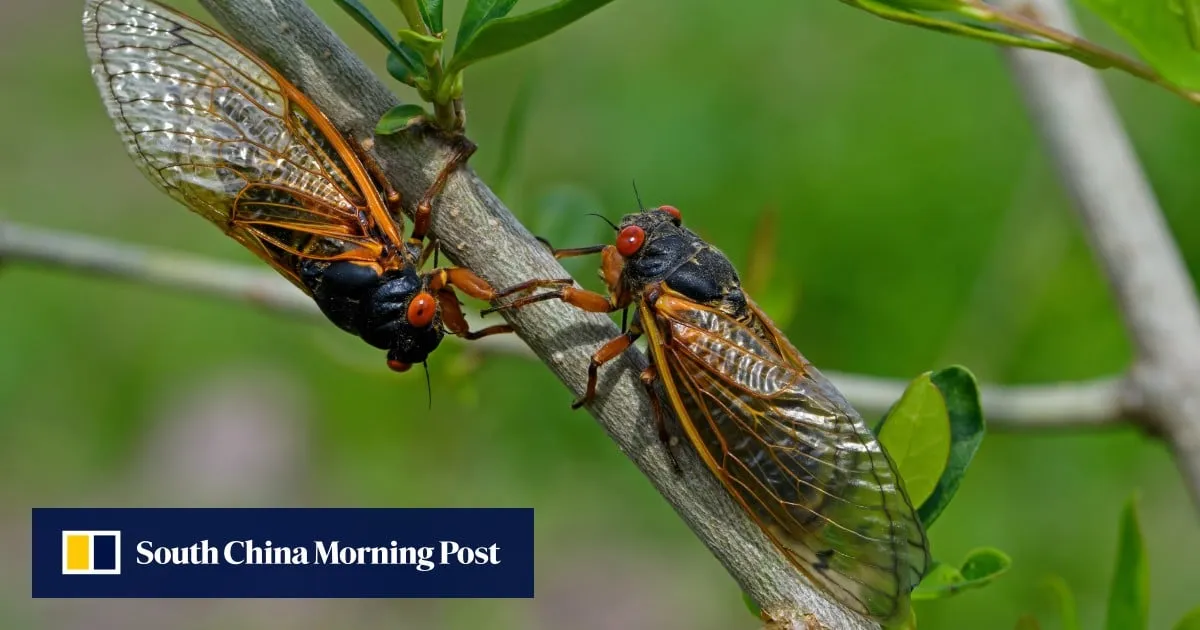
An 18-year-old boy in eastern China suffered temporary hearing impairment after being exposed to the droning of cicadas for several hours.This news garnered significant attention on social media, amassing 4.5 million views, as many believe that natural sounds are harmless to their health.According to Shandian News, the boy, identified by his surname Yang, lives in Ningbo, Zhejiang province, and went camping in a forest in early July.Around noon, he experienced intense cicada droning in the thick forests. Without any soundproofing equipment, Yang remained in this noisy environment for four hours.In the evening, he felt a sensation of fullness in his ears, which were swollen. He struggled to hear high-pitched sounds, such as birds singing or alerts from his mobile phone.Cicadas can be deceptive; while a single drone might seem relaxing, an entire swarm can be overwhelming and potentially lead to long-term hearing damage. Photo: Getty ImagesYang was later diagnosed with temporary hearing impairment due to noise exposure. His hearing returned to normal after receiving medical treatment and refraining from noise for 14 days, according to the report.Li Ji, a senior doctor in the otorhinolaryngology (Ear, Nose and Throat) department of Ningbo-university-no-1-affiliated-hospital" class="entity-link entity-organization" data-entity-id="178632" data-entity-type="organization">Ningbo University No 1 Affiliated Hospital, mentioned that they see numerous patients every summer affected by cicada droning.“Many people mistakenly believe that natural sounds are harmless to their ears,” Li stated in an interview.He explained that while a single cicada produces a sound measured at 70 decibels, which is not harmful to human ears, a chorus of cicadas can exceed 85 decibels – the threshold where noise-induced hearing damage begins.After the incident, the teenager was diagnosed with temporary hearing impairment due to noise exposure. Photo: Shutterstock“The hair cells in the cochlea can develop oedema due to the irritation from loud noises for a relatively short duration. They typically recover after avoiding the noisy environment and resting for 1-2 weeks,” Li said.“However, if the hair cells become necrotic, they cannot regenerate. The resulting hearing impairment is permanent and irreversible, forcing the patient to rely on hearing aids for auditory assistance,” he added.Li recounted the case of a 60-year-old gardener surnamed Liu, who has pruned trees every day from June to August for the past 12 years, exposing him to intense cicada droning for extended periods.Liu reported experiencing ringing in his ears and difficulty hearing women’s voices or conversations in lower tones.This news shocked many online, challenging the common belief that natural sounds are beneficial for health — in reality, they can pose risks. Photo: Getty ImagesLiu has developed permanent hearing impairment from noise exposure, according to Li.Further ReadingThe story sparked a frenzy on mainland social media.“My God! I’ve learned something new. I thought being immersed in the forest and surrounded by chirping cicadas was refreshing, but it turns out to be a health risk,” commented one online observer.Another chimed in humorously: “Now I understand why many elderly residents in rural areas tend to be deaf.”
SRCSouth China Morning Post
LANGEN
LEANCenter-Right
WORDS484
ENT10
WED · 2026-08-05 · 06:00 GMTBRIEF NSR-2026-0805-99269
NSR-2026-0805-99269News Report·EN·Public Health
Chinese student suffers temporary hearing loss after 4 hours of cicada noise while camping
An 18-year-old boy in Ningbo, Zhejiang province, China, experienced temporary hearing impairment after camping for four hours in a forest with intense cicada droning. The incident, which gained significant social media attention, highlights the potential risks of prolonged exposure to loud natural sounds.
Alice YanSouth China Morning PostFiled 2026-08-05 · 06:00 GMTLean · Center-RightRead · 2 min
South China Morning PostFIG 01
Reading time
2min
Word count
484words
Sources cited
2cited
Entities identified
10entities
Quality score
100%
§ 01
Briefing Summary
AI-generatedNEWSAR · AI
An 18-year-old boy in Ningbo, Zhejiang province, China, experienced temporary hearing impairment after camping for four hours in a forest with intense cicada droning. The incident, which gained significant social media attention, highlights the potential risks of prolonged exposure to loud natural sounds. Doctors explained that while a single cicada's sound is not harmful, a chorus can exceed 85 decibels, the threshold for noise-induced hearing damage. The boy's hearing returned to normal after medical treatment and a two-week period of avoiding noise. This case serves as a reminder that natural sounds, when excessively loud, can pose a risk to hearing health, unlike the common belief that they are always harmless.
Confidence 0.90Sources 2Claims 5Entities 10
§ 02
Article analysis
Model · rule-basedFraming
Public Health
Human Interest
Tone
Mixed Tone
AI-assessed
CalmNeutralAlarmist
Factuality
0.80 / 1.00
Factual
LowHigh
Sources cited
2
Limited
FewMany
§ 03
Key claims
5 extracted01
Many people mistakenly believe natural sounds are harmless to their ears.
factualLi Ji (Senior Doctor)
Confidence
1.00
02
A 60-year-old gardener developed permanent hearing impairment due to prolonged exposure to cicada droning.
factualLi Ji (Senior Doctor)
Confidence
1.00
03
Temporary hearing impairment from loud noise can recover if hair cells in the cochlea avoid irritation and rest for 1-2 weeks.
factualLi Ji (Senior Doctor)
Confidence
1.00
04
A chorus of cicadas can exceed 85 decibels, the threshold for noise-induced hearing damage.
factualLi Ji (Senior Doctor)
Confidence
1.00
05
An 18-year-old boy suffered temporary hearing impairment after 4 hours of intense cicada noise while camping.
factualShandian News
Confidence
1.00
§ 04
Full report
2 min read · 484 words§ 05
Entities
10 identifiedKey playerOppositionContextPositiveNeutralNegative
Organizations2
§ 06
Keywords & salience
8 termshearing impairment
1.00
cicada noise
1.00
noise exposure
0.90
temporary hearing loss
0.80
decibels
0.70
cochlea hair cells
0.60
natural sounds
0.50
medical treatment
0.40
§ 07
Topic connections
Interactive graph No topic relationship data available yet. This graph will appear once topic relationships have been computed.