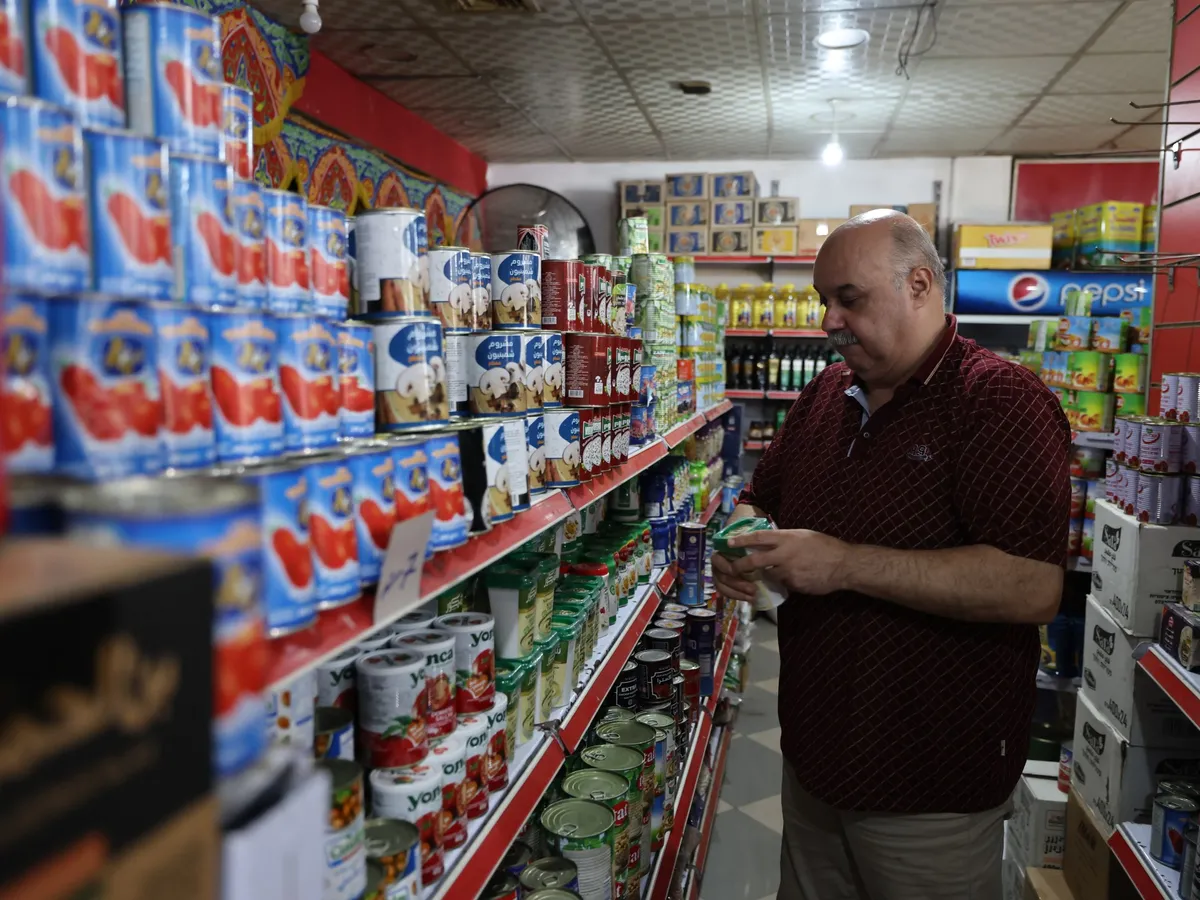
Displaced Palestinians in Gaza struggle daily to afford food, with soaring prices and limited income opportunities.The aisles in Maher al-Khudari's store are fully stocked, but most Palestinians in Gaza can't afford to buy [Omar Al-Shtaywi/Al Jazeera]Published On 5 Aug 2026Gaza City, Gaza Strip – Every day is a struggle for Ghadeer Nassar, as she struggles to provide for her seven children.They live together in a small classroom in Remal Model School, alongside other displaced Palestinians.Recommended Stories list of 3 itemslist 1 of 3Tech giant Palantir posts ‘otherworldly’ growth despite criticism over Gazalist 2 of 3Gaza holds mass funeral for 112 people killed in Israel’s 2023 Sabra attacklist 3 of 3Seventh round of Israel-Lebanon talks begins – what’s on the agenda?end of listSome goods have returned to Gaza’s markets, after months of shortages driven by Israel’s blockade on the territory, running alongside its genocidal war. But the challenge now for families like Nassar’s is finding the money to buy those goods.Nassar’s husband has no stable source of income, even before the war, which began in October 2023. Instead, he depends on temporary work opportunities that provide the family – their children range in age from 14 years to nine months – with little financial stability.“He used to do whatever work was available,” said Nassar. “On some days he would earn no more than seven or 10 shekels ($2.27 or $3.25).”Ghadeer has been forced to turn to options she never thought imaginable, like selling her wedding ring and her husband’s phone so she could provide for her children.And when money is simply unavailable, she turns to bartering. Once, Nassar said, she exchanged one kilogramme of rice for four kilogrammes of lentils – the latter could feed her family for longer.“I try to make whatever food we have last as long as possible,” she said. “I don’t buy what I want, I buy what I can afford.”Ghadeer Nassar sits and eats with her children in Gaza City [Omar Al-Shtaywi/Al Jazeera]Only the necessitiesMaher al-Khudari, a shop owner in Gaza City, says that purchasing patterns have changed dramatically compared with before the war.Although larger quantities of goods are now available, prices remain high due to shortages and the cost of bringing in and transporting products, while most residents have exhausted their savings and lost their jobs.Shop owners themselves face a daily dilemma: customers need food, but many can no longer afford to pay for it. Al-Khudari says some people ask to buy necessities on credit, but that puts him in a predicament.“People come wanting to buy on credit, but their circumstances are difficult. I am also someone trying to make a living, and if I give everyone who needs help credit, I will lose everything, because all of Gaza is in need,” he explained.Al-Khudari has noticed that those who are buying from him aren’t buying what they used to: the person who would buy a kilogramme of vegetables now purchases a few pieces, while things like sweets have become luxuries.“The problem is that people do not even have the minimum amount of money to secure a piece of bread,” he said.Maher al-Khudari says that a lot of customers in Gaza try to buy goods with credit [Omar Al-Shtaywi/Al Jazeera]Economic collapseAccording to the United Nations, food insecurity remains high in Gaza. The World Food Programme notes that while the entry of commercial and humanitarian supplies has increased in the last two months, the number of households reporting that they were finding it difficult to buy goods from markets because of unaffordability had also increased.With Israel unwilling to allow reconstruction to properly commence in Gaza, and the Palestinian enclave’s economy to rebound, the current situation is likely to continue. That forces the territory’s population, the majority of them displaced, to be reliant on food aid.The scale of the economic collapse caused by the war is reflected in the numbers. The latest UN market data indicates that the food consumer price index is 102 percent higher than pre-war levels.Palestinian economic expert Mohammed Abu Jiab said that one of the biggest challenges facing the Gaza economy was a shortage of cash liquidity.Abu Jiab explained that the availability of goods in markets in Gaza is not evidence of genuine economic activity, because purchasing power has sharply declined in the wake of thousands of families losing their jobs and savings as a result of the war. Instead, they have become dependent on aid or temporary sources of income.The expert added that simply populating the markets with goods is not enough for the economy to recover. Instead, more income and job opportunities need to be created, allowing people to earn money that they can then spend on purchasing goods.That is unlikely to happen without real long-term stability in Gaza, something that Israel appears unwilling to allow.And so, for Palestinians like Ghadeer, every decision at the store is a difficult one, and she is forced to only buy what she urgently needs.Her three-year-old daughter, Sham, newly out of hospital after being treated for a broken leg, wanted an orange recently. Nassar’s husband couldn’t afford to buy one, but taking pity on Sham after hearing her pleading, the shopkeeper gave her one for free.“There are many times when I cannot find anything to feed my children,” Nassar said. “I boil water with vegetable powder and they drink it without any vegetables or meat.”“My biggest fear is that these may be my best days,” she added, “and that the worst is yet to come.”
SRCAl Jazeera
LANGEN
LEANCenter
WORDS909
ENT11
WED · 2026-08-05 · 05:46 GMTBRIEF NSR-2026-0805-99284
NSR-2026-0805-99284News Report·EN·Economic Impact
Return of goods to markets in Gaza doesn’t mean people can afford them
Despite the return of goods to markets in Gaza, displaced Palestinians are struggling to afford them due to soaring prices and limited income opportunities. Families like Ghadeer Nassar's are forced to make difficult choices, selling possessions and bartering to secure basic necessities.
Lina Ghassan Abu ZayedAl JazeeraFiled 2026-08-05 · 05:46 GMTLean · CenterRead · 4 min
Al JazeeraFIG 01
Reading time
4min
Word count
909words
Sources cited
2cited
Entities identified
11entities
Quality score
100%
§ 01
Briefing Summary
AI-generatedNEWSAR · AI
Despite the return of goods to markets in Gaza, displaced Palestinians are struggling to afford them due to soaring prices and limited income opportunities. Families like Ghadeer Nassar's are forced to make difficult choices, selling possessions and bartering to secure basic necessities. Shop owners report a significant shift in purchasing patterns, with customers buying fewer items and relying on credit, which they often cannot provide. Economic experts state that the increased availability of goods does not reflect genuine economic activity, as purchasing power has drastically declined due to job and savings losses from the war. The situation is exacerbated by a lack of cash liquidity and the ongoing inability to reconstruct Gaza's economy, leaving the population dependent on food aid.
Confidence 0.90Sources 2Claims 5Entities 11
§ 02
Article analysis
Model · rule-basedFraming
Economic Impact
Human Interest
Tone
Measured
AI-assessed
CalmNeutralAlarmist
Factuality
0.60 / 1.00
Mixed
LowHigh
Sources cited
2
Limited
FewMany
§ 03
Key claims
5 extracted01
Shop owner Maher al-Khudari notes customers are buying fewer items and asking for credit due to financial hardship.
quoteMaher al-Khudari
Confidence
1.00
02
Ghadeer Nassar has resorted to selling personal items and bartering to provide food for her seven children.
quoteGhadeer Nassar
Confidence
1.00
03
Some goods have returned to Gaza's markets after months of shortages, but families struggle to afford them.
factual
Confidence
0.90
04
Displaced Palestinians in Gaza struggle daily to afford food due to soaring prices and limited income opportunities.
factual
Confidence
0.90
05
Prices remain high in Gaza's markets due to shortages and increased transportation costs.
factual
Confidence
0.80
§ 04
Full report
4 min read · 909 words§ 05
Entities
11 identifiedKey playerOppositionContextPositiveNeutralNegative
Organizations2
Locations4
Topics1
§ 06
Keywords & salience
9 termsgaza
1.00
affordability crisis
0.90
food prices
0.80
displaced palestinians
0.80
limited income
0.70
economic hardship
0.70
market shortages
0.60
israeli blockade
0.50
bartering
0.40
§ 07
Topic connections
Interactive graph Network visualization showing 51 related topics
View Full Graph Person Organization Location Event|Click node to navigate|Edge numbers = shared articles