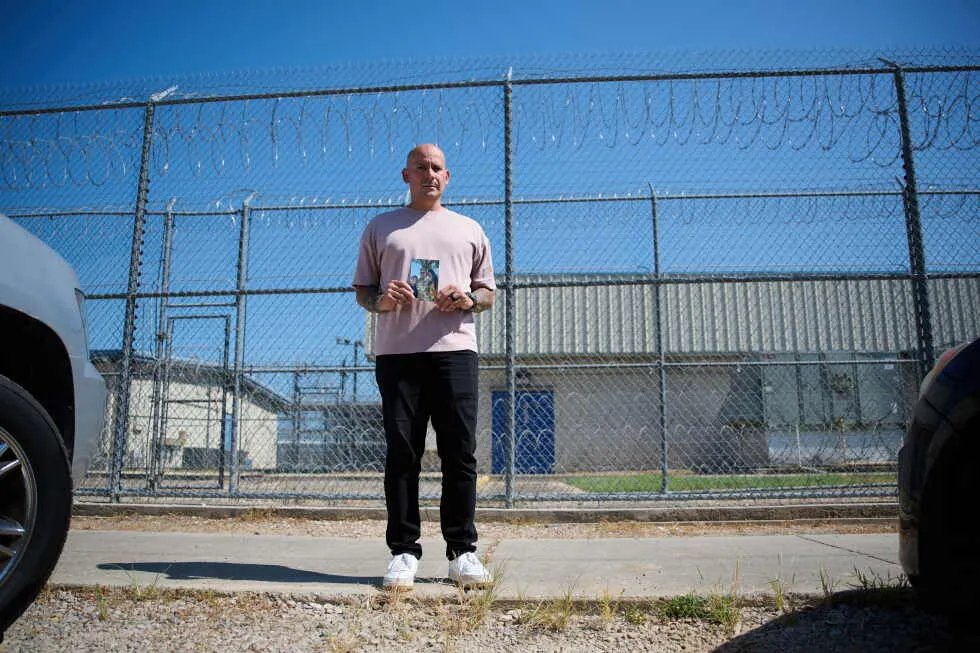
AP Exclusive: Trump’s Immigration Crackdown has detained more than 50 military spouses and parents 0 seconds of 2 minutes, 40 secondsVolume 0% Press shift question mark to access a list of keyboard shortcuts Keyboard ShortcutsEnabledDisabled Shortcuts Open/Close/ or ? Play/PauseSPACE Increase Volume↑ Decrease Volume↓ Seek Forward→ Seek Backward← Captions On/Offc Fullscreen/Exit Fullscreenf Mute/Unmutem Decrease Caption Size- Increase Caption Size+ or = Seek %0-9 Next Up Wildfires force George Clooney's family to evacuate their home in southern France 00:49 00:00 02:40 02:40 More Videos 00:49 Wildfires force George Clooney's family to evacuate their home in southern France 00:44 John Carpenter's 'Cathedral' album and graphic novel are a family project 00:34 Bosnia faces extreme heat and drought conditions 00:40 Trump says he will order halt to Iran strikes after parameters reached for deal to end war 00:55 Families search for loved ones after deadly migrant crossing from Morocco to Spain 01:27 Trump says US could see surge of migrants like Spain if Republicans don't win midterms 00:54 AP explains questions Musk likely to face during SpaceX's first earnings call as a public company 01:33 Trump discusses Europe's migration crisis and UK energy policy Close 1 of 6 | The Trump administration’s expanded immigration enforcement has led to the detention of dozens of spouses and parents of active-duty U.S. service members after ending protections previously available to Military Families. 2 of 6 | Army Staff Sgt. Alexis Jaramillo poses with a photo of his wife, Maisa Lopes Eliaser, a Brazilian national who is being detained by ICE, before visiting her at the South Louisiana ICE Processing Center in Basile, La., Sunday, Aug. 2, 2026. (AP Photo/Joseph Vidrine) 3 of 6 | Army Sgt. Hedar Leonel Turcios Juarez, whose wife Cristy has been detained by immigration authorities, poses for a photo at home in El Paso, Texas, July 21, 2026. (AP Photo/Ryan Romero) 4 of 6 | Army Staff Sgt. Alexis Jaramillo visits his wife, Maisa Lopes Eliaser, a Brazilian national who is being detained by ICE, at the South Louisiana ICE Processing Center in Basile, La., Sunday, Aug. 2, 2026. (AP Photo/Joseph Vidrine) 5 of 6 | Army Sgt. Hedar Leonel Turcios Juarez, whose wife Cristy has been detained by immigration authorities, holds a necklace he gave to her at home in El Paso, Texas, July 21, 2026. (AP Photo/Ryan Romero) 6 of 6 | Army Staff Sgt. Alexis Jaramillo walks to the entrance of the South Louisiana ICE Processing Center to visit his wife, Maisa Lopes Eliaser, a Brazilian national who is being detained by ICE, in Basile, La., Sunday, Aug. 2, 2026. (AP Photo/Joseph Vidrine) By JACK BROOK, SAFIYAH RIDDLE and AARON KESSLER Updated 1:09 PM MESZ, August 5, 2026 Leer en español Add AP News on Google Add AP News as your preferred source to see more of our stories on Google. Share Share Facebook Copy Link copied Print Email X LinkedIn Bluesky Flipboard Pinterest Reddit President Donald Trump’s administration has detained dozens of parents and spouses of active-duty U.S. troops as it rolls back immigration protections for Military Families to pursue its mass deportation agenda, an Associated Press investigation found. More than 50 parents and spouses of active-duty service members have been detained since Trump took office for a second term, and at least six have been deported, the AP found in the first accounting of such detentions, which the government does not track. At least eight immediate family members of U.S. service members remain in federal immigration custody. Parents and spouses of people in the military have generally been shielded from deportation under bipartisan consensus for decades. But the AP found they’re now routinely being detained for months as they try to adjust their legal status through the policies available to service members’ close relatives and even as the military continues to recruit by advertising immigration benefits for enlistees’ families. Experts warn that the reversal could undermine military preparedness even as the U.S. is at war in Iran. It’s left military members without emotional support and caretakers for their children, delayed deployments and forced some to take leave. Army Sgt. Hedar Leonel Turcios Juarez, whose wife Cristy has been detained by immigration authorities, poses for a photo at home in El Paso, Texas, July 21, 2026. (AP Photo/Ryan Romero) “How can I even focus on my military career because I have to worry about how my wife is doing?” said Army Sgt. Hedar Leonel Turcios Juarez, who was stationed in Fort Bliss, Texas, when his wife was detained outside a Walmart in front of their 6-year-old daughter in July. A handful of detentions of service members’ spouses have prompted public backlash and led to intervention by Homeland Security Secretary Markwayne Mullin to secure their release. Takeaways from AP’s review of Military Families detained under Trump’s Immigration Crackdown 5 MIN READ Lawsuit says US illegally shared confidential information on Iranian asylum seekers with Iran 3 MIN READ Maine shooting and officer’s background raise new questions about ICE’s rapid hiring 3 MIN READ The Department of Homeland Security has said it does not compile data on these cases. The AP obtained information by analyzing thousands of federal court records compiled by Habeas Dockets, a project run by the Immigration Justice Transparency Initiative; by reviewing existing media coverage; and by verifying information with family members and attorneys. The actual number is likely much higher than the 51 cases AP found. The AP asked for comment from DHS on each case, including the individuals’ immigration and criminal history. The agency did not provide specific information about the majority of cases but noted that at least seven people had been removed from the U.S. before, at least eight had removal orders and at least two had drunken driving or drug-related convictions. “DHS and ICE value the contributions of all those who have served in the U.S. military,” DHS said in a statement. “U.S. military service alone does not automatically grant lawful immigration status, or exempt aliens from the consequences of violating U.S. immigration laws.” The Pentagon declined to comment on the AP’s findings. Air Force Tech. Sgt. Wendy Gbeve, 30, said she hasn’t had a good night’s sleep since her father, Luis Alberto Ramirez Zavala, was detained by immigration officials last month. Gbeve was there when he was arrested at a routine interview with U.S. Citizenship and Immigration Services in Missouri about his pending application for legal status. She spent hours refreshing the USCIS page to track where the government was taking her father: from a county jail in Missouri to an Immigration and Customs Enforcement detention facility in Texas. Finally, roughly two weeks after he was detained, she found out he had been deported to his native Mexico. “It’s the most frustrating, helpless feeling,” Gbeve said. Have a news tip? Tell our investigators AP’s global investigative team accepts tips securely and confidentially. Choose the method that works best for you. Email investigative@ap.org Signal +1 (202) 281-8604 Secure and confidential Gbeve said ICE still hasn’t informed her family why her father was removed so quickly. Ramirez Zavala spent most of his life in the U.S. working as a ranch hand in rural Illinois. Ramirez Zavala’s wife of 30 years, a legal permanent resident, is considering returning to Mexico to be with her husband. For Gbeve, whose husband is also in the Air Force, that would leave no one to watch their children, ages 2 and 4, if both were deployed. Military members have had to take leave or delay a deployment Some service members have been left caring for children alone. Army Staff Sgt. Alexis Jaramillo, an aviation operations specialist who has served for more than a decade, said he would normally be involved in training soldiers at Fort Polk, Louisiana. Instead, he is on administrative leave, caring for his 5-year-old stepson, Noah, after his Brazilian wife, Maisa Lopes Eliaser, was detained in early July. It happened during what the family thought was a routine appointment at a USCIS office in Alabama. Eliaser arrived in the U.S. on a tourist visa in 2019, and the couple was trying to change her status. Army Staff Sgt. Alexis Jaramillo visits his wife, Maisa Lopes Eliaser, a Brazilian national who is being detained by ICE, at the South Louisiana ICE Processing Center in Basile, La., Sunday, Aug. 2, 2026. (AP Photo/Joseph Vidrine) Immigration officials asked Jaramillo and his stepson to leave the room. Minutes later, they were told that Eliaser had been detained. The next time they saw her was inside a detention facility. “It is really overwhelming because I need to take care of my kid by myself. No one is here to help me out,” Jaramillo said. At least one active-duty soldier halted her imminent deployment after her husband was detained by immigration officers, leaving no one to care for their then-5-year-old son, court records show. A judge eventually ordered the husband released. Trump’s policy is a reversal even from his first administration A new policy, implemented in April 2025, states that “military service alone does not exempt aliens from the consequences of violating U.S. immigration laws.” Experts in military immigration law said this marks a stark shift from previous administrations across the political spectrum, including Trump’s first administration. Dan Gividen, who served as ICE’s deputy chief counsel from 2016 to 2019 under Trump, represents a soldier’s father who has been in ICE custody for more than eight months. He said that during his time as an ICE prosecutor, immigration authorities rarely detained service members’ immediate family members unless they had committed violent crimes. “We would not place them into removal proceedings, period. That’s insane,” Gividen said. “The fact that they’re doing it now is just outrageous.” ICE previously generally canceled past removal orders and allowed parents or spouses of troops to adjust their legal status, said Margaret Stock, an immigration attorney and retired lieutenant colonel in the Army Reserve. She said that’s because the government wanted to ensure troops focused on their duties. “It’s the same thing that happens if you don’t provide healthcare to the troops, or you don’t provide housing to the troops,” she said. If soldiers are preoccupied with detained or deported family, “they’re not concentrating on their job anymore.” Even some congressional Republicans who are otherwise largely supportive of Trump’s aggressive Immigration Crackdown have pushed for the release of service members’ relatives. “The immigration system is failing the honorable and good Americans,” Florida Republican Rep. Maria Elvira Salazar said at a news conference in July advocating for the release of the wife of retired Staff Sgt. Wilmer Trujillo, who served in Iraq and Afghanistan. DHS said she illegally reentered the U.S. after being deported in 2005. Although DHS said it does not have data on active-duty troops, it has released figures for former service members, who also qualify for immigration benefits along with their immediate families. From Jan. 20, 2025, through Jan. 26, 2026, immigration authorities detained 125 military veterans — placing 34 into removal proceedings — and arrested more than 150 immediate family members, DHS said in a letter to several Democratic senators. Anh Dung Cong Tran, known as “Tony,” had both a father and son who served in the military. Tran came to the U.S. in 1990 through a program for children of American military personnel born in Vietnam. Tran, 56, was deported in July, having lived in the U.S. for decades with regular check-ins with immigration authorities after an assault conviction soon after his arrival. His son Antonio Tran said his father persuaded him to enlist in the military in 2022. “He has a totally different view on America now,” said Tran, who was discharged as an Army specialist in March after a serious injury. Benefits for service members include what’s known as parole-in-place Military recruiters tout immigration benefits for troops’ families as a selling point to enlist. One of the military’s most highly advertised immigration benefits is “military parole-in-place,” which allows the spouses, children and parents of active-duty service members and veterans to obtain legal immigration status from within the country. Not everyone qualifies: Those who overstayed visas or who already applied for legal status at the border, for example. Army Sgt. Hedar Leonel Turcios Juarez, whose wife Cristy has been detained by immigration authorities, holds a necklace he gave to her at home in El Paso, Texas, July 21, 2026. (AP Photo/Ryan Romero) The policy was implemented under Republican President George W. Bush during the U.S. war with Iraq in 2007 and codified under Democratic President Barack Obama. DHS agencies can grant it on a case-by-case basis. Under Trump, the average time it takes to receive military parole-in-place has more than doubled to 12 months, according to USCIS data. That leaves Military Families more vulnerable to being placed in ICE custody. Recruiters are still promoting immigration benefits The AP found that troops’ immediate family members have repeatedly been detained by ICE while applying for parole-in-place or seeking to adjust their status, including during immigration appointments. Marine Cpl. Jose Manuel Vilchis-Valle’s mother, Ursula Borja Valle, was detained at an appointment in August 2025 and deported to Mexico within a week. She had lived in the U.S. since the 1990s without a known criminal record. Her son was attempting to help her clear up a decades-old removal order through the immigration benefits that military recruiters had used to help convince him to enlist. “They basically told me that if you serve, and if you served honorably, you can help your parents,” said Vilchis-Valle, 23, who was honorably discharged shortly after his mother was deported. “In a perfect world, I wished, because of my service, they could have pardoned her.” In other cases, ICE has detained people who had already been granted protection, with the agency later arguing in court filings that their parole status had been revoked. In June 2025, the Marine Corps officially stopped advertising enlistment as a way to protect immigrant family members, in response to inquiries from the AP. But recruiters for the Army and the National Guard still promote it. “For some service members, enlisting isn’t just about serving their country,” read an Instagram post published in late July by an official Army recruiter based in California. “It’s also about doing everything they can to help protect their parents who sacrificed everything for them.” Recruiters are expected to highlight the benefits of service to attract applicants and military parole-in-place remains in effect, Army spokesperson Christopher Surridge said. The National Guard said it does not track detentions of its troops’ relatives or which recruiters advertise immigration benefits and referred additional comment to DHS. A soldier who helped patrol the border grapples with his father’s detention For U.S. Army Specialist Romero Ralios, his father’s detention has left him remorseful about his deployment last year to the Joint Task Force Southern Border, where he spent nine months supporting U.S. Customs and Border Patrol. His father, Sebastian Ralios Tino, a Guatemalan landscaper with no known criminal record, was detained this summer. He lived in the U.S. for nearly two decades without legal status. Ralios’ commanding officer, Capt. Mohamed Elmaola, told the AP he wanted to speak up because Ralios is a “phenomenal soldier” whose father should receive due process. “It’s very hard to communicate and to have credibility as a leader when your own subordinates are unable to get support,” Elmaola said. “Considering he enlisted his time and his life into supporting and defending the United States Constitution, it is the right thing to do to support soldiers and their families.” Romero Ralios now struggles to sleep at night due to the stress and wishes he had not been involved in immigration enforcement, even though he was just following orders. “It was karma. I should’ve known,” Ralios told the AP. “All those families I broke. I have regrets.” Brook is a corps member for The Associated Press/Report for America Statehouse News Initiative. Report for America is a nonprofit national service program that places journalists in local newsrooms to report on undercovered issues. JACK BROOK Based in New Orleans, Brook covers Louisiana with a focus on state government, environmental issues and infrastructure. He is a Report for America corps member and can be reached on the secure messaging app Signal at jackbrook.88 twitter instagram mailto SAFIYAH RIDDLE Riddle is a national law enforcement reporter based in Los Angeles, California. mailto AARON KESSLER Kessler is a data scientist specializing in investigative reporting and data analysis at the intersection of business and politics. He is based in Washington, D.C. mailto
SRCAssociated Press (AP)
LANGEN
LEANCenter
WORDS2 751
ENT12
WED · 2026-08-05 · 11:23 GMTBRIEF NSR-2026-0805-99355
NSR-2026-0805-99355News Report·EN·Human Interest
AP Exclusive: Trump’s immigration crackdown has detained more than 50 military spouses and parents
An Associated Press investigation found that the Trump administration has detained over 50 spouses and parents of active-duty U.S. service members as part of its immigration crackdown.
Associated Press (AP)Filed 2026-08-05 · 11:23 GMTLean · CenterRead · 12 min
Associated Press (AP)FIG 01
Reading time
12min
Word count
2 751words
Sources cited
0cited
Entities identified
12entities
Quality score
100%
§ 01
Briefing Summary
AI-generatedNEWSAR · AI
An Associated Press investigation found that the Trump administration has detained over 50 spouses and parents of active-duty U.S. service members as part of its immigration crackdown. This marks a significant departure from decades of bipartisan consensus that generally shielded military families from deportation. At least eight immediate family members remain in federal immigration custody, and six have been deported. The government does not track these detentions, but the AP's analysis of court records indicates the actual number is likely higher. Experts warn this policy reversal could negatively impact military readiness by disrupting service members' focus and support systems. The Department of Homeland Security stated that military service does not exempt individuals from immigration law violations.
Confidence 0.90Claims 4Entities 12
§ 02
Article analysis
Model · rule-basedFraming
Human Interest
Social Justice
Tone
Mixed Tone
AI-assessed
CalmNeutralAlarmist
Factuality
0.80 / 1.00
Factual
LowHigh
Sources cited
0
No named sources
FewMany
§ 03
Key claims
4 extracted01
Army Sgt. Hedar Leonel Turcios Juarez's wife Cristy has been detained by immigration authorities.
factualAP
Confidence
0.95
02
Army Staff Sgt. Alexis Jaramillo's wife, Maisa Lopes Eliaser, a Brazilian national, is being detained by ICE.
factualAP
Confidence
0.95
03
The Trump administration ended protections previously available to military families.
factualAP
Confidence
0.90
04
Trump's immigration crackdown has detained more than 50 military spouses and parents.
factualAP
Confidence
0.90
§ 04
Full report
12 min read · 2 751 words§ 05
Entities
12 identifiedKey playerOppositionContextPositiveNeutralNegative
People5
Organizations1
Locations4
§ 06
Keywords & salience
8 termsimmigration crackdown
1.00
military families
0.90
detention
0.80
ice
0.70
trump administration
0.60
parents
0.50
spouses
0.50
immigration enforcement
0.40
§ 07
Topic connections
Interactive graph Network visualization showing 51 related topics
View Full Graph Person Organization Location Event|Click node to navigate|Edge numbers = shared articles