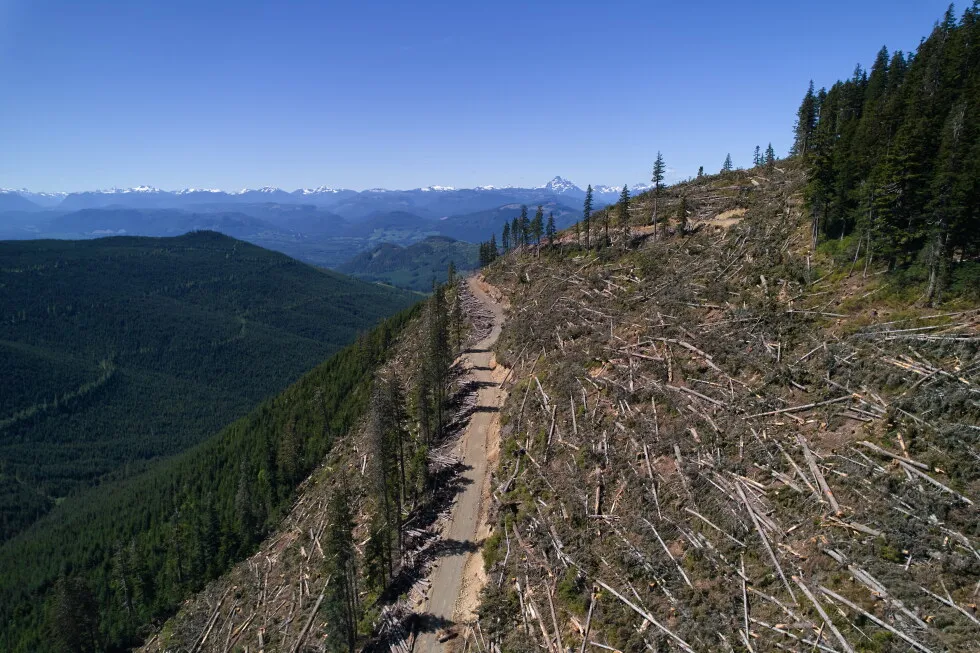
Logged trees lie in a section of the Prince of Wales Range near Campbell River, British Columbia, Sunday, May 31, 2026. (AP Photo/Annika Hammerschlag) Updated [hour]:[minute] [AMPM] [timezone], [monthFull] [day], [year] Port Renfrew, British Columbia (AP) — The five-car caravan crept down a gravel logging road as the day’s last beams of golden light filtered through the trees. About 20 forest defenders were making a stand in southwest Vancouver Island, at a spot where a logging company was expected to cut old-growth trees the following morning.They made camp in tents and the backs of cars. One truck parked sideways across the road. They awoke at 3 a.m., their headlamps tracing the ground, as they took their positions.An hour later, headlights appeared in the distance. A logging truck slowed, idled, then turned around. Nobody got out. Nobody spoke. It was a small, inconclusive victory in a fight that has spanned generations. But for those gathered in the forest, it mattered. Bill Jones, a First Nations Pacheedaht elder, speaks to land defenders during a logging blockade near Port Renfrew, British Columbia, Wednesday, May 27, 2026. (AP Photo/Annika Hammerschlag) Bill Jones, a First Nations Pacheedaht elder, speaks to land defenders during a logging blockade near Port Renfrew, British Columbia, Wednesday, May 27, 2026. (AP Photo/Annika Hammerschlag) Add AP News on Google Add AP News as your preferred source to see more of our stories on Google. Share Bill Jones, a First Nations Pacheedaht elder, prepares to join a blockade on a road used for logging before dawn near Port Renfrew, British Columbia, Thursday, May 28, 2026. (AP Photo/Annika Hammerschlag) Bill Jones, a First Nations Pacheedaht elder, prepares to join a blockade on a road used for logging before dawn near Port Renfrew, British Columbia, Thursday, May 28, 2026. (AP Photo/Annika Hammerschlag) Add AP News on Google Add AP News as your preferred source to see more of our stories on Google. Share Land defenders gather on a logging road before dawn as a logging vehicle approaches the blockade near Port Renfrew, British Columbia, Thursday, May 28, 2026. (AP Photo/Annika Hammerschlag) Land defenders gather on a logging road before dawn as a logging vehicle approaches the blockade near Port Renfrew, British Columbia, Thursday, May 28, 2026. (AP Photo/Annika Hammerschlag) Add AP News on Google Add AP News as your preferred source to see more of our stories on Google. Share “There is no dispute about what happened to our land,” said Bill Jones, a First Nations Pacheedaht elder who sat in the road as daylight crept in. At 86, he’s watched the forests on his nation’s territory disappear for most of his adult life. He started logging himself at age 18, he said, before he understood what he was helping to dismantle.“There’s nothing left — it’s practically naked, bare,” he said. “There’s few remnants here and there, and so we have to save what we can.” Vancouver Island’s old-growth rainforests are among the rarest ecosystems on Earth Activists on Vancouver Island are once again trying to stop the logging of old growth forests, some of the rarest and most carbon rich ecosystems on Earth. (AP Video by Annika Hammerschlag. Produced by Julián Trejo Bax) Coastal temperate rainforests cover barely half a percent of Earth’s land surface. Vancouver Island’s remaining stands — some are home to thousand-year-old trees — store more carbon per hectare than nearly any other forest system, according to the Sierra Club of British Columbia. Yet trees that took a millennium to grow can be felled in under an hour. Since industrial logging began more than a century ago, most of Vancouver Island’s productive old-growth forests — those capable of growing the large trees characteristic of the island’s rainforests — have been cut. About 20% of those forests remain, according to the Sierra Club, and most of what remains is still open to logging. Old-growth western red cedar, defined by the province as trees 250 years or older, produces wood so durable and rot-resistant that it fetches significantly higher prices than other local species. It’s widely used in construction and, despite recent tariffs, the United States remains a major export market. Second-growth forests, by contrast, are younger stands that regenerated after previous logging and produce less-durable wood products. Although the province says more than 11 million hectares of old growth remain, scientists say there is only about 415,000 hectares of productive old growth capable of growing the largest trees. Note: Definitions of old growth, sometimes called ancient, vary by ecosystems and species. Across most of Vancouver Island, British Columbia generally classifies forests that are more than 250 years old as old growth. Years 2014, 2015 and 2016 are missing. The fight is not unique to British Columbia. During what became known as the Timber Wars of the late 1980s and 1990s, activists occupied giant redwoods, chained themselves to logging equipment and blockaded roads across California, Oregon and Washington. The battles ultimately helped secure protections for many of the remaining ancient forests. The conflict has flared for decades Logs float on the water in Jordan River, British Columbia, Wednesday, May 27, 2026. (AP Photo/Annika Hammerschlag) Logs float on the water in Jordan River, British Columbia, Wednesday, May 27, 2026. (AP Photo/Annika Hammerschlag) Add AP News on Google Add AP News as your preferred source to see more of our stories on Google. Share More than 850 people were arrested during the 1993 “War in the Woods” protests at Clayoquot Sound. Nearly 30 years later, more than 1,100 were arrested at Fairy Creek, where blockades won temporary protections now set to expire in September. As old-growth logging has continued elsewhere on the island, activists are again returning to the forests. In the Walbran Valley, also on Pacheedaht territory, logging by Tsawak-qin Forestry, a company co-owned by the Huu-ay-aht First Nation and forestry giant Western Forest Products, has exposed tensions over whether forests on traditional territories should be managed for economic development, conservation, or both, and who within Indigenous communities can decide. A bald eagle’s nest sits atop a remaining tree within a logged area near Campbell River, British Columbia, Saturday, May 30, 2026. (AP Photo/Annika Hammerschlag) A bald eagle’s nest sits atop a remaining tree within a logged area near Campbell River, British Columbia, Saturday, May 30, 2026. (AP Photo/Annika Hammerschlag) Add AP News on Google Add AP News as your preferred source to see more of our stories on Google. Share British Columbia’s forests minister, Ravi Parmar, said that if a long-term agreement with the Pacheedaht Nation is not reached before the Fairy Creek deferral expires he would seek another extension. The province says it has deferred or protected 2.4 millions of hectares of old growth since 2021, but critics say most of those measures are temporary and some deferred areas continue to be logged. At the same time, British Columbia Premier David Eby’s government has pledged to increase timber harvests in an effort to revitalize the forestry sector. Opponents argue those goals are incompatible. The ecological consequences of losing what remains would be extensive Andy MacKinnon, a forest ecologist, stands beneath the forest canopy near Victoria, British Columbia, Friday, May 29, 2026. (AP Photo/Annika Hammerschlag) Andy MacKinnon, a forest ecologist, stands beneath the forest canopy near Victoria, British Columbia, Friday, May 29, 2026. (AP Photo/Annika Hammerschlag) Add AP News on Google Add AP News as your preferred source to see more of our stories on Google. Share Some coastal old-growth stands on Vancouver Island have not experienced a major disturbance since the end of the last ice age some 12,000 years ago. Their layered canopies, nurse logs and ancient root systems create habitat for hundreds of species, including threatened marbled murrelet seabirds and salmon. “Once an old-growth forest is logged, it will require millennia before it has the structure, composition and function of the forest that was logged — if in fact it can ever recover in times of changing climate,” said Andy MacKinnon, a forest ecologist in British Columbia. The forests also drive tourism, which some researchers argue outweighs their value as lumber. Visitors from around the world flock to the island’s ancient groves to experience towering, moss-draped cedars and Douglas firs. Visitors walk through Cathedral Grove, an old growth forest in MacMillan Provincial Park near Port Alberni, British Columbia, Saturday, May 30, 2026. (AP Photo/Annika Hammerschlag) Visitors walk through Cathedral Grove, an old growth forest in MacMillan Provincial Park near Port Alberni, British Columbia, Saturday, May 30, 2026. (AP Photo/Annika Hammerschlag) Add AP News on Google Add AP News as your preferred source to see more of our stories on Google. Share Moss drips from tree branches in a forest near Port Renfrew, British Columbia, Thursday, May 28, 2026. (AP Photo/Annika Hammerschlag) Moss drips from tree branches in a forest near Port Renfrew, British Columbia, Thursday, May 28, 2026. (AP Photo/Annika Hammerschlag) Add AP News on Google Add AP News as your preferred source to see more of our stories on Google. Share Still, the transition away from old-growth logging cannot happen overnight, said Parmar, the forests minister. He pointed to the province’s old-growth deferrals and protections, alongside investments in second-growth hemlock milling, as evidence that British Columbia is moving away from dependence on old-growth timber. He said the industry is also under pressure from U.S. tariffs on Canadian softwood lumber, which now top 45%. “Forestry is the foundation of our economy. It provides good paying, family supporting jobs — about 100,000 direct and indirect,” he said. “If we were to shut down harvesting of all old forests here in British Columbia, it would shut down our sector completely on day one.”For some, the fight to protect old growth is personal Land defender Steven “Shambu” Daniluk drives down a road used for logging near Port Renfrew, British Columbia, Thursday, May 28, 2026. (AP Photo/Annika Hammerschlag) Land defender Steven “Shambu” Daniluk drives down a road used for logging near Port Renfrew, British Columbia, Thursday, May 28, 2026. (AP Photo/Annika Hammerschlag) Add AP News on Google Add AP News as your preferred source to see more of our stories on Google. Share “This is our ivory trade,” said Steven “Shambu” Daniluk, a longtime blockader who spent nearly two years on the front lines at Fairy Creek. But unlike the illegal poaching of elephants, much of the world remains unaware of what is happening in British Columbia’s forests, he said.“People feel unheard,” he said. “Being engaged in this way, risking that arrest, is the only way.” Land defender Steven “Shambu” Daniluk peers up at an old growth tree near Port Renfrew, British Columbia, Thursday, May 28, 2026. (AP Photo/Annika Hammerschlag) Land defender Steven “Shambu” Daniluk peers up at an old growth tree near Port Renfrew, British Columbia, Thursday, May 28, 2026. (AP Photo/Annika Hammerschlag) Add AP News on Google Add AP News as your preferred source to see more of our stories on Google. Share Veronika Sitar, an outdoor enthusiast from Campbell River, has found her own way of reckoning with the losses. Most weekends she drives and hikes hours into the backcountry to document old-growth stands before the loggers reach them — spending time, she said, with trees she fears won’t be there when she returns.On a recent trip into the north island’s Prince of Wales Range, she pushed through dense undergrowth and snaked around thorny plants to reach General Buxton, one of the largest yellow cedars in British Columbia. She was still catching her breath when she spotted flagging tape just 200 feet (60 meters) away, marking the route of a proposed logging road. “I don’t want to get too attached knowing what will be logged,” she said. Veronika Sitar, an outdoor enthusiast, sits on the stump of a yellow cedar in a recently logged area of the Prince of Wales Range, near Campbell River, British Columbia, Sunday, May 31, 2026. (AP Photo/Annika Hammerschlag) Veronika Sitar, an outdoor enthusiast, sits on the stump of a yellow cedar in a recently logged area of the Prince of Wales Range, near Campbell River, British Columbia, Sunday, May 31, 2026. (AP Photo/Annika Hammerschlag) Add AP News on Google Add AP News as your preferred source to see more of our stories on Google. Share Veronika Sitar, an outdoor enthusiast, shows an image on her phone of herself sitting at a yellow cedar just weeks before it was logged in the Prince of Wales Range, near Campbell River, British Columbia, Sunday, May 31, 2026. (AP Photo/Annika Hammerschlag) Veronika Sitar, an outdoor enthusiast, shows an image on her phone of herself sitting at a yellow cedar just weeks before it was logged in the Prince of Wales Range, near Campbell River, British Columbia, Sunday, May 31, 2026. (AP Photo/Annika Hammerschlag) Add AP News on Google Add AP News as your preferred source to see more of our stories on Google. Share Veronika Sitar, an outdoor enthusiast, lies on a yellow cedar stump within a logged area near Campbell River, British Columbia, Sunday, May 31, 2026. (AP Photo/Annika Hammerschlag) Veronika Sitar, an outdoor enthusiast, lies on a yellow cedar stump within a logged area near Campbell River, British Columbia, Sunday, May 31, 2026. (AP Photo/Annika Hammerschlag) Add AP News on Google Add AP News as your preferred source to see more of our stories on Google. Share Back at the blockade, word spread of a new area where logging was being planned, this time on Ditidaht First Nation territory to the north. They began making calls, hoping to connect with local land defenders. Jones, the Pacheedaht elder, said he was troubled not just by the loss of the forests, but by people’s connection to them and, in turn, to themselves. That, he said, is why they continue to protect the remaining old growth. “We’re just fighting over the leftovers.” logging roads wind through mountains near Port Renfrew, British Columbia, Thursday, May 28, 2026. (AP Photo/Annika Hammerschlag) logging roads wind through mountains near Port Renfrew, British Columbia, Thursday, May 28, 2026. (AP Photo/Annika Hammerschlag) Add AP News on Google Add AP News as your preferred source to see more of our stories on Google. Share ___Follow Annika Hammerschlag on Instagram: @ahammergram.___The Associated Press receives support from the Walton Family Foundation for coverage of water and environmental policy. The AP is solely responsible for all content. For all of AP’s environmental coverage, visit https://apnews.com/hub/climate-and-environment Hammerschlag is a text and visual journalist covering the intersection of oceans and climate change globally for The Associated Press. She is based in Seattle.
SRCAssociated Press (AP)
LANGEN
LEANCenter
WORDS2 410
ENT11
WED · 2026-08-05 · 13:23 GMTBRIEF NSR-2026-0805-99391
NSR-2026-0805-99391News Report·EN·Environmental
British Columbia is logging its last old growth. Protesters are sleeping in the road to stop it
Activists are protesting logging of old-growth forests on Vancouver Island, British Columbia, where only about 20% of productive old-growth forests remain. Forest defenders, including First Nations elder Bill Jones, have blockaded logging roads to prevent companies from cutting trees that are at least 250 years old.
By
ANNIKA HAMMERSCHLAGAssociated Press (AP)Filed 2026-08-05 · 13:23 GMTLean · CenterRead · 10 min
Associated Press (AP)FIG 01
Reading time
10min
Word count
2 410words
Sources cited
1cited
Entities identified
11entities
Quality score
100%
§ 01
Briefing Summary
AI-generatedNEWSAR · AI
Activists are protesting logging of old-growth forests on Vancouver Island, British Columbia, where only about 20% of productive old-growth forests remain. Forest defenders, including First Nations elder Bill Jones, have blockaded logging roads to prevent companies from cutting trees that are at least 250 years old. These ancient forests are rare, carbon-rich ecosystems, and their logging has been a point of contention for decades, with past protests resulting in significant arrests. While the province has protected some old-growth areas, critics argue these measures are temporary and conflict with government plans to increase timber harvests. The fight highlights tensions between economic development, conservation, and Indigenous rights, as activists aim to preserve what little remains of these vital ecosystems.
Confidence 0.90Sources 1Claims 5Entities 11
§ 02
Article analysis
Model · rule-basedFraming
Environmental
Human Interest
Tone
Mixed Tone
AI-assessed
CalmNeutralAlarmist
Factuality
0.60 / 1.00
Mixed
LowHigh
Sources cited
1
Limited
FewMany
§ 03
Key claims
5 extracted01
Elder Bill Jones began logging at age 18 before understanding the impact.
quoteBill Jones
Confidence
1.00
02
Bill Jones, a First Nations Pacheedaht elder, states that the forests on his nation's territory have largely disappeared.
quoteBill Jones
Confidence
1.00
03
A logging truck turned around after encountering a protest blockade.
factual
Confidence
0.90
04
Protesters are blocking logging roads to prevent the cutting of old-growth trees in British Columbia.
factual
Confidence
0.90
05
Vancouver Island's old-growth rainforests are among the last remaining.
factual
Confidence
0.80
§ 04
Full report
10 min read · 2 410 words§ 05
Entities
11 identifiedKey playerOppositionContextPositiveNeutralNegative
Organizations2
Locations5
§ 06
Keywords & salience
8 termsold growth logging
1.00
forest defenders
0.90
logging blockade
0.90
vancouver island
0.80
environmental protest
0.70
first nations
0.60
conservation
0.50
logging industry
0.40
§ 07
Topic connections
Interactive graph No topic relationship data available yet. This graph will appear once topic relationships have been computed.