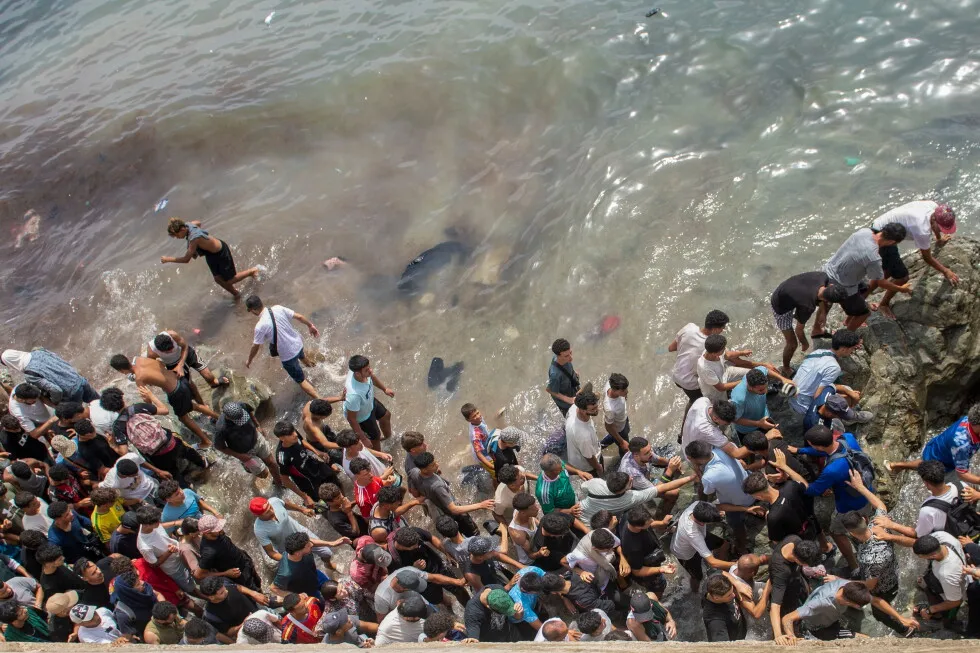
Moroccan families seek missing loved ones after the migrant surge to Spain’s Ceuta 0 seconds of 55 secondsVolume 0% Press shift question mark to access a list of keyboard shortcuts Keyboard ShortcutsEnabledDisabled Shortcuts Open/Close/ or ? Play/PauseSPACE Increase Volume↑ Decrease Volume↓ Seek Forward→ Seek Backward← Captions On/Offc Fullscreen/Exit Fullscreenf Mute/Unmutem Decrease Caption Size- Increase Caption Size+ or = Seek %0-9 Next Up Crowds of migrants swim around border from Morocco into Spanish territory of Ceuta 01:00 00:00 00:55 00:55 More Videos 01:00 Crowds of migrants swim around border from Morocco into Spanish territory of Ceuta 00:39 Gregg Araki declares it's 'Olivia summer' for Olivia Wilde 00:30 Crowd breaks through border from Spanish territory of Ceuta from Morocco 01:25 People at the Tarajal border fence in Ceuta as migrants try to reach Spanish territory 01:33 Trump says Pirro 'choked' and 'folded like an umbrella' 01:27 Trump says US could see surge of migrants like Spain if Republicans don't win midterms 01:47 Moroccans who crossed into Ceuta explain why they attempted to reach the Spanish territory 00:42 Protest outside Moroccan Embassy in Madrid after Ceuta crisis Close 1 of 5 | Days after tens of thousands of migrants crossed from Morocco into Spain’s North African enclave of Ceuta, families on Monday kept searching for their loved ones. Although most of the migrants returned voluntarily by Friday evening, young men continued to stream back across the border Monday. 2 of 5 | People walk on a beach as they attempt to cross from the Moroccan northern town of Fnideq to the Spanish enclave of Ceuta, Friday, July 31, 2026. (AP Photo) 3 of 5 | Migrants, some of them unaccompanied minors, who crossed from Morocco into Spain, write down their contact information to give to a neighborhood association in the Spanish enclave of Ceuta, Tuesday, Aug. 4, 2026. (AP Photo/Bernat Armangue) 4 of 5 | A migrant who crossed from Morocco into Spain holds a sign reading, in Spanish, “asylum” as he lines up for food distribution on a beach in the Spanish enclave of Ceuta, Monday, Aug. 3, 2026. (AP Photo/Bernat Armangue) 5 of 5 | Migrants who crossed from Morocco into Spain line up for food distribution on a beach in the Spanish enclave of Ceuta, Monday, Aug. 3, 2026. (AP Photo/Bernat Armangue) By Akram Oubachir Updated 3:11 PM MESZ, August 5, 2026 Add AP News on Google Add AP News as your preferred source to see more of our stories on Google. Share Share Facebook Copy Link copied Print Email X LinkedIn Bluesky Flipboard Pinterest Reddit Fnideq, Morocco (AP) — Mothers, fathers, brothers, sisters and friends gather along the Moroccan side of the border with the Spanish territory of Ceuta, scanning for familiar faces. Each returning migrant is met with the question: Have you seen my son? My daughter? My brother? Authorities say all but a few thousand of the 72,000 migrants who crossed into Ceuta in recent days have since returned to Morocco. Some families were relieved to welcome them home. Others were disappointed that the migration attempt failed. The surge to Ceuta was largely driven by poverty and fueled by online rumors that the border was open, triggering a crisis resonating across Europe. More than 80 people died on both sides of the border, according to authorities, as people swam or climbed fences in the attempt. Nearly all of the migrants who survived were expelled by Spanish authorities or returned voluntarily after seeing they were unwelcome. Many of those who made it back borrowed phones from strangers to reassure anxious relatives because they had lost or abandoned their phones in the journey. Runaway online rumors sparked frantic rush by migrants to the Spanish territory of Ceuta 3 MIN READ 12 Spain installs sea barrier on Ceuta’s border with Morocco after frontier rush that killed 67 4 MIN READ 21 ‘I just want a chance': Moroccans sought better future in collective crossing to Spain territory 4 MIN READ 21 As the first migrants trickled back to Morocco, an Associated Press reporter watched families hold up printed photographs of missing relatives, stopping returnees one by one in hopes that someone might recognize a face. The migrants studied each picture, offering what reassurance they could, often saying only that they hoped the missing person was safe. “I have been looking for my son for five days now,” said Ibtissam Chari, whose son Rayan crossed with friends after hearing that the border had opened. “He called me when he arrived, and since then I haven’t heard anything from him.” Another woman stood silently facing the border. She said she has heard nothing from her 12-year-old son, who crossed into Ceuta with his older brother. Only the older one has returned. “I have nothing else to do but come here and wait,” said the woman, who spoke on condition of anonymity to protect her children. “I spend all my days here. I will come back tomorrow again.” Facebook groups that helped the crossing seek the missing An estimated 1,000 of the few thousand migrants estimated to remain in Ceuta are minors. Spanish security forces are not authorized by law to expel them, and their fate is uncertain. It remains unclear whether all of the dead have been found or returned to Morocco. Local newspapers and a source at the morgue in Tetouan, the largest Moroccan city near Ceuta, said the facility had received more than a dozen bodies. Journalists were not allowed to enter. The source spoke on condition of anonymity because they were not authorized to speak to journalists. Meanwhile, Moroccan authorities have welded shut the small opening in the border fence that had been opened to allow many returning migrants to re-enter the country. Facebook groups that had circulated videos showing where to swim and tracking Spanish and Moroccan patrols have now taken on a different purpose. Families post photos there of missing relatives, hoping someone has seen them. “If anyone has seen this girl in Ceuta or Castillejos, please let us know. Her family is going crazy,” one user, Hiba Nakaax, wrote in the Facebook group Fnideq Bab Sebta. Some parents hope their children try again for Europe migration has long been woven into the aspirations of many young Moroccans. Poverty and youth unemployment remain high, particularly in inland regions that have not shared in the economic gains seen along parts of the coast. For many, Europe represents the possibility of work, stability and a different future. Last year’s youth-led Gen Z protests in Morocco reflected growing frustration over inequality and the quality of public services. Some parents knew their children intended to make the journey. After returning from Ceuta, 26-year-old Othmane El Merzoug was barefoot and hungry and desperate to communicate with his family. He asked to borrowed an AP reporter’s phone to call his father in the Moroccan city of Salé. “Dad, I’ve returned from Ceuta. They didn’t allow me to stay,” he said over speakerphone. His father promised to send money to get him home. A traumatized 17-year-old from Taounate, Mohamed Chakor, also asked to borrow a phone to call his father, who asked for help in finding other ways to reach Europe. Majd Semlali in Fnideq, Morocco, contributed to this report.
SRCAssociated Press (AP)
LANGEN
LEANCenter
WORDS1 205
ENT10
WED · 2026-08-05 · 13:23 GMTBRIEF NSR-2026-0805-99392
NSR-2026-0805-99392News Report·EN·Human Interest
Moroccan families seek missing loved ones after the migrant surge to Spain’s Ceuta
Following a surge of approximately 72,000 migrants from Morocco into Spain's Ceuta enclave, families on the Moroccan side are desperately searching for missing loved ones. Driven by poverty and false rumors of an open border, the crossing resulted in over 80 deaths.
Associated Press (AP)Filed 2026-08-05 · 13:23 GMTLean · CenterRead · 5 min
Associated Press (AP)FIG 01
Reading time
5min
Word count
1 205words
Sources cited
1cited
Entities identified
10entities
Quality score
100%
§ 01
Briefing Summary
AI-generatedNEWSAR · AI
Following a surge of approximately 72,000 migrants from Morocco into Spain's Ceuta enclave, families on the Moroccan side are desperately searching for missing loved ones. Driven by poverty and false rumors of an open border, the crossing resulted in over 80 deaths. While most migrants have since returned to Morocco, some families remain without news of their relatives, holding up photos and questioning returnees. Facebook groups that previously facilitated the crossing are now being used by families to post pictures of the missing. Spanish authorities expelled most adult migrants, but the fate of an estimated 1,000 unaccompanied minors who remain in Ceuta is uncertain.
Confidence 0.90Sources 1Claims 5Entities 10
§ 02
Article analysis
Model · rule-basedFraming
Human Interest
Human Rights
Tone
Measured
AI-assessed
CalmNeutralAlarmist
Factuality
0.80 / 1.00
Factual
LowHigh
Sources cited
1
Limited
FewMany
§ 03
Key claims
5 extracted01
Moroccan families are searching for loved ones who went missing after a surge of migrants crossed into Spain's Ceuta.
factual
Confidence
1.00
02
Migrants are seeking asylum and lining up for food distribution on a beach in Ceuta.
factual
Confidence
0.90
03
Migrants, including unaccompanied minors, are providing contact information to neighborhood associations in Ceuta.
factual
Confidence
0.90
04
Young men continued to cross back into Ceuta from Morocco on Monday.
factual
Confidence
0.90
05
Authorities state that most of the 72,000 migrants who crossed into Ceuta have returned to Morocco.
factualAuthorities
Confidence
0.90
§ 04
Full report
5 min read · 1 205 words§ 05
Entities
10 identifiedKey playerOppositionContextPositiveNeutralNegative
Organizations1
Locations5
§ 06
Keywords & salience
9 termsmigrant surge
1.00
ceuta
1.00
moroccan families
0.90
missing loved ones
0.90
morocco
0.80
spain
0.80
border crossing
0.70
unaccompanied minors
0.60
asylum
0.50
§ 07
Topic connections
Interactive graph Network visualization showing 51 related topics
View Full Graph Person Organization Location Event|Click node to navigate|Edge numbers = shared articles