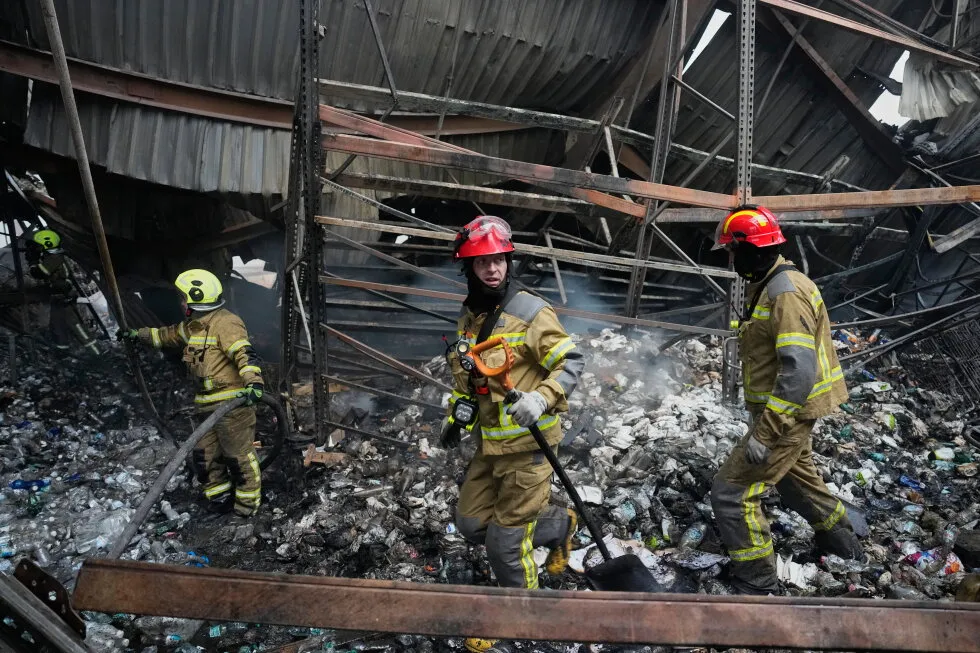
Why Russia’s ballistic missiles are increasingly getting through Ukrainian defenses 1 of 5 | Firefighters put out a fire after Russian missiles hit a food warehouse near Kyiv, Ukraine, Wednesday, Aug. 5, 2026. (AP Photo/Efrem Lukatsky) 2 of 5 | Firefighters put out a fire after Russian missiles hit a warehouse in Kyiv, Ukraine, Wednesday, Aug. 5, 2026. (AP Photo/Dan Bashakov) 3 of 5 | Firefighters put out a fire after Russian missiles hit a warehouse in Kyiv, Ukraine, Wednesday, Aug. 5, 2026. (AP Photo/Dan Bashakov) 4 of 5 | In this photo provided by the Ukrainian Emergency Service, firefighters put out a fire in a residential building following a Russian air attack in Kramatorsk, Donetsk region, Ukraine, Wednesday, Aug. 5, 2026. (Ukrainian Emergency Service via AP) 5 of 5 | A police officer examines a damaged Nova Poshta postal warehouse after Russian missiles strikes in Kyiv, Ukraine, Wednesday, Aug. 5, 2026. (AP Photo/Efrem Lukatsky) By ILLIA NOVIKOV Updated 8:05 PM MESZ, August 5, 2026 Leer en español Add AP News on Google Add AP News as your preferred source to see more of our stories on Google. Share Share Facebook Copy Link copied Print Email X LinkedIn Bluesky Flipboard Pinterest Reddit Kyiv, Ukraine (AP) — When Russia fires a ballistic missile at Ukraine, air-defense systems have only minutes — sometimes seconds — to detect and intercept the deadly threat. The lack of time has left Kyiv and other cities increasingly exposed to devastating attacks by the missiles that come down so fast and so steeply that Ukraine says only the U.S.-made Patriot defense system can stop them. But Ukraine says it has too few batteries and interceptors to protect itself. Unlike cruise missiles, which behave like pilotless planes, ballistic missiles are launched like rockets and then dive steeply toward their targets at several times the speed of sound. That sharply reduces the time available to find and destroy a warhead. The result has been repeated attacks like the latest barrage on the Ukrainian capital that targeted a brewery, a warehouse and a mail-sorting office. At least 17 people were killed and dozens more wounded, President Volodymyr Zelenskyy said Wednesday. When the warhead is hurled toward its target, “it’s very, very steep and it’s going at a ridiculous speed,” said Thomas Withington, an expert on electronic warfare at the Royal United Services Institute, who compared the physics to playing catch. If the ball is “going really fast, it’s harder to catch.” Russia’s ground-launched Iskander-M missile is the Kremlin’s main ballistic missile. Another example is the air-launched Kinzhal missile. Russia has also fired S-300 and S-400 air-defense missiles at ground targets. A model known as the Zircon is technically a hypersonic anti-ship cruise missile, but its high speed resembles that of a ballistic missile and creates a similar interception problem. Here’s a look at the challenge of shielding Ukraine from some of Russia’s deadliest projectiles. Russia’s missile and drone attacks on Ukraine kill at least 22 2 MIN READ Russian barrage in Ukraine’s capital region kills 17 as air defenses fall short 1 MIN READ Russian strikes across Ukraine kill 10 and NATO scrambles jets after a missile falls in Poland 1 MIN READ Patriot system offers some protection The most capable Patriot system supplied to Ukraine is designed for high-speed missile defense. Instead of exploding near a target, the PAC-3 system uses a maneuverable interceptor designed to collide with an incoming warhead. The Patriot technology must track the missile, predict its path and launch within minutes, sometimes leaving seconds for the final engagement. Patriots are currently the only system in Ukrainian service able to intercept the Russian Iskander-M, S-400 and Zircon missiles, according to Ukrainian Air Force spokesman Yurii Ihnat. The United States and its allies operate other anti-ballistic systems, including THAAD and sea-based Aegis defenses, but they have not been provided to Ukraine. Even Patriot protection is not guaranteed. When a Patriot battery is absent, out of position or short of missiles, most other Ukrainian defenses cannot substitute for it. Ukraine has too few batteries to shield every city. Russia combines ballistic missiles with cruise missiles, drones and decoys, forcing defenders to track many threats and ration scarce interceptors. Shortage of interceptors is only a part of a global problem The interceptor shortage has become more acute as the U.S.-Israeli war with Iran has consumed large numbers of Patriot and THAAD interceptors. An analysis by The Associated Press estimated that the U.S. Patriot inventory had fallen by at least 65% from its prewar level, while the Pentagon said it retained a deep arsenal. Production cannot immediately close the gap. Lockheed Martin delivered more than 600 PAC-3 MSE interceptors in 2025 and is working toward annual capacity of 2,000 by the end of 2030. NATO says Europe’s first Patriot missile production facility is expected to open in September in Germany. Political signals from Washington have also shifted. At a NATO summit last month in Turkey, President Donald Trump said the United States would give Ukraine a license to produce Patriots. About three weeks later, he said he had not made a final decision. Even with a license, officials and experts told AP that starting production in Ukraine would take years. Ukraine is also trying to destroy Russian missile launchers and infrastructure before missiles can be fired — shooting the archer instead of the arrow. People familiar with the discussions told AP that Zelenskyy asked Trump to help secure Elon Musk’s permission for Ukrainian forces to use Starlink communications for targeting inside Russia, where Musk has restricted the service. Such access could help Ukrainian drones hunt launchers and related infrastructure, reducing the number of missiles Patriot batteries must face. The request had not been publicly confirmed by the White House, the Ukrainian Embassy or SpaceX. Kyiv is also developing Freya, a proposed Ukrainian-led, lower-cost anti-ballistic system intended to reduce dependence on Patriots. Ukraine and nine European countries formed a coalition in July to pursue a shared missile-defense capability, with Zelenskyy saying they could jointly develop a mass-produced system within 12 months. Freya remains under development, and it is unclear when it could become operational. Following the most recent Russian ballistic attack on Kyiv, Zelenskyy said Ukraine received only one-third as many air-defense missiles in the first half of 2026 as in the same period last year. He said Ukraine’s partners that are unwilling to increase interceptor deliveries immediately should instead impose new sanctions, noting that a significant share of Russia’s ballistic missile production has been untouched by sanctions. Associated Press Writer Danica Kirka in London contributed to this report. ILLIA NOVIKOV Novikov is an Associated Press reporter covering news in Ukraine since 2022. He is based in Kyiv. instagram mailto
SRCAssociated Press (AP)
LANGEN
LEANCenter
WORDS1 119
ENT12
WED · 2026-08-05 · 18:23 GMTBRIEF NSR-2026-0805-99514
NSR-2026-0805-99514News Report·EN·Conflict
Why Russia’s ballistic missiles are increasingly getting through Ukrainian defenses
Russia's ballistic missiles are increasingly penetrating Ukrainian defenses due to their high speed and steep trajectory, leaving air defense systems with minimal time to react. Ukraine states that only the U.S.-made Patriot system can effectively intercept these threats, but they possess too few batteries and interceptors.
Associated Press (AP)Filed 2026-08-05 · 18:23 GMTLean · CenterRead · 5 min
Associated Press (AP)FIG 01
Reading time
5min
Word count
1 119words
Sources cited
1cited
Entities identified
12entities
Quality score
100%
§ 01
Briefing Summary
AI-generatedNEWSAR · AI
Russia's ballistic missiles are increasingly penetrating Ukrainian defenses due to their high speed and steep trajectory, leaving air defense systems with minimal time to react. Ukraine states that only the U.S.-made Patriot system can effectively intercept these threats, but they possess too few batteries and interceptors. Russia employs various ballistic missiles, including the Iskander-M and Kinzhal, as well as air defense missiles like the S-300 and S-400 against ground targets, and the Zircon missile presents a similar interception challenge. The global shortage of interceptors, exacerbated by other conflicts, further limits Ukraine's defensive capabilities. Ukraine is attempting to counter these attacks by targeting Russian missile launchers and developing its own anti-ballistic systems.
Confidence 0.90Sources 1Claims 5Entities 12
§ 02
Article analysis
Model · rule-basedFraming
Conflict
Technology
Tone
Measured
AI-assessed
CalmNeutralAlarmist
Factuality
0.70 / 1.00
Factual
LowHigh
Sources cited
1
Limited
FewMany
§ 03
Key claims
5 extracted01
Ballistic missiles dive steeply and at several times the speed of sound, reducing interception time.
factual
Confidence
0.95
02
Russia's ground-launched Iskander-M and air-launched Kinzhal are examples of ballistic missiles used against Ukraine.
factual
Confidence
0.90
03
Ukraine claims it has too few Patriot batteries and interceptors to protect itself.
factualUkraine
Confidence
0.90
04
Ukraine states that only the U.S.-made Patriot defense system can stop these fast-diving ballistic missiles.
factualUkraine
Confidence
0.90
05
Russia's ballistic missiles are increasingly getting through Ukrainian defenses due to limited detection and interception time.
factual
Confidence
0.90
§ 04
Full report
5 min read · 1 119 words§ 05
Entities
12 identifiedKey playerOppositionContextPositiveNeutralNegative
Organizations1
Locations6
§ 06
Keywords & salience
9 termsukrainian defenses
1.00
ballistic missiles
1.00
patriot defense system
0.90
missile interception
0.80
speed of sound
0.70
air-defense systems
0.60
russia
0.50
ukraine
0.50
electronic warfare
0.40
§ 07
Topic connections
Interactive graph Network visualization showing 51 related topics
View Full Graph Person Organization Location Event|Click node to navigate|Edge numbers = shared articles