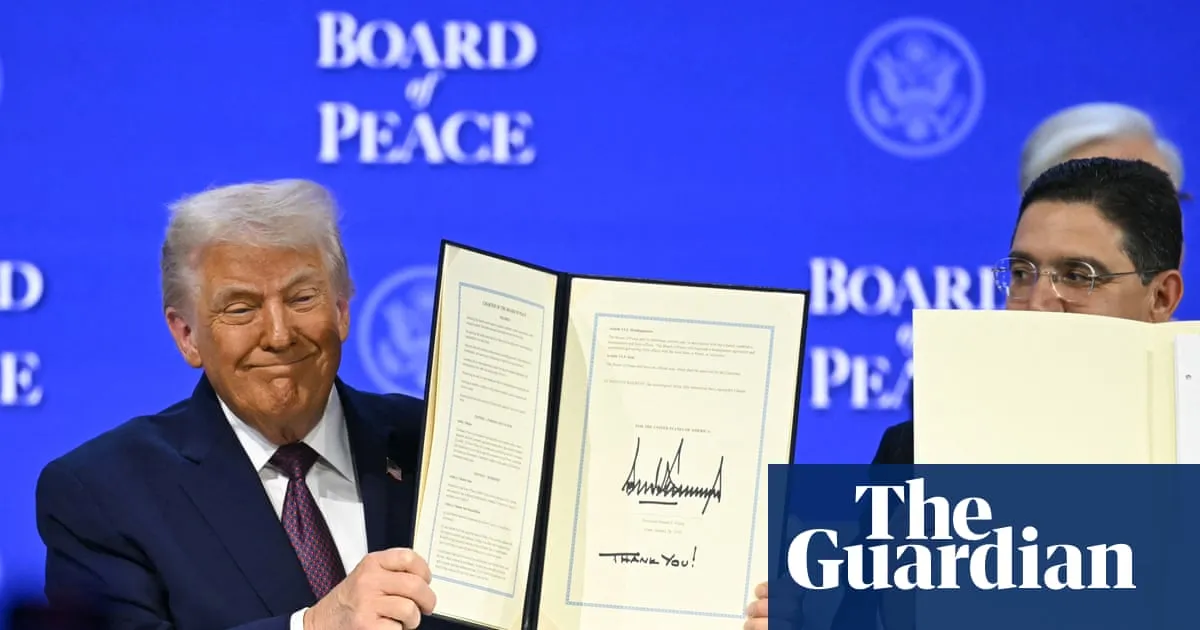
Morocco’s foreign minister, Nasser Bourita, sits next to Donald Trump as he holds up the signed founding charter of his Board of Peace in January. Photograph: Fabrice Coffrini/AFP/Getty ImagesMorocco’s foreign minister, Nasser Bourita, sits next to Donald Trump as he holds up the signed founding charter of his Board of Peace in January. Photograph: Fabrice Coffrini/AFP/Getty ImagesWashington-Rabat ties under scrutiny as questions swirl over what led to deadly influx into tiny Spanish territoryThe cosy relationship between Washington and Rabat has long been flaunted by both sides, from Morocco’s announcement this year that it would be the first African state to join Donald Trump’s Board of Peace to the congratulatory message recently sent by Trump to mark King Mohammed VI’s 27 years in power.The latest example landed this week. As Spain grappled with the aftermath of the sudden influx – and swift return – of more than 70,000 people into Ceuta, Morocco’s monarch confirmed he had named a $1bn highway flanking the disputed territory of Western Sahara after Trump.The deepening ties have come under renewed scrutiny as questions continue to swirl over what exactly led to the deadly Mass border crossing into the tiny Spanish territory in north Africa.“I think there’s enough evidence to hypothesise or claim that Morocco is behind this,” said Riccardo Fabiani, the north Africa project director for the International Crisis Group. “But there was no clear trigger for this, and this is what is puzzling for everyone.”0:44Migrants in Spain's Ceuta enclave escorted back to Morocco – videoObservers have suggested Spain’s recent rapprochement with Rabat’s archrival, Algeria, could have set off Morocco. But another, perhaps more plausible explanation pointed towards the US, said Fabiani.“It’s obviously impossible to demonstrate,” he said. “But in terms of plausibility, I don’t think it’s impossible to imagine that Morocco might have done something to earn brownie points with its allies, given that Morocco and this particular administration in Washington do have a very close, excellent relationship.”While Morocco had likely not “masterminded” the surge into Ceuta, he said, its relationship with the Trump administration – along with the Moroccan king’s desire to keep its claim to Ceuta in the spotlight – may have affected how it responded to fast-spreading online rumours about the Spanish border being thrown open.A young person is escorted by Spanish security forces after attempting to cross into Ceuta on Saturday. Photograph: Violeta Santos Moura/Reuters“For sure the Moroccan security forces were monitoring those conversations,” said Fabiani. “They saw that and there was probably some conversation where they decided to do nothing and see where this goes.”What followed made headlines across the globe as tens of thousands of people swam or waded across one of the EU’s two land borders with Africa. As Spain scrambled to cope, far-right voices seized on the images.In the US, the vice-president, JD Vance, and the state department blamed the influx on the Socialist-led government of Spain, while Trump warned that electing Democrats would make what happened in Spain “look small-time”. At no point did any of them mention Morocco or the potential role it might have played.Trump and his administration have long been open about the deep antipathy they feel for Pedro Sánchez, the Spanish prime minister, whose refusal to allow the US to use its airbases during the Iran war, rejection of the 5% defence spending target and vociferous criticism of Israel’s actions in Gaza have arguably made Spain the administration’s least favourite EU country.The American response seemed to be a triumph for Rabat, whose relationship with the US president traces back to his first term, when Morocco agreed to normalise ties with Israel in exchange for Trump’s recognition of its sovereignty claim over the disputed territory of Western Sahara.Since then, Morocco’s all-powerful monarch had doubled down on outreach efforts, said Fabiani. “The Moroccans have really made extra efforts to cultivate every single major decision-maker within the administration, including the president himself, to make sure that this administration will support, until the end, the Moroccan autonomy plan for Western Sahara.”A hint that the relationship could help Morocco lay claim to more than Western Sahara came in a recent US congressional report that appeared to be sympathetic to Morocco’s refusal to recognise Ceuta as Spanish territory, describing it as “Spanish-administered” rather than a part of Spain, as it has been since 1580.Days after the influx, interest in Ceuta remained heightened among those close to both Trump and the Israeli government, said Haizam Amirah-Fernández, the director of the Madrid-based Centre for Contemporary Arab Studies. “They haven’t stopped talking about Ceuta for several days in a row, which is quite striking.”Red Cross personnel distributing food at Trampolín beach in Ceuta this week. Photograph: REDUAN/EPAWhat had been laid bare was Rabat’s willingness to use “hybrid tactics to achieve political objectives”, said Amirah-Fernández, drawing a parallel with May 2021 when Rabat loosened border controls to allow more than 8,000 people to cross into Ceuta in a show of anger over Madrid’s decision to allow a Western Sahara pro-independence leader to travel to Spain to be treated for Covid-19.This time around, as nearly 10 times more people crossed into Ceuta, it set off a bout of finger-pointing across the EU rather than any kind of concerted effort to push back using the bloc’s status as Morocco’s largest trading partner and largest foreign investor. “The reaction of several governments in the EU was, in the end, what the White House was looking for – the erosion of solidarity between European partners,” said Amirah-Fernández.Senior officials in Morocco have pushed back against accusations it was in any way complicit.King Mohammed VI and Trump in 2018. Photograph: Ludovic Marin/AFP/Getty ImagesAt the Rabat-based Moroccan Institute for Policy Analysis, there was little doubt that relations between Morocco and the US were in their “golden era”. Even so, the country’s approach to the Trump administration remained pragmatic, said Said Saddiki, a senior fellow at the institute.“Moroccan policymakers are well aware of President Trump’s transactional style and have sought to preserve Morocco’s strategic autonomy,” Saddiki said in an email, citing efforts to maintain partnerships with the EU, China and the Gulf states, among others.“The relationship with the Trump administration has strengthened Morocco’s international position, but so far it has not come at the expense of its relations with Spain or the European Union.”For Fabiani, the events in Ceuta served to underscore the perils of Europe’s reliance on north African states to control migration flows. “This has made Europe entirely vulnerable and dependent on the goodwill of a country like Morocco,” he said. “Morocco is a partner, but at the same time it has its own interests. This vulnerability was on show.”This weakness could become more of an issue as time passed, given Morocco’s perception that the issue of Ceuta remained unsettled, Fabiani warned. “And Morocco feels emboldened, and there is an administration in Washington that is willing to back it up,” he said. “I don’t think Europe is ready for what comes next because it could get much more complicated.”Most viewedMost viewed
SRCThe Guardian - World News
LANGEN
LEANCenter-Left
WORDS1 163
ENT12
THU · 2026-08-06 · 09:45 GMTBRIEF NSR-2026-0806-99666
NSR-2026-0806-99666News Report·EN·Political Strategy
‘Morocco feels emboldened’: Trump’s influence in spotlight after Ceuta disaster
The article examines the close relationship between Washington and Rabat, particularly in the context of a recent influx of over 70,000 people into the Spanish territory of Ceuta. Questions are being raised about Morocco's potential role in this event, with some experts suggesting that Morocco may have allowed the surge to occur to gain favor with its allies, especially given its strong ties with the Trump administration.
Ashifa Kassam in MadridThe Guardian - World NewsFiled 2026-08-06 · 09:45 GMTLean · Center-LeftRead · 5 min
The Guardian - World NewsFIG 01
Reading time
5min
Word count
1 163words
Sources cited
1cited
Entities identified
12entities
Quality score
100%
§ 01
Briefing Summary
AI-generatedNEWSAR · AI
The article examines the close relationship between Washington and Rabat, particularly in the context of a recent influx of over 70,000 people into the Spanish territory of Ceuta. Questions are being raised about Morocco's potential role in this event, with some experts suggesting that Morocco may have allowed the surge to occur to gain favor with its allies, especially given its strong ties with the Trump administration. This hypothesis is supported by Morocco's naming of a highway after Trump and the administration's focus on criticizing Spain's government rather than mentioning Morocco's involvement. The article highlights Morocco's strategic efforts to cultivate relationships within the Trump administration to secure support for its claim over Western Sahara.
Confidence 0.90Sources 1Claims 5Entities 12
§ 02
Article analysis
Model · rule-basedFraming
Political Strategy
Diplomatic
Tone
Mixed Tone
AI-assessed
CalmNeutralAlarmist
Factuality
0.40 / 1.00
Mixed
LowHigh
Sources cited
1
Limited
FewMany
§ 03
Key claims
5 extracted01
Morocco’s monarch confirmed he had named a $1bn highway flanking Western Sahara after Trump.
factual
Confidence
1.00
02
Morocco announced this year that it would be the first African state to join Donald Trump’s Board of Peace.
factual
Confidence
1.00
03
Morocco's foreign minister sat next to Donald Trump as he held up the signed founding charter of his Board of Peace in January.
factual
Confidence
1.00
04
Riccardo Fabiani hypothesizes or claims that Morocco is behind the deadly influx into Ceuta.
quoteRiccardo Fabiani
Confidence
0.80
05
Fabiani suggests Morocco might have done something to earn brownie points with its allies, given its close relationship with the Trump administration.
quoteRiccardo Fabiani
Confidence
0.70
§ 04
Full report
5 min read · 1 163 words§ 05
Entities
12 identifiedKey playerOppositionContextPositiveNeutralNegative
Organizations1
Locations7
§ 06
Keywords & salience
9 termsmorocco
1.00
trump administration
0.90
ceuta
0.90
border crossing
0.80
washington-rabat ties
0.70
migrant influx
0.60
western sahara
0.60
algeria
0.50
foreign policy
0.40
§ 07
Topic connections
Interactive graph Network visualization showing 51 related topics
View Full Graph Person Organization Location Event|Click node to navigate|Edge numbers = shared articles