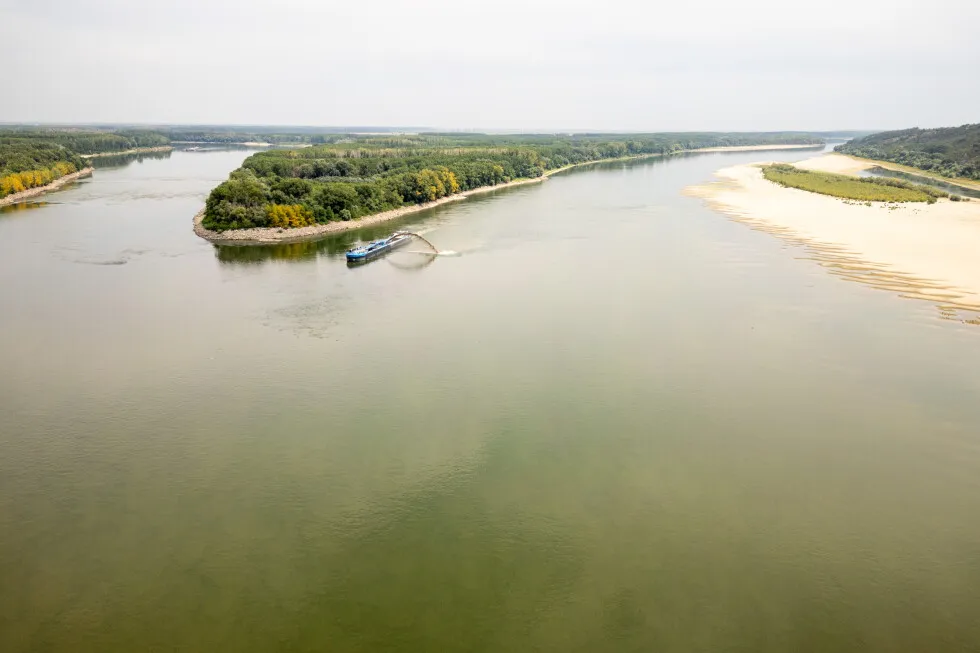
Romania rushes to sink 4 barges in the Danube to keep a nuclear power plant’s second reactor running 1 of 3 | A dredger ship operates on the Danube River after a controlled demolition of submerged rocks to improve water flow to the Cernavoda Nuclear Power Plant amid exceptionally low water levels of the Danube River, in Izvoarele, Romania, Monday, Aug. 3 2026. (AP Photo/ Vadim Ghirda) 2 of 3 | The Romanian Navy detonates underwater explosives during a controlled demolition of submerged rocks to improve water flow to the Cernavoda Nuclear Power Plant amid exceptionally low water levels on the Danube River, in Izvoarele, Romania, Monday, Aug. 3, 2026. (AP Photo/Andreea Alexandru) 3 of 3 | Usually submerged areas of the Danube River are exposed amid exceptionally low water levels, in Rasova, Romania, Monday, Aug. 3 2026. (AP Photo/ Vadim Ghirda) By STEPHEN McGRATH and VADIM GHIRDA Updated 5:21 PM MESZ, August 6, 2026 Leer en español Add AP News on Google Add AP News as your preferred source to see more of our stories on Google. Share Share Facebook Copy Link copied Print Email X LinkedIn Bluesky Flipboard Pinterest Reddit Bucharest, Romania (AP) — Romania raced on Thursday to sink four barges laden with rock into the Danube River in an attempt to redirect water downstream toward a nuclear power plant, to buy more time before its second reactor is likely forced offline due to Record-low water levels. Extreme heatwaves and Low rainfall across the region have left the Danube at record lows over the past week, forcing the shutdown of a reactor at Romania’s Cernavoda nuclear plant last week. The state-owned nuclear power plant accounts for about 20% of the country’s electricity generation when fully operational and uses river water to cool its reactors. The four barges were loaded with rock that Romania’s military blasted from the river this week using explosives near the Danube’s Bala Canal. Once submerged, the barges will create an underwater barrier to redirect the water down the river’s main channel and toward the Cernavoda plant. Speaking to local news channel Digi24, the plant’s director Romeo Urjan said Thursday the Danube’s water level had decreased about two centimeters (0.7 inches) from Wednesday to Thursday and that, without sinking the barges, the plant’s second reactor would likely have to be shut down in five to six days. “If the installed barges bring surplus water ... instead of five to six days, we will talk about nine to 10 days of operation from today onward,” he said. Record low Danube levels push some countries in Eastern Europe to the brink of energy emergency 3 MIN READ 15 Hungary braces for a full shutdown of the Paks nuclear plant as the Danube River hits record lows 4 MIN READ Los niveles récord del Danubio llevan a países de Europa oriental al borde de emergencia energética 4 MIN READ He added that the impact of the barges being submerged could take about a day to reach Cernavoda, since it’s located around 60 kilometers (37 miles) downstream. Authorities have implemented a series of emergency measures since the first reactor shut down, including dredging of the river. The Danube’s water flow has fallen to its lowest in decades this week at 1,400 cubic meters per second in Romania, less than a third of what is typical for this time of year. Acting Prime Minister Ilie Bolojan announced a nationwide state of alert in the energy sector on Jul. 31. He appealed to citizens and local authorities again on Thursday to voluntarily limit electricity usage in peak evening hours, and said that the sinking of the barges would likely last till Friday. Bolojan said after a government meeting that the works carried out so far aim to maintain a flow even if the Danube levels are forecast to be low, focusing on maintaining water flowing so that the second reactor can operate “at maximum capacity.” He added that Romania could face potential energy shortfalls if the Cernavoda plant is taken completely offline, adding that it could depend on whether energy could be imported during peak evening hours from neighboring countries, many of which are dealing with their own shutdowns amid the drought. In neighboring Hungary, the Danube’s record-low levels have pushed the country’s only nuclear power plant to the brink of powering down entirely for the first time in decades. In Moldova, which relies heavily on imported electricity, including from Romania, the authorities have urged citizens to voluntarily reduce usage during peak hours.
SRCAssociated Press (AP)
LANGEN
LEANCenter
WORDS753
ENT12
THU · 2026-08-06 · 15:53 GMTBRIEF NSR-2026-0806-99813
NSR-2026-0806-99813News Report·EN·Economic Impact
Romania rushes to sink 4 barges in the Danube to keep a nuclear power plant’s second reactor running
Romania is sinking four barges filled with rock into the Danube River to redirect water flow towards the Cernavoda Nuclear Power Plant. This emergency measure aims to prevent the shutdown of the plant's second reactor, which is threatened by record-low water levels caused by extreme heatwaves and drought.
Associated Press (AP)Filed 2026-08-06 · 15:53 GMTLean · CenterRead · 4 min
Associated Press (AP)FIG 01
Reading time
4min
Word count
753words
Sources cited
2cited
Entities identified
12entities
Quality score
100%
§ 01
Briefing Summary
AI-generatedNEWSAR · AI
Romania is sinking four barges filled with rock into the Danube River to redirect water flow towards the Cernavoda Nuclear Power Plant. This emergency measure aims to prevent the shutdown of the plant's second reactor, which is threatened by record-low water levels caused by extreme heatwaves and drought. The Cernavoda plant, responsible for about 20% of Romania's electricity, uses river water for cooling. The barges are intended to extend the reactor's operational time by an estimated four to five days. Authorities have also declared a state of alert in the energy sector and are urging voluntary electricity usage reductions. Neighboring countries like Hungary and Moldova are also facing energy challenges due to the low Danube levels.
Confidence 0.90Sources 2Claims 5Entities 12
§ 02
Article analysis
Model · rule-basedFraming
Economic Impact
Environmental
Tone
Measured
AI-assessed
CalmNeutralAlarmist
Factuality
0.90 / 1.00
Factual
LowHigh
Sources cited
2
Limited
FewMany
§ 03
Key claims
5 extracted01
Record low water levels in the Danube River have forced the shutdown of one reactor at the Cernavoda nuclear plant.
factual
Confidence
1.00
02
The Cernavoda nuclear plant accounts for about 20% of Romania's electricity generation.
factual
Confidence
1.00
03
Romania is sinking four barges laden with rock into the Danube River to redirect water towards a nuclear power plant.
factual
Confidence
1.00
04
Without the barges, the plant's second reactor would likely be forced offline in five to six days.
predictionRomeo Urjan
Confidence
0.90
05
The submerged barges could extend the operation of the second reactor by an additional four to five days.
predictionRomeo Urjan
Confidence
0.80
§ 04
Full report
4 min read · 753 words§ 05
Entities
12 identifiedKey playerOppositionContextPositiveNeutralNegative
Locations6
§ 06
Keywords & salience
10 termsdanube river
1.00
low water levels
1.00
nuclear power plant
1.00
cernavoda nuclear power plant
0.90
electricity generation
0.80
reactor shutdown
0.80
extreme heatwaves
0.70
barges
0.60
water flow
0.50
romania
0.40
§ 07
Topic connections
Interactive graph No topic relationship data available yet. This graph will appear once topic relationships have been computed.