Despite a slowing economy, recurring trade frictions and intensifying price competition, the value of China’s exports rose in 2025 by 6.1 per cent, year on year, to a record 26.98 trillion yuan (US$3.87 trillion) – cementing its position as the world’s largest trading nation.Behind that growth, China’s export machine is increasingly being shaped by coastal concentration and industrial upgrading, with market diversification cushioning external shocks at the cost of weaker prices and thinner margins.How has China’s export landscape changed?Export momentum remains highly concentrated in a handful of coastal manufacturing provinces and municipalities. Guangdong retained its position as China’s largest exporting province, with shipments reaching 6.03 trillion yuan in 2025, followed by Jiangsu and Zhejiang.Regionally, the Yangtze River Delta – home to Jiangsu, Zhejiang and Shanghai – exported goods worth about 10.85 trillion yuan, accounting for 40.2 per cent of the national total, while the Pearl River Delta, centred on Guangdong, shipped goods worth 5.83 trillion yuan. The two regions also contributed over 60 per cent of China’s export growth, reflecting their continued roles as core economic engines.While traditional contract manufacturing and industries heavily reliant on a single overseas market faced mounting pressure, exports of electromechanical equipment, new energy products, high-end manufactures and intermediate goods remained relatively resilient.In 2025, hi-tech exports grew by 13.2 per cent, year on year, contributing 2.4 percentage points to overall export growth. Exports of specialised equipment rose by 20.6 per cent, those of high-end machine tools were up 21.5 per cent, and industrial robots registered an increase of 48.7 per cent, according to customs data, with production and exporters concentrated in Guangdong, Jiangsu, Zhejiang and Shanghai.Industrial robot exports surpassed imports for the first time in 2025, rising by 8.7 per cent and underscoring China’s improved competitiveness in advanced manufacturing equipment.
SRCSouth China Morning Post
LANGEN
LEANCenter-Right
WORDS294
ENT8
FRI · 2026-01-23 · 13:30 GMTBRIEF NSR-2026-0123-9986
NSR-2026-0123-9986News Report·EN·Economic Impact
How are US tariffs and trade barriers redrawing China’s export map?
In 2025, China's exports reached a record $3.87 trillion, solidifying its position as the world's largest trading nation despite economic headwinds and trade frictions. Export growth is increasingly concentrated in coastal manufacturing provinces like Guangdong, Jiangsu, and Zhejiang, particularly within the Yangtze River and Pearl River Delta regions.
He HuifengSouth China Morning PostFiled 2026-01-23 · 13:30 GMTLean · Center-RightRead · 2 min
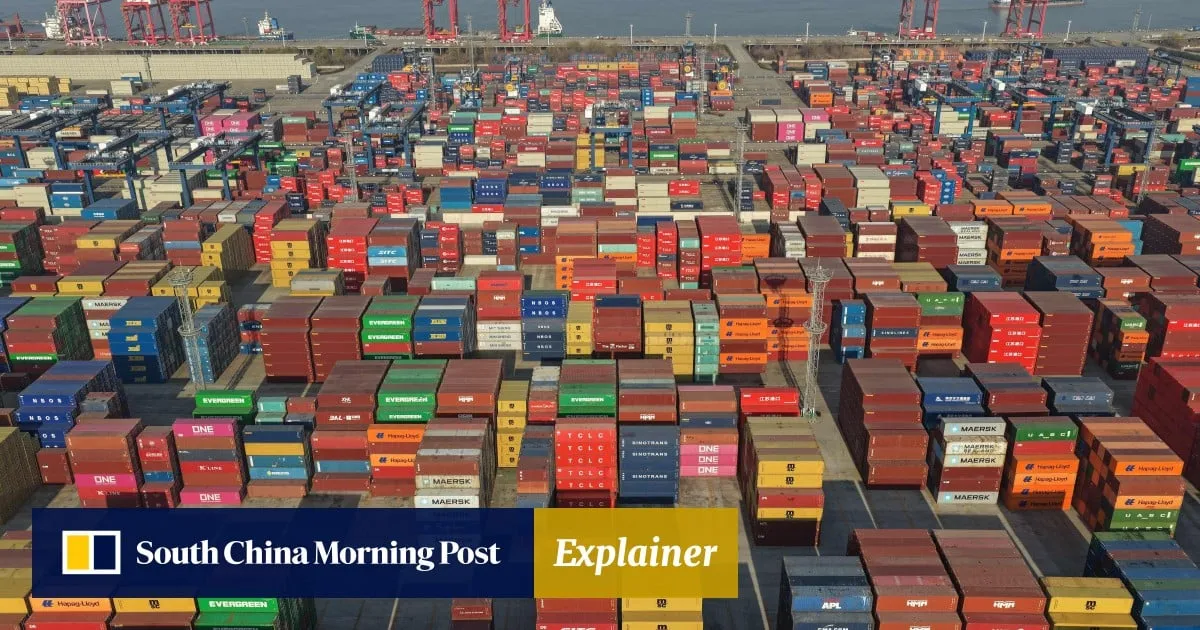
South China Morning PostFIG 01
Reading time
2min
Word count
294words
Sources cited
1cited
Entities identified
8entities
Quality score
100%
§ 01
Briefing Summary
AI-generatedNEWSAR · AI
In 2025, China's exports reached a record $3.87 trillion, solidifying its position as the world's largest trading nation despite economic headwinds and trade frictions. Export growth is increasingly concentrated in coastal manufacturing provinces like Guangdong, Jiangsu, and Zhejiang, particularly within the Yangtze River and Pearl River Delta regions. While traditional manufacturing faces pressure, exports of electromechanical equipment, new energy products, and high-end manufactures have remained resilient. Hi-tech exports grew significantly, with notable increases in specialized equipment, high-end machine tools, and industrial robots, signaling China's industrial upgrading. For the first time, China's industrial robot exports surpassed imports, highlighting improved competitiveness in advanced manufacturing.
Confidence 0.90Sources 1Claims 5Entities 8
§ 02
Article analysis
Model · rule-basedFraming
Economic Impact
Technology
Tone
Measured
AI-assessed
CalmNeutralAlarmist
Factuality
0.80 / 1.00
Factual
LowHigh
Sources cited
1
Limited
FewMany
§ 03
Key claims
5 extracted01
Industrial robot exports surpassed imports for the first time in 2025, rising by 8.7 per cent.
statisticnull
Confidence
1.00
02
In 2025, hi-tech exports grew by 13.2 per cent, year on year, contributing 2.4 percentage points to overall export growth.
statisticnull
Confidence
1.00
03
The Yangtze River Delta exported goods worth about 10.85 trillion yuan, accounting for 40.2 per cent of the national total.
statisticnull
Confidence
1.00
04
Guangdong retained its position as China’s largest exporting province, with shipments reaching 6.03 trillion yuan in 2025.
statisticnull
Confidence
1.00
05
China's exports rose in 2025 by 6.1 per cent, year on year, to a record 26.98 trillion yuan (US$3.87 trillion).
statisticnull
Confidence
1.00
§ 04
Full report
2 min read · 294 words§ 05
Entities
8 identifiedKey playerOppositionContextPositiveNeutralNegative
§ 06
Keywords & salience
10 termschina's export map
0.80
high-tech exports
0.80
trade barriers
0.70
yangtze river delta
0.60
coastal concentration
0.60
electromechanical equipment
0.60
industrial upgrading
0.50
pearl river delta
0.50
trade frictions
0.50
export momentum
0.40
§ 07
Topic connections
Interactive graph Network visualization showing 51 related topics
View Full Graph Person Organization Location Event|Click node to navigate|Edge numbers = shared articles