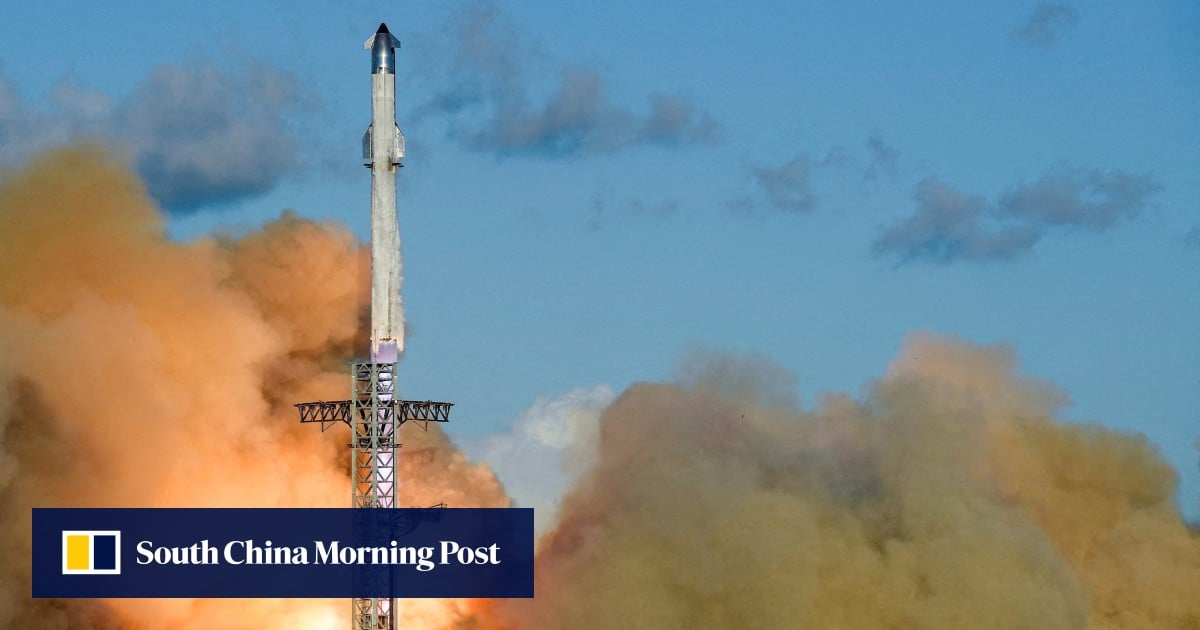
China should seize a potential strategic window opened by Elon Musk’s plans for a reusable launch vessel to stay competitive with the US as it faces the risk of a new power game in space, a Chinese research institute has urged.In 2022, the US Air Force Research Laboratory awarded Musk’s firm SpaceX a five-year contract to explore how Starship – which it is developing with the aim of creating the world’s largest and most powerful launch vehicle – could be used for “global rapid mobility”, which refers to the swift, efficient movement of troops and equipment across the world.So far the concept is theoretical. But if it can be made a reality, it may reduce the US military’s reliance on overseas bases or aircraft carrier fleets and make existing air defences, such as missiles and early warning systems, obsolete.This could also reshape “the traditional strategic balance” on the planet and herald the dawn of a new global power game, Beijing-based think tank Anbound said in a report issued on Tuesday, adding that China faced both a “challenge and opportunity”.“[Starship’s] suborbital flight trajectory crosses the boundary between the atmosphere and near-Earth space, theoretically free from traditional airspace restrictions and difficult for existing defence systems to intercept or effectively constrain,” it added.It predicted: “The emergence of this ‘sovereignty in orbit’ signals that great-power competition is shifting from horizontal geographic expansion to a contest for control over [launch] timing. Whoever masters the launch window will hold the initiative over timing.”
SRCSouth China Morning Post
LANGEN
LEANCenter-Right
WORDS247
ENT7
FRI · 2026-01-23 · 12:01 GMTBRIEF NSR-2026-0123-9993
NSR-2026-0123-9993News Report·EN·National Security
Can Elon Musk’s Starship upend the strategic order? A Chinese think tank warns it might
A Chinese think tank, Anbound, has warned that Elon Musk's Starship program could disrupt the global strategic order and create a new space-based power dynamic. The concern stems from a US Air Force Research Laboratory contract with SpaceX to explore Starship's potential for rapid global mobility, which could allow for swift troop and equipment deployment.
Orange WangSouth China Morning PostFiled 2026-01-23 · 12:01 GMTLean · Center-RightRead · 1 min
South China Morning PostFIG 01
Reading time
1min
Word count
247words
Sources cited
2cited
Entities identified
7entities
Quality score
100%
§ 01
Briefing Summary
AI-generatedNEWSAR · AI
A Chinese think tank, Anbound, has warned that Elon Musk's Starship program could disrupt the global strategic order and create a new space-based power dynamic. The concern stems from a US Air Force Research Laboratory contract with SpaceX to explore Starship's potential for rapid global mobility, which could allow for swift troop and equipment deployment. Anbound suggests that if Starship's suborbital flight capabilities become a reality, it could render existing air defenses obsolete and reduce reliance on traditional military infrastructure. The think tank argues that this development presents both a challenge and an opportunity for China, requiring them to compete for control over launch timing to maintain strategic parity with the US. They believe mastering the launch window will give a country the initiative.
Confidence 0.90Sources 2Claims 5Entities 7
§ 02
Article analysis
Model · rule-basedFraming
National Security
Technology
Tone
Measured
AI-assessed
CalmNeutralAlarmist
Factuality
0.70 / 1.00
Factual
LowHigh
Sources cited
2
Limited
FewMany
§ 03
Key claims
5 extracted01
The US Air Force Research Laboratory awarded SpaceX a five-year contract to explore Starship's use for “global rapid mobility”.
factual
Confidence
1.00
02
China should seize a potential strategic window opened by Elon Musk’s plans for a reusable launch vessel.
quoteChinese research institute
Confidence
0.90
03
Starship's suborbital flight trajectory is theoretically free from traditional airspace restrictions.
quoteAnbound
Confidence
0.80
04
Great-power competition is shifting from geographic expansion to a contest for control over launch timing.
predictionAnbound
Confidence
0.70
05
Starship may reduce the US military’s reliance on overseas bases or aircraft carrier fleets.
prediction
Confidence
0.60
§ 04
Full report
1 min read · 247 words§ 05
Entities
7 identifiedKey playerOppositionContextPositiveNeutralNegative
Organizations2
§ 06
Keywords & salience
9 termsstarship
1.00
strategic order
0.90
global rapid mobility
0.80
space competition
0.70
military strategy
0.60
launch vehicle
0.60
suborbital flight
0.50
great-power competition
0.50
us air force
0.40
§ 07
Topic connections
Interactive graph Network visualization showing 51 related topics
View Full Graph Person Organization Location Event|Click node to navigate|Edge numbers = shared articles