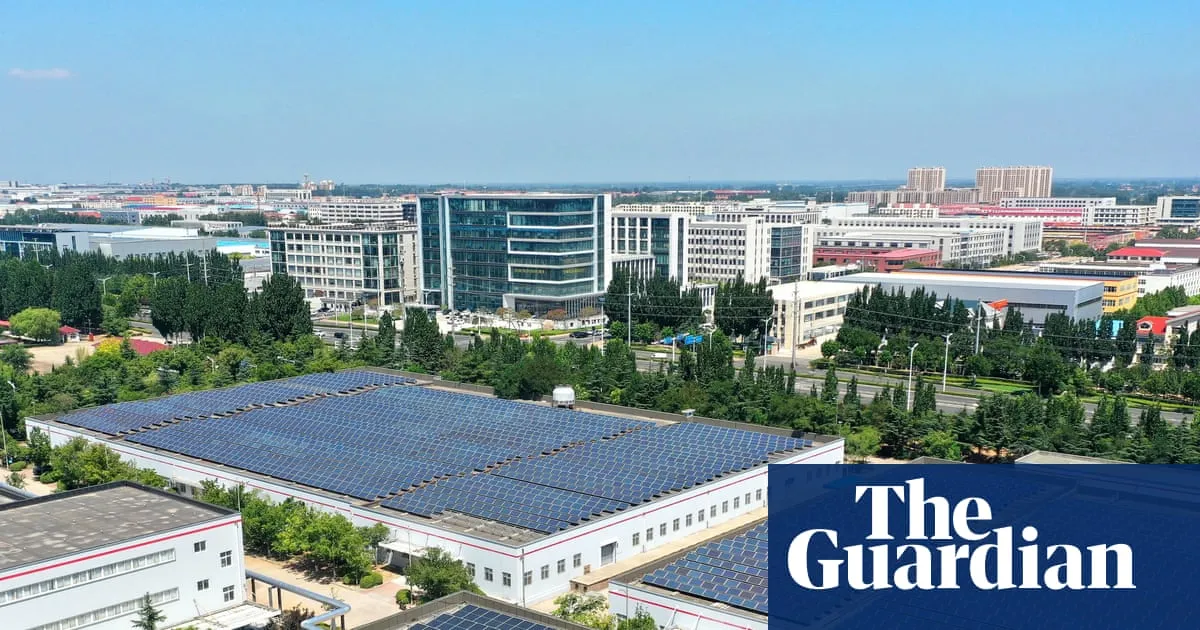
Donald Trump has ordered a new 15% tariff on imported products made of Polysilicon, an important ingredient in microchip manufacturing that is primarily produced by China.The new tariff, which will take effect on 4 December, is aimed at supporting US chip and solar panel supply chains to compete with Beijing on Artificial Intelligence and energy.The executive order signed by the president on Thursday evening said: “The plan of action in this proclamation will, among other things, help ensure the commercial viability of United States production of Polysilicon and its derivatives that is necessary to meet United States economic and national security requirements.”Polysilicon, an ultra-pure form of silicon, is an important ingredient in making the semiconductors vital for AI processing power, datacentres and solar power generation.US solar factories have long accused Chinese rivals of dumping cheaper panels on the market, which they say have been enabled by excessive government subsidies and by moving manufacturing to other countries to dodge US tariffs.China’s foreign affairs ministry hit back at the latest measures, accusing the US of “overstretching the concept of national security, and abusing state power to go after Chinese businesses”.Solar Panels advance toward final testing at a First Solar manufacturing facility in Perrysburg, Ohio, US. Photograph: Emily Elconin/Bloomberg via Getty Images“Protectionism will not make the US more competitive,” the spokesperson Lin Jian said, arguing that the move “seriously disrupts normal trade and economic exchanges between Chinese and US businesses, and is not in the interest of US businesses and consumers or anyone else for that matter”.“China will continue firmly protecting our businesses’ legitimate and lawful rights and interests,” Lin added.The US has two main Polysilicon factories, including Hemlock Semiconductor, which operates a plant in Michigan and is a joint venture between the US tech company Corning and Japan’s Shin-Etsu Handotai. The Munich-based Wacker Chemie runs a factory in Tennessee.A spokesperson for Corning said the new tariff encouraged “continued investment in US capacity and supports long-term US competitiveness”, while Wacker said it appreciated the administration’s engagement “given the ramifications for semiconductor supply chain resilience, advanced computing infrastructure, and broader US defence and security interests”.Trump said in the order that he had accepted recommendations by the commerce secretary, Howard Lutnick, to set minimum import prices of $21 (£15.62) a kilogram for Polysilicon, $100 a kilogram for Polysilicon ingots and wafers, $0.22 a watt for solar cells, and $0.38 a watt for solar modules or panels.skip past newsletter promotionafter newsletter promotionThe order also allows the commerce department to create an incentive programme for companies that invest in factories to produce Polysilicon or derivative products.Trump’s move against China comes as Beijing revealed the country’s exports surged by 23.9% in dollar terms year-on-year in July, driven by shipments of AI-related products.Sheana Yue, senior Asia economist at the consultancy Oxford Economics, said China’s “strong electronics and machinery exports”, combined with industrial input imports, suggested that “AI and electrification will drive global manufacturing”.She added that although disruption in the Middle East could continue to keep energy and transport costs elevated, “China’s competitiveness in AI hardware, electric vehicles, batteries, and other high-value manufacturing will probably allow it to continue gaining global export market share despite softer demand”.
SRCThe Guardian - World News
LANGEN
LEANCenter-Left
WORDS527
ENT12
FRI · 2026-08-07 · 09:11 GMTBRIEF NSR-2026-0807-100045
NSR-2026-0807-100045News Report·EN·Economic Impact
Trump orders new 15% tariff on key material for solar panels and microchips
President Trump has ordered a new 15% tariff on imported polysilicon products, set to take effect on December 4th. This measure aims to bolster domestic US supply chains for microchips and solar panels, which are crucial for artificial intelligence and energy sectors.
Lauren Almeida and Alicia Chen in TaipeiThe Guardian - World NewsFiled 2026-08-07 · 09:11 GMTLean · Center-LeftRead · 3 min
The Guardian - World NewsFIG 01
Reading time
3min
Word count
527words
Sources cited
4cited
Entities identified
12entities
Quality score
100%
§ 01
Briefing Summary
AI-generatedNEWSAR · AI
President Trump has ordered a new 15% tariff on imported polysilicon products, set to take effect on December 4th. This measure aims to bolster domestic US supply chains for microchips and solar panels, which are crucial for artificial intelligence and energy sectors. The tariff is intended to support US polysilicon production and make it more competitive against China, the primary global producer. China's foreign affairs ministry criticized the move, calling it protectionist and disruptive to trade. US companies like Corning and Wacker Chemie, which operate polysilicon factories in the US, expressed support for the tariff, citing benefits for domestic investment and supply chain resilience. The order also establishes minimum import prices for polysilicon and related products.
Confidence 0.90Sources 4Claims 5Entities 12
§ 02
Article analysis
Model · rule-basedFraming
Economic Impact
Diplomatic
Tone
Measured
AI-assessed
CalmNeutralAlarmist
Factuality
0.80 / 1.00
Factual
LowHigh
Sources cited
4
Well sourced
FewMany
§ 03
Key claims
5 extracted01
The order also allows the commerce department to create an incentive programme for companies that invest in factories to produce polysilicon or derivative products.
factual
Confidence
1.00
02
China's foreign affairs ministry accused the US of 'overstretching the concept of national security, and abusing state power to go after Chinese businesses'.
quoteChina's foreign affairs ministry
Confidence
1.00
03
The new tariff, which will take effect on 4 December, is aimed at supporting US chip and solar panel supply chains to compete with Beijing on artificial intelligence and energy.
factual
Confidence
1.00
04
Donald Trump has ordered a new 15% tariff on imported products made of polysilicon.
factual
Confidence
1.00
05
US solar factories have long accused Chinese rivals of dumping cheaper panels on the market.
factualUS solar factories
Confidence
0.90
§ 04
Full report
3 min read · 527 words§ 05
Entities
12 identifiedKey playerOppositionContextPositiveNeutralNegative
Organizations4
§ 06
Keywords & salience
8 termspolysilicon tariff
1.00
solar panels
0.90
microchips
0.90
us china trade
0.80
supply chains
0.70
artificial intelligence
0.60
national security
0.50
protectionism
0.40
§ 07
Topic connections
Interactive graph Network visualization showing 51 related topics
View Full Graph Person Organization Location Event|Click node to navigate|Edge numbers = shared articles