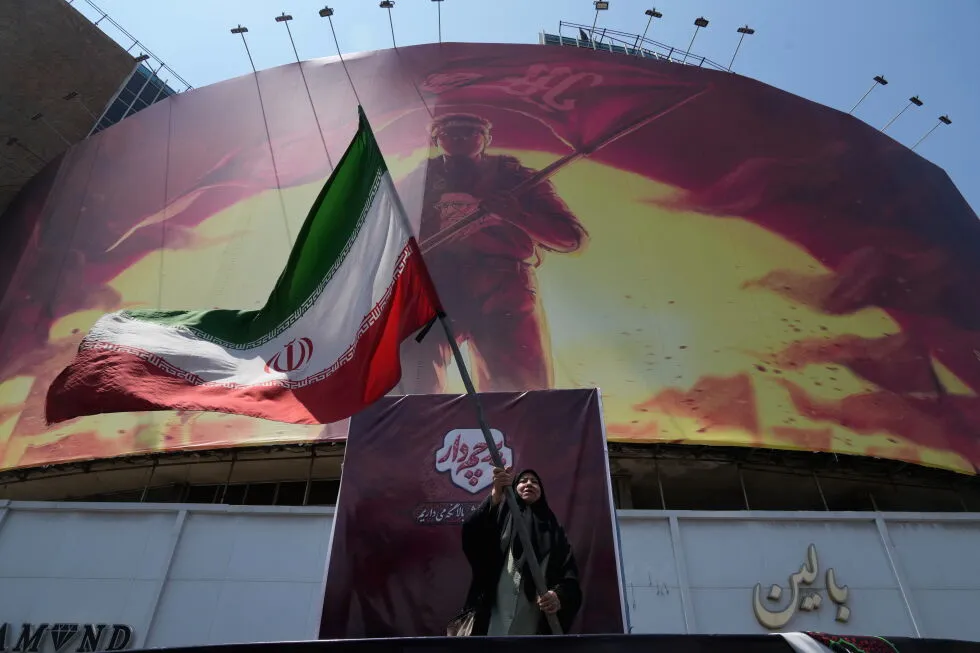
Iran’s leaders believe a victory is within reach, and that time is on their side 1 of 5 | A woman waves an Iranian flag next to a billboard showing a graphic of a man wearing a shirt showing the face of late Iranian Supreme Leader Ayatollah Ali Khamenei, who was killed during a joint U.S. and Israeli strike on Feb. 28, with words calling upon the avengers of Imam Hussein, one of Shiite Islam’s most beloved historical saints, in a square in downtown Tehran, Iran, Saturday, Aug. 1, 2026. (AP Photo/Vahid Salemi) CORRECTS: Amends wording for clarity. 2 of 5 | People spend time at a beach as commercial vessels are anchored in the Strait of Hormuz off Bandar Abbas, Iran, Wednesday, Aug. 5, 2026. (Amirhosein Khorgooi/ISNA via AP) 3 of 5 | Women walk past a banner showing portraits of the late Iranian revolutionary founder Ayatollah Khomeini, left, Supreme Leader Ayatollah Mojtaba Khamenei, center, and the late Supreme Leader Ayatollah Ali Khamenei, who was killed in the U.S. and Israel strike on Feb. 28, under a bridge in northern Tehran, Iran, Sunday, Aug. 2, 2026. (AP Photo/Vahid Salemi) 4 of 5 | Vehicles drive past a billboard showing a photo of the late Iranian Supreme Leader Ayatollah Ali Khamenei, right, greeting the late Hamas leader Ismail Haniyeh, and Iranian and Palestinian flags, at an intersection in downtown Tehran, Iran, Saturday, Aug. 1, 2026. (AP Photo/Vahid Salemi) 5 of 5 | President Donald Trump speaks in the Oval Office of the White House, Thursday, Aug. 6, 2026, in Washington. (AP Photo/Alex Brandon) By JOSEPH KRAUSS and AMIR-HUSSEIN RADJY Updated 6:03 AM MESZ, August 8, 2026 Leer en español Add AP News on Google Add AP News as your preferred source to see more of our stories on Google. Share Share Facebook Copy Link copied Print Email X LinkedIn Bluesky Flipboard Pinterest Reddit The Strait of Hormuz is, by some accounts, named for a Zoroastrian deity destined to emerge victorious after a 9,000-year standoff with an adversary. Iran’s leaders feel their own victory is at hand and won’t require the same epic patience. They are betting that military pressure will ultimately force the United States to accept their control over the crucial waterway for global energy — and that time is on their side. They know about the diminishing stockpiles of key U.S. weapons such as advanced missile interceptors. They know the war is deeply unpopular with Americans. They know that as long as the strait is largely closed, the price of gas and other goods will stay high ahead of U.S. congressional elections in November. They know that trying to open it by force would be costly and may require American ground troops. They know their Houthi allies in Yemen could widen the war and disrupt another major trade route. By that logic, U.S. President Donald Trump has no choice but to capitulate. Trump points to strikes that have decimated Iran’s top leadership, navy and air force. He alternates between threatening escalation and saying talks are going well. Iran’s own economy has been battered, in part because of a U.S. blockade. Iranians rose up in mass protests just months ago and could do so again. And Iran’s leaders need only look to how Trump’s “short-term excursion” to the Middle East has bogged down to be reminded that wars rarely turn out as expected. US military says it is striking Iran in response to attack on civilian vessel in Strait of Hormuz 3 MIN READ 20 US airstrikes hit northern Iran as it disables ship trying to run the blockade 3 MIN READ 23 US military completes 11th night of strikes on Iran as attacks overshadow diplomacy 3 MIN READ 23 An evolving deal could give Iran a major win Iran says it is close to reaching a deal with Oman to manage the strait, which runs between the two countries. But it would be conditioned on the U.S. lifting its blockade, so even if there are no direct negotiations — as Iran says — Trump would have to approve. It’s unclear whether the deal would allow Iran to charge fees. But it would formalize its control over what had been an open international waterway before the war, one that carried a fifth of the world’s traded oil and gas. Abdolreza Davari, an analyst who once advised former President Mahmoud Ahmadinejad, said Iran’s effective control of the strait has given it leverage with the U.S. and regional countries that can help guarantee its security. “More than revenue from the strait, Iran wants to confirm its management and sovereignty over the strait,” he said by phone from Tehran. Formal control over even part of the strait would be a clear win for Iran and a loss for the U.S., which has yet to accomplish some of its various and shifting goals in the war. It would also deal a blow to global norms on freedom of navigation and set a precedent that much of the world would find disturbing — that nations can shut down trade choke points at will. China, which buys oil from Iran and has influence over it, said as recently as May that “normal and safe passage” through the strait should be restored. To borrow a phrase from Trump’s own theory of geopolitics, Iran believes it holds the cards. “They started the war, but its end was never with them. We always decide for ourselves when it ends,” Mahdi Mohammadi, an adviser to Iran’s chief negotiator, posted on social media. “Iran is going after the enemy’s defeat — not an agreement.” He said a surprise Iranian attack on Jordan in July “compensated” for a drop in oil prices. That contributed to the collapse of an interim agreement reached in June that had offered significant concessions to Iran, including a U.S. waiver to sell oil internationally and the promise of broader sanctions relief. Iran has repeatedly said the Strait of Hormuz will not go back to being an open waterway, and that it will keep attacking ships trying to transit without its permission. Iran’s joint military command has called it an “unbreakable red line.” “For Iran, the Strait of Hormuz has become a strategic lever for deterrence, maintaining the regional balance of power, and reshaping the security rules in the Persian Gulf,” said Mostafa Najafi, a Tehran-based security analyst. That poses a major obstacle to ending the war, much less resolving the even more complex, long-standing dispute over Iran’s nuclear program. “The atomic issue, because of the conflict in the Strait of Hormuz, has been pushed to the side, and in reality, that is in Iran’s interests,” said Rahman Ghahremanpour, an Iran-based analyst. Control of the strait would give Iran leverage if the nuclear talks resume, he added. The economic fallout from the war has spread worldwide but is particularly acute in Iran. U.S. and Israeli strikes have pummeled its industrial base. The U.S. blockade has choked off much of its oil exports. Iranians are grappling with triple-digit food inflation. Trump has repeatedly threatened major strikes on civilian infrastructure like water and electricity. In December, a currency crisis sparked some of the biggest anti-government protests in the 47-year history of the Islamic Republic. Authorities responded with a bloody crackdown in which thousands were killed and tens of thousands detained. Many in Iran, including those close to its moderate President Masoud Pezeshkian, fear it may go too far. Mohammad Javad Zarif, who as foreign minister helped negotiate the 2015 nuclear deal, wrote in a recent essay that Iran’s achievements in the war had opened “an exceptional window for diplomacy.” But he warned that if it doesn’t strike a deal soon, then “economic recovery will be difficult, and the possibility of internal unrest or renewed aggression, especially after the U.S. elections, cannot be ruled out.” After the first wave of U.S. and Israeli airstrikes on Feb. 28 killed Iran’s supreme leader and other top officials, Trump suggested it would be over in a matter of weeks. Instead, the conflict has emboldened Iran’s leaders and mobilized their supporters. Tehran is using the strait “to show that it has not been defeated,” Ghahremanpour said. “It can increase its legitimacy at home.” But the strategy could also backfire. Iran’s resilience has limits and there are concerns that an economic crash could trigger unrest. “Iran cannot continue with this strategy forever, and at a certain point, in reality, it has to reach a deal with America,” he said. But Davari said that for now, Iran can withstand the pressure. “It’s unlikely, despite the difficulties of the economic situation, that Iran will retreat from its positions,” he said. Associated Press reporter Hend Kortam in Cairo contributed. Krauss has reported from across the Middle East for more than 20 years, including postings in Cairo, Baghdad and Jerusalem. Radjy is a Cairo-based journalist who has reported on Iran for over a decade.
SRCAssociated Press (AP)
LANGEN
LEANCenter
WORDS1 485
ENT12
SAT · 2026-08-08 · 04:23 GMTBRIEF NSR-2026-0808-100296
NSR-2026-0808-100296News Report·EN·Political Strategy
Iran’s leaders believe a victory is within reach, and that time is on their side
Iran's leaders believe they are close to victory in their conflict with the United States, feeling that time is on their side. They are leveraging military pressure, including control over the Strait of Hormuz, to force the U.S.
Associated Press (AP)Filed 2026-08-08 · 04:23 GMTLean · CenterRead · 6 min
Associated Press (AP)FIG 01
Reading time
6min
Word count
1 485words
Sources cited
0cited
Entities identified
12entities
Quality score
100%
§ 01
Briefing Summary
AI-generatedNEWSAR · AI
Iran's leaders believe they are close to victory in their conflict with the United States, feeling that time is on their side. They are leveraging military pressure, including control over the Strait of Hormuz, to force the U.S. to accept their dominance over the crucial waterway. Iran is aware of diminishing U.S. weapons stockpiles and the unpopularity of the war among Americans, anticipating this will pressure President Trump ahead of U.S. elections. While Iran faces economic hardship and internal dissent, it is also exploring a deal with Oman to manage the strait, which would formalize its control. This strategy carries risks, including potential escalation and internal unrest, but Iran's leaders believe they can withstand the pressure and achieve their objectives.
Confidence 0.90Claims 5Entities 12
§ 02
Article analysis
Model · rule-basedFraming
Political Strategy
Conflict
Tone
Measured
AI-assessed
CalmNeutralAlarmist
Factuality
0.60 / 1.00
Mixed
LowHigh
Sources cited
0
No named sources
FewMany
§ 03
Key claims
5 extracted01
Iran knows the war is deeply unpopular with Americans.
factualIran
Confidence
0.80
02
Iran's leaders believe a victory is within reach and that time is on their side.
factualIran's leaders
Confidence
0.80
03
Iran knows about the diminishing stockpiles of key U.S. weapons such as advanced missile interceptors.
factualIran
Confidence
0.70
04
Iran's leaders are betting that military pressure will ultimately force the United States to accept their control over the Strait of Hormuz.
factualIran's leaders
Confidence
0.70
05
By that logic, U.S. President Donald Trump has no choice but to capitulate.
prediction
Confidence
0.50
§ 04
Full report
6 min read · 1 485 words§ 05
Entities
12 identifiedKey playerOppositionContextPositiveNeutralNegative
People5
Organizations1
§ 06
Keywords & salience
9 termsiran's leaders
1.00
strait of hormuz
1.00
military pressure
0.90
global energy
0.80
u.s. weapons
0.70
iranian flag
0.60
ayatollah ali khamenei
0.50
donald trump
0.40
hamas leader
0.40
§ 07
Topic connections
Interactive graph Network visualization showing 51 related topics
View Full Graph Person Organization Location Event|Click node to navigate|Edge numbers = shared articles