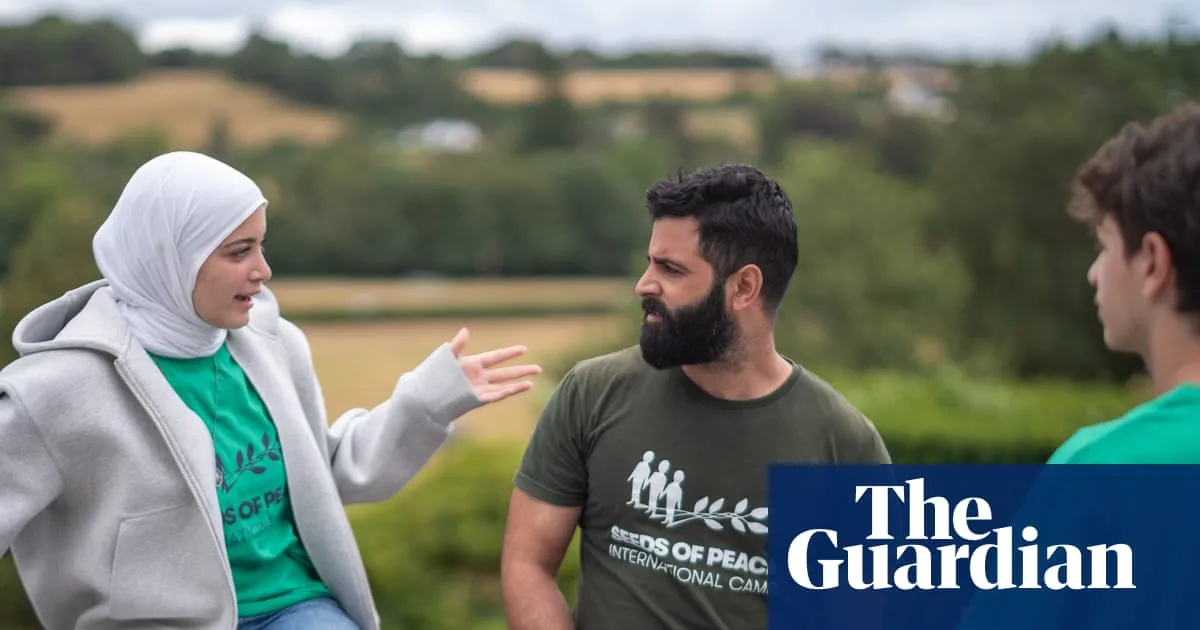
On the surface it looks like a normal summer school in the Devon countryside, with teenagers playing volleyball in the sun, doing arts and crafts in the hall, and preparing for the night’s talent show.But behind the scenes, intensive discussions are taking place. Many of these teenagers come from opposite sides of historical national conflicts – from Israel and Palestine, India and Pakistan.Every day at Seeds of Peace they spend two hours in dialogue sessions with each other, sharing their personal experiences, their pain and trauma, and trying to find the common ground that unites them. Over the course of three weeks, that is 32 hours in a room discussing heavy topics and trying to build bridges.“You won’t find them sitting with maps and facts and books,” said Eva Armour, Seeds of Peace’s executive director. “They’re talking about their own lived experiences – that’s how the learning is happening. You can’t debate someone else’s lived experience the way that you might debate what happened in the war.Eva Armour, Seeds of Peace executive director, with global youth programme lead, Qasim Aslam. Photograph: Jim Wileman/The Guardian“It’s almost embarrassingly simple how well this model works, but we need to invest in this work even a fraction of what we’re investing in the aftermath of war.”The Seeds of Peace summer camp, for teenagers aged 14 to 17 from eight different countries including the UK, has been running for 30 years but this is the first time it has been held in Britain.Founded in 1993 by the American journalist John Wallach, it usually takes place in the US but political uncertainty meant organisers felt the UK was a safer bet this year.The 14- to 17-year-olds at the camp, who come from all over the world, are known as ‘seeds’. Photograph: Jim Wileman/The Guardian“Picking a country to host this is one of the enormous challenges,” said Qasim Aslam, the global youth programme lead. “If you pull up a map, there are very few countries where all parents from all eight countries would be comfortable sending their kids, and where we can get visas for all participants.”Coming to the end of their three-week stay at a Devonshire boarding school in Tavistock, many of the campers – known as “seeds” – said the experience had been challenging but life-changing.Mika, 17 from Israel: ‘Facing someone who is supposed to be my enemy, but she’s just a girl like me – it’s difficult.’ Photograph: Jim Wileman/The GuardianMika, a 17-year-old from Israel, said she was glad she attended even though she had not come closer to answering her questions about peace. “Now I’m thinking, did I really expect three weeks to fix it all?“Facing someone who is supposed to be my enemy, but she’s just a girl like me – it’s difficult,” she said. “I could just not know about it and go and have fun in another summer camp and it would be way easier. But I prefer knowing it and starting to work through it for what I believe.“If one day maybe I have the power to change something, I don’t want to be ignorant. I want to know the pains of everyone.”Hala, 16, is Palestinian and from Jerusalem: ‘It was hard at first, I thought I was betraying something deep down inside of me.’ Photograph: Jim Wileman/The GuardianHala, a 16-year-old Palestinian from Jerusalem, said it was the first time she had met Israelis “outside of checkpoints, raids and IDF uniforms”.“It was hard at first, I thought I was betraying something deep down inside of me,” she said. “But when I got to know these people, I realised they have very different views about their government. And we like the same movie. We have so many things in common.”Esther, 17, from Belfast: ‘It’s really powerful to hear from people themselves.’ Photograph: Jim Wileman/The GuardianEven for those coming from outside the main conflict zones, the experience has been enlightening. “I have never had the chance to speak to people from different countries like Israel and Palestine before – you never know how the media censors stuff so it’s really powerful to hear from people themselves,” said Esther, a 17-year-old from Belfast. “I feel like I’ll be much less quick to judge people now.”For some participants, the act of attending is fraught with difficulty. Ahmad, a 26-year-old Palestinian camp counsellor who previously attended as a teenager, said he would not be speaking about his summer trip back home.The act of attending can be fraught with difficulty for some. Photograph: Jim Wileman/The Guardian“For some people, it feels like you’re betraying your country, because you’re trying to make peace with the people who are killing you at the same time,” he said. “You can’t just go home and expect people to understand Seeds of Peace in a second. You need to be here to understand that.”While camp organisers aim to get a diverse range of teenagers, they admitted there were limits to how accessible they could be – English language skills are required so the dialogue sessions can be most effective.The cost to attend the summer camp is $9,000 (£6,700), although many of those attending receive scholarships to cover the vast majority of this fee. And in some countries there is a competitive application process. “We’re trying to identify young people that could be influencers in their respective communities in the future,” said Aslam.Many past attenders have gone on to become politicians, ambassadors and business leaders, taking the skills they learned at Seeds of Peace with them into their work.Past attenders have gone on to become politicians, ambassadors and business leaders. Photograph: Jim Wileman/The GuardianOver the past three decades, the organisers have worked in areas such as the Balkans, Cyprus, Greece, Turkey and Afghanistan, tailoring their camps to respond to geopolitical events. They also do year-round work and regional camps in place where need is greatest.“It feels like it’s getting harder for people to be able to talk to each other across differences,” said Armour. “After 7 October [attacks on Israel by Hamas], we actually got a lot of calls from schools and institutions saying we don’t really know how to talk to each other about this, can you help?”Joud, 17, from Jordan: ‘I learned how to listen and understand, not just respond.’ Photograph: Jim Wileman/The GuardianJoud, a 17-year-old from Jordan attending for the second year, said the camp had enabled her to have healthy debate with her family for the first time, and she had become good friends with a Jewish girl from the US, which she “never expected”.“Our social identities are complete opposites. But we connected in many different ways, and I learned how to listen and understand, not just respond,” she said.“In what situations are 14- to 17-year-olds with very opposing ideologies and opinions sat down together in a room for two hours talking about things that maybe the leaders of their own countries don’t have the courage to sit down and talk about?”
SRCThe Guardian - World News
LANGEN
LEANCenter-Left
WORDS1 154
ENT12
SAT · 2026-08-08 · 08:00 GMTBRIEF NSR-2026-0808-100332
NSR-2026-0808-100332News Report·EN·Human Interest
Planting the seeds? Teenagers from across global divide talk peace in Devon
For the first time in its 30-year history, the Seeds of Peace summer camp has been held in Devon, UK. The program brings together teenagers aged 14-17 from countries with historical national conflicts, including Israel and Palestine, and India and Pakistan.
Jessica Murray Social affairs correspondentThe Guardian - World NewsFiled 2026-08-08 · 08:00 GMTLean · Center-LeftRead · 5 min
The Guardian - World NewsFIG 01
Reading time
5min
Word count
1 154words
Sources cited
2cited
Entities identified
12entities
Quality score
100%
§ 01
Briefing Summary
AI-generatedNEWSAR · AI
For the first time in its 30-year history, the Seeds of Peace summer camp has been held in Devon, UK. The program brings together teenagers aged 14-17 from countries with historical national conflicts, including Israel and Palestine, and India and Pakistan. Participants engage in daily dialogue sessions for three weeks, sharing personal experiences and trauma to find common ground. This approach focuses on lived experiences rather than debates about facts. The move to the UK was due to political uncertainty, with organizers citing the difficulty of finding a host country where all participants' parents would be comfortable sending their children. Campers described the experience as challenging but life-changing, fostering understanding and a desire to work towards peace despite the difficulties.
Confidence 0.90Sources 2Claims 5Entities 12
§ 02
Article analysis
Model · rule-basedFraming
Human Interest
Conflict
Tone
Measured
AI-assessed
CalmNeutralAlarmist
Factuality
0.60 / 1.00
Mixed
LowHigh
Sources cited
2
Limited
FewMany
§ 03
Key claims
5 extracted01
Mika, a 17-year-old from Israel, found it difficult but preferable to face someone perceived as an enemy who is 'just a girl like me'.
quoteMika
Confidence
1.00
02
This is the first time the Seeds of Peace camp, running for 30 years, has been held in Britain.
factual
Confidence
1.00
03
Eva Armour states that learning happens through discussing lived experiences, not through maps and facts.
quoteEva Armour
Confidence
1.00
04
The camp involves daily dialogue sessions where teenagers share personal experiences, pain, and trauma to find common ground.
factual
Confidence
1.00
05
Seeds of Peace is a summer camp for teenagers aged 14-17 from countries with historical national conflicts.
factual
Confidence
1.00
§ 04
Full report
5 min read · 1 154 words§ 05
Entities
12 identifiedKey playerOppositionContextPositiveNeutralNegative
Organizations1
§ 06
Keywords & salience
10 termspeacebuilding
1.00
conflict resolution
0.90
dialogue sessions
0.80
seeds of peace
0.80
youth programs
0.70
lived experiences
0.70
international relations
0.60
national conflicts
0.50
summer camp
0.40
devon
0.40
§ 07
Topic connections
Interactive graph No topic relationship data available yet. This graph will appear once topic relationships have been computed.