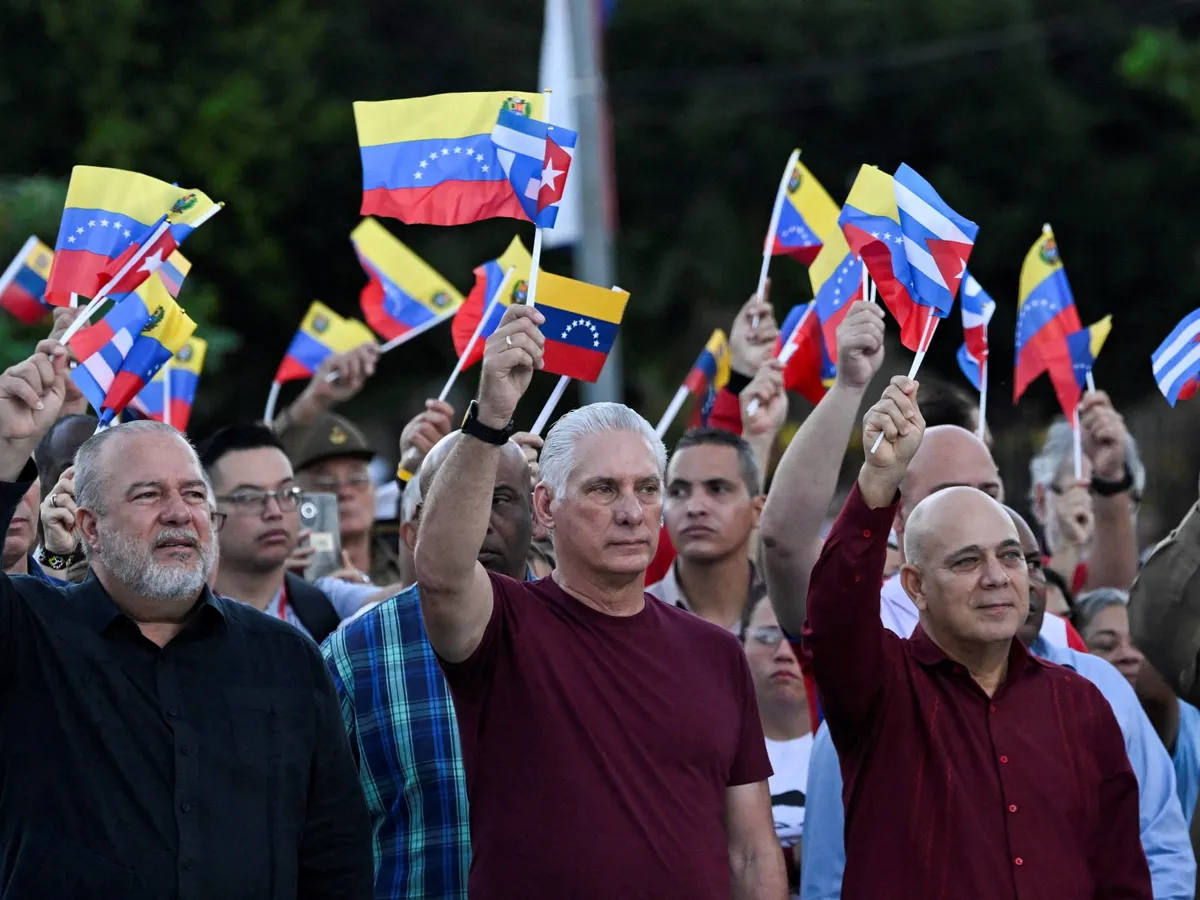
Donald Trump has threatened to sever Venezuelan supplies of oil and funds. But will an ever-more fragile Cuban economy be a boon or a setback?Cuba's President Miguel Diaz-Canel has maintained close relations with the government of Venezuela [File: Norlys Perez/Reuters]Cuba's President Miguel Diaz-Canel has maintained close relations with the government of Venezuela [File: Norlys Perez/Reuters]Published On 23 Jan 2026Havana, Cuba – “I have two bits of news for you: one good and one bad.”Those were the first words Elena Garcia, a 28-year-old web designer, heard when she woke up on the morning of January 3, hours after a United States military operation abducted Venezuelan President Nicolas Maduro and his wife, Cilia Flores.“The good news is that the water has arrived,” her boyfriend continued. “The bad news is that they kidnapped Maduro, and that means that this year we will surely have blackouts.”Supply shortages are endemic throughout much of Cuba. In Villa Panamericana, the neighbourhood in Havana where Garcia lives, deliveries of fresh water had not arrived for a week.Still, compared to the rest of the city, the neighbourhood is relatively privileged: It suffers from fewer power outages than other areas.But until this month, Cuba has been able to rely on Venezuela for support, including through shipments of the fuel needed to run its electrical grid.That changed on January 3. With Maduro's ouster, Cuba risks losing one of its closest allies in the Western Hemisphere.By January 11, US President Donald Trump announced Venezuela would no longer supply Cuba with oil or money.The threat of ending Venezuela's support is expected to further devastate the Cuban economy — and possibly trigger unrest.So far, since the US attack on Venezuela, the streets of Havana have been calm, and the Cuban government has pledged to maintain ties with Venezuela.By contrast, debates are raging on social media about what will come next, as the US flexes its might.“There are people who fear an invasion and people who are calling for one,” said Amanda Terrero, 28, a communications professor at the University of Havana.She explained that the country is gripped with uncertainty about what the future holds.“People are even making contingency plans to leave the country," she said.Protesters fill the streets of Havana, Cuba, to show support for Venezuela following the US abduction of Nicolas Maduro [Courtesy of Belly of the Beast]Protesters fill the streets of Havana, Cuba, to show support for Venezuela following the US abduction of Nicolas Maduro [Courtesy of Belly of the Beast]A punishing sanctions regimeCuba's economic hardships and its political leadership have long been a source of public frustration.Like Venezuela, the Caribbean country has long been governed by a left-wing government criticised for the suppression of dissent.The political divide between the US and Cuba resulted in the imposition of punishing sanctions in the 1960s that continue to this day, undermining the island's economy.The Cuban government has indicated a willingness to establish better relations with the US, and in 2014, then-leader Raul Castro struck a brief detente with his US counterpart Barack Obama.But Trump's first election in 2016 put an end to that rapprochement. Since his first term, the US has pummelled Cuba with increased economic restrictions, leading to one of the worst economic crises in the island's history.Cuba managed to withstand the pressure in part thanks to an agreement with Venezuela.Since 2000, the South American country has sent subsidised oil to the island in exchange for thousands of Cuban doctors, nurses, teachers and other professionals sent to work in the country.While imports of Venezuelan oil to Cuba have decreased in recent years, the country has still served as a lifeline to its Caribbean counterpart.Fuel shortages have already contributed to blackouts in recent years, with some lasting more than 12 hours a day.Cuba today is able to generate less than half of the electricity the country needs. Anger at the outages, as well as shortages of food and medicine, helped spark mass protests in 2021, with thousands rallying against the government.According to Terrero, a similar situation could repeat itself.“Any protest will be motivated first and foremost by economic issues,” Terrero said. “If people had some respite, regardless of whether the political decisions are the most popular, they would be at ease. But the problem is that people aren't getting any relief, because there's no electricity, water or food.”A march on January 3 in the Cuban capital of Havana saw protesters wave a sea of Cuban and Venezuelan flags [Courtesy of Belly of the Beast]A march on January 3 in the Cuban capital of Havana saw protesters wave a sea of Cuban and Venezuelan flags [Courtesy of Belly of the Beast]Weighing interventionStill, residents in Havana expressed scepticism at the idea that Trump could launch a government overthrow in Cuba similar to the one in Venezuela.Garcia, the web designer, explained she had seen calls for intervention circulating online.“Calling for an invasion is the most annexationist thing someone can do,” Garcia said. “It’s very clear that what people want are changes that they don’t know how to achieve, and this is a route they think is easy.”In the weeks following the January 3 attack, the Trump administration has made vague statements about its intentions towards the Caribbean country.Some have been threatening. "Look, if I lived in Havana and I was in the government, I'd be concerned," Trump's Secretary of State Marco Rubio said in the hours after the attack.Other statements indicated a more passive stance. Trump himself signalled he would wait for the consequences of Maduro's removal to chip away at Cuba's economy."Cuba always survived because of Venezuela. Now they won't have that money coming in," Trump said on Air Force One earlier this month."Cuba looks like it's ready to fall. I don't know if they're going to hold out."The government in Havana, meanwhile, has responded with defiance. On January 11, Cuban President Miguel Diaz-Canel posted on X that his country was prepared to defend itself "to the last drop of blood".It’s not clear how many Cubans are willing to do so. There should be diplomatic engagement rather than war, said Lazaro Gomez, a 38-year-old tour guide, as he sat in a park in Havana watching his son run around.“But the US shouldn’t impose anything on us. As Cubans, we don’t like being threatened,” said Gomez.A man at the January 3 protest in Havana, Cuba, lifts up a scarf that bears Venezuela's name [Courtesy of Belly of the Beast]A man at the January 3 protest in Havana, Cuba, lifts up a scarf that bears Venezuela's name [Courtesy of Belly of the Beast]Pushing for stabilityBut the prospect of a destabilised Cuba could have unintended repercussions for the Trump administration.The recent economic crisis led to an unprecedented exodus from the island in the early 2020s. Approximately 10 percent of Cuba's population left the island.A repeat of that mass migration could complicate Trump's efforts to decrease immigration into the US, according to experts.Carlos Alzugaray, a political analyst and retired Cuban ambassador, explained that if the Cuban government were to "fall", the US would have to deal with the consequences — particularly since Cuba lies only 145 kilometres (90 miles) from its shore.Alzugaray believes that the Trump administration has already adjusted its stance as a result.He pointed out that Rubio, a hardliner who has advocated for regime change in Cuba, once said he would only come to Havana to negotiate “the fall of the government".But Alzugaray has noted a shift. "In recent days, Rubio has introduced a new element when talking about Cuba: stability."On January 9, for example, Rubio told a meeting of oil executives that the US does not "have an interest in a destabilised Cuba".He indicated it would be the Cuban government's choice whether to seek prosperity or succumb to "systemic and societal collapse".Trump himself has signalled he is open to negotiations, using his social media platform to call on Cuba "to make a deal, BEFORE IT IS TOO LATE".Still, Cuba's economic prospects without Venezuela remain unclear, and some residents are preparing for the worst.One 25-year-old university professor in Havana, who asked to remain anonymous, told Al Jazeera that her family ordered three packages of food and medicine from abroad after they learned of Maduro’s abduction.They plan to keep the supplies as a precaution, just in case the situation deteriorates.
SRCAl Jazeera
LANGEN
LEANCenter
WORDS1 371
ENT8
FRI · 2026-01-23 · 15:29 GMTBRIEF NSR-2026-0123-10036
NSR-2026-0123-10036News Report·EN·Economic Impact
After the US attack on Venezuela, will Cuba’s economy survive?
Following a US military operation that removed Venezuelan President Maduro from power in January 2026, Cuba faces potential economic hardship. Venezuela has been a key ally, providing Cuba with vital oil shipments to support its electrical grid.
Dariel PradasAl JazeeraFiled 2026-01-23 · 15:29 GMTLean · CenterRead · 6 min
Al JazeeraFIG 01
Reading time
6min
Word count
1 371words
Sources cited
3cited
Entities identified
8entities
Quality score
100%
§ 01
Briefing Summary
AI-generatedNEWSAR · AI
Following a US military operation that removed Venezuelan President Maduro from power in January 2026, Cuba faces potential economic hardship. Venezuela has been a key ally, providing Cuba with vital oil shipments to support its electrical grid. US President Trump has threatened to cut off Venezuelan oil and financial support to Cuba, which could worsen existing supply shortages and power outages. The Cuban government has pledged to maintain ties with Venezuela, but there is growing uncertainty and anxiety among the Cuban population. Some fear further intervention, while others contemplate leaving the country due to the potential economic fallout. The situation is causing debate and concern about Cuba's future.
Confidence 0.90Sources 3Claims 5Entities 8
§ 02
Article analysis
Model · rule-basedFraming
Economic Impact
Political Strategy
Tone
Mixed Tone
AI-assessed
CalmNeutralAlarmist
Factuality
0.70 / 1.00
Factual
LowHigh
Sources cited
3
Well sourced
FewMany
§ 03
Key claims
5 extracted01
The political divide between the US and Cuba resulted in the imposition of punishing sanctions in the 1960s that continue to this day.
factualArticle
Confidence
1.00
02
US President Donald Trump announced Venezuela would no longer supply Cuba with oil or money.
factualArticle
Confidence
1.00
03
A United States military operation abducted Venezuelan President Nicolas Maduro and his wife, Cilia Flores.
factualArticle
Confidence
1.00
04
People are even making contingency plans to leave the country.
quoteAmanda Terrero, communications professor at the University of Havana
Confidence
0.80
05
The threat of ending Venezuela's support is expected to further devastate the Cuban economy.
predictionArticle
Confidence
0.70
§ 04
Full report
6 min read · 1 371 words§ 05
Entities
8 identifiedKey playerOppositionContextPositiveNeutralNegative
People4
§ 06
Keywords & salience
8 termscuba economy
0.90
venezuela
0.80
us attack
0.70
oil supplies
0.60
nicolas maduro
0.50
power outages
0.50
political unrest
0.50
united states
0.40
§ 07
Topic connections
Interactive graph Network visualization showing 51 related topics
View Full Graph Person Organization Location Event|Click node to navigate|Edge numbers = shared articles