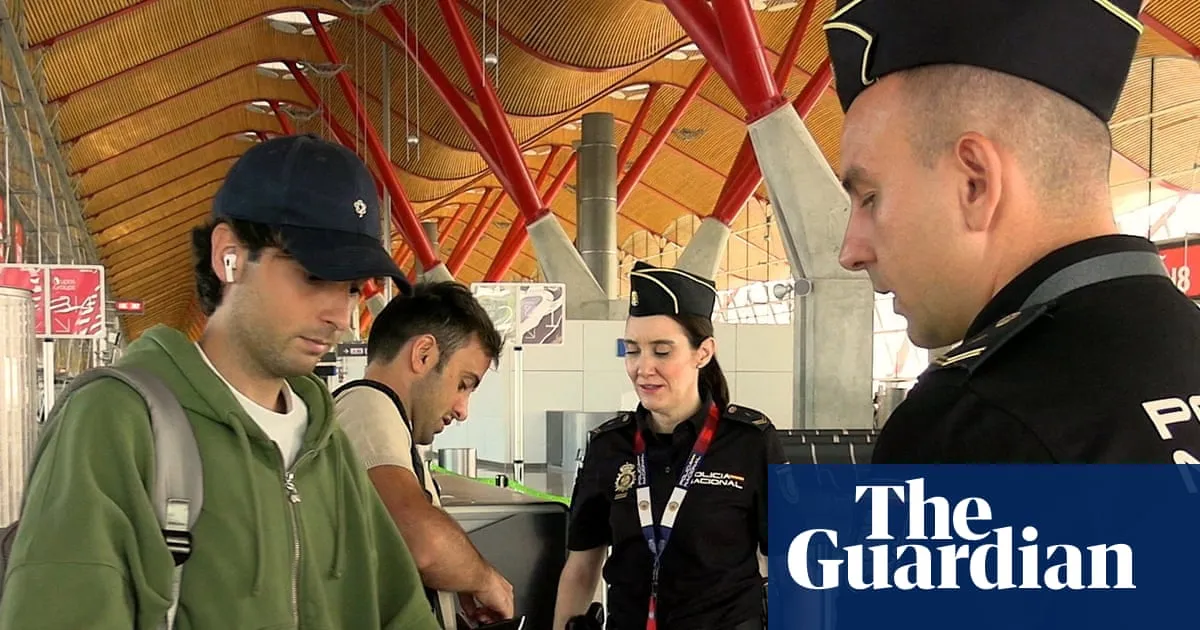
Italy’s foreign minister has called Spain’s decision to impose retaliatory checks on travellers from Italy “incomprehensible and completely unacceptable” as people making their way between the two EU countries were left grappling with the effects of the escalating feud.Spain started carrying out spot checks on visitors from Italy at midnight on Saturday. The tit-for-tat move came after Rome infuriated Madrid by launching checks on 1 August for travellers from Spain in response to the recent influx of about 72,000 people into Ceuta, a Spanish territory in north Africa.Spanish officials were swift to point out that the Italian checks made little sense, given that by 1 August, the border in Ceuta was back under control and the vast majority of those who had arrived had been returned to Morocco. Ceuta is not part of the Schengen free-movement zone, Madrid has repeatedly stressed, meaning there is little chance of onward travel to continental Europe without EU citizenship or residency.The checks by Italy had led to “intolerable” scenes at Italian airports, Spain’s foreign minister, José Manuel Albares, told reporters. “This measure is, first and foremost, an attack on the dignity of the Spanish people, but, secondly, it is a torpedo fired at the hull of European unity,” he said.In an interview published on Sunday in La Stampa, Italy’s foreign minister defended the move by Rome. “Some order needs to be brought in: we’re not against Spain, but we have a duty to protect our borders,” said Antonio Tajani, voicing concerns about some of the migrants potentially holding Jihadist views. “What is incomprehensible and completely unacceptable is Spain’s reaction.”He pushed back against the suggestion that Rome’s actions were symbolic, given the remote possibility of anyone making it to Italy from Ceuta. “Where do they go after arriving in Spain? Italy, as a destination, is the country most at risk. We’re not Germany or Norway.”When asked if Italy’s response was proportionate, Tajani pointed to the reports of fresh calls online for a mid-August mass crossing. “We hope to be able to lift the suspension soon, as soon as the risk is no longer present,” he said.Italy’s interior minister publicly praised Spain last week for its handling of the crisis, but Tajani blasted Spain for not being “as vigilant” as it should have been.Passengers caught up in the border controls speak to the media in Madrid. Photograph: Chema Moya/EPAHe linked the influx to Spain’s recent regularisation programme, describing the move to provide working migrants with papers as a “negative message that puts everyone’s safety at risk,” despite the EU’s earlier dismissal of any connection between the Ceuta influx and regularisation.Italy’s government has long criticised Spain’s efforts to regularise undocumented migrants, even as it quietly works on similar plans to give nearly 1.1 million work permits to foreign workers by 2028. Speaking to the Financial Times, one researcher described the Italian government’s efforts as a “disguised amnesty.”Spain and Italy both have a long history of regularisation programmes. In 2002, Tajani’s party, Forza Italia, carried out one of Italy’s largest such programmes, issuing just over 634,000 permits.Even so, the perception of differences in their approach to migration has pitted Madrid and Rome against each other, with Italy’s prime minister, Giorgia Meloni, seeking to position herself as a hardliner on migration while Spain’s Pedro Sánchez – who has defended the need for foreign workers to grow Spain’s economy and stave off demographic collapse – said Italy had registered the highest number of irregular crossings in recent years in the EU, with figures that are double those of Spain.skip past newsletter promotionafter newsletter promotionMigrants who crossed into the Spanish enclave of Ceuta in north Africa last month. Photograph: Pedro Nunes/ReutersIn recent days, the row has widened to include people making their way between the two countries, a route used by more than 8 million last year.“It’s ridiculous that we’re in this situation,” Elisa Fabbri, 41, told Spanish news site Eldiario.es as she left Madrid-Barajas airport on Saturday. Israel Pérez, a Cuban-born Spanish citizen, described it as an “absurd spiral” that risked pulling everyone down. “If we keep imposing checks on each other, in the end we’ll all end up losing,” he said. “This shouldn’t be happening between two European countries.”In Italy, opposition politicians accused Meloni of unleashing an “unfounded diplomatic crisis” that would ultimately harm Italians. “The cynical propaganda of the Meloni government has produced what was predictable: a boomerang that Italians will pay dearly for,” said Nicola Fratoianni, the leader of the Greens and Left Alliance. “This is a colossal mistake.”The EU commissioner for migration, Magnus Brunner, said on Saturday that he had been in contact with the interior ministers of the two countries. “Both confirmed that the internal border controls are temporary,” he said on social media. “Spanish authorities assured us the events in Ceuta will have no lasting effect on the Schengen area. That is why there are signals from Italy that controls could be lifted soon.”The row between Rome and Madrid after the events in Ceuta hints at sensitivities over migration across the EU, particularly as governments in Italy, France and Poland prepare to face off against far-right challengers in upcoming elections.But the latest Eurobarometer poll, which tracks public opinions every quarter, suggests the focus on migration may be out of step with Europeans’ top priorities. When asked about the topics that should be a priority for the European parliament, migration ranked sixth, behind issues such as the cost of living, the defence and security of the EU and the economy and job creation.
SRCThe Guardian - World News
LANGEN
LEANCenter-Left
WORDS918
ENT12
SUN · 2026-08-09 · 14:59 GMTBRIEF NSR-2026-0809-100629
NSR-2026-0809-100629News Report·EN·Diplomatic
Italy condemns Spain’s ‘unacceptable’ border controls as Ceuta fallout intensifies
Italy has condemned Spain's imposition of border checks on travelers from Italy as "incomprehensible and completely unacceptable." This retaliatory measure, implemented by Spain on Saturday, followed Italy's decision on August 1st to introduce checks on travelers from Spain. Italy's action was a response to a recent influx of approximately 72,000 people into Ceuta, a Spanish territory in North Africa.
Ashifa Kassam in MadridThe Guardian - World NewsFiled 2026-08-09 · 14:59 GMTLean · Center-LeftRead · 4 min
The Guardian - World NewsFIG 01
Reading time
4min
Word count
918words
Sources cited
3cited
Entities identified
12entities
Quality score
100%
§ 01
Briefing Summary
AI-generatedNEWSAR · AI
Italy has condemned Spain's imposition of border checks on travelers from Italy as "incomprehensible and completely unacceptable." This retaliatory measure, implemented by Spain on Saturday, followed Italy's decision on August 1st to introduce checks on travelers from Spain. Italy's action was a response to a recent influx of approximately 72,000 people into Ceuta, a Spanish territory in North Africa. Italy's foreign minister defended their move, stating a need to protect their borders and expressing concerns about potential jihadist views among migrants. Spain argued that Italy's checks were illogical as the situation in Ceuta had been resolved and most arrivals had been returned to Morocco. The escalating dispute is impacting travelers between the two EU countries.
Confidence 0.90Sources 3Claims 5Entities 12
§ 02
Article analysis
Model · rule-basedFraming
Diplomatic
National Security
Tone
Mixed Tone
AI-assessed
CalmNeutralAlarmist
Factuality
0.60 / 1.00
Mixed
LowHigh
Sources cited
3
Well sourced
FewMany
§ 03
Key claims
5 extracted01
Spain's foreign minister stated Italy's measure is 'an attack on the dignity of the Spanish people' and 'a torpedo fired at the hull of European unity'.
quoteJosé Manuel Albares
Confidence
1.00
02
Italy's foreign minister expressed concerns about some migrants potentially holding jihadist views.
quoteAntonio Tajani
Confidence
1.00
03
Spain initiated spot checks on travelers from Italy in response to Italy's checks on travelers from Spain.
factual
Confidence
1.00
04
Italy's foreign minister called Spain's border checks 'incomprehensible and completely unacceptable'.
quoteItaly's foreign minister
Confidence
1.00
05
Italy's government has long criticized Spain's efforts to regularize undocumented migrants.
factual
Confidence
0.90
§ 04
Full report
4 min read · 918 words§ 05
Entities
12 identifiedKey playerOppositionContextPositiveNeutralNegative
Locations6
§ 06
Keywords & salience
9 termsborder controls
1.00
ceuta
0.90
eu unity
0.80
migrant influx
0.70
retaliatory checks
0.70
european unity
0.60
national borders
0.50
schengen zone
0.50
diplomatic feud
0.40
§ 07
Topic connections
Interactive graph Network visualization showing 51 related topics
View Full Graph Person Organization Location Event|Click node to navigate|Edge numbers = shared articles