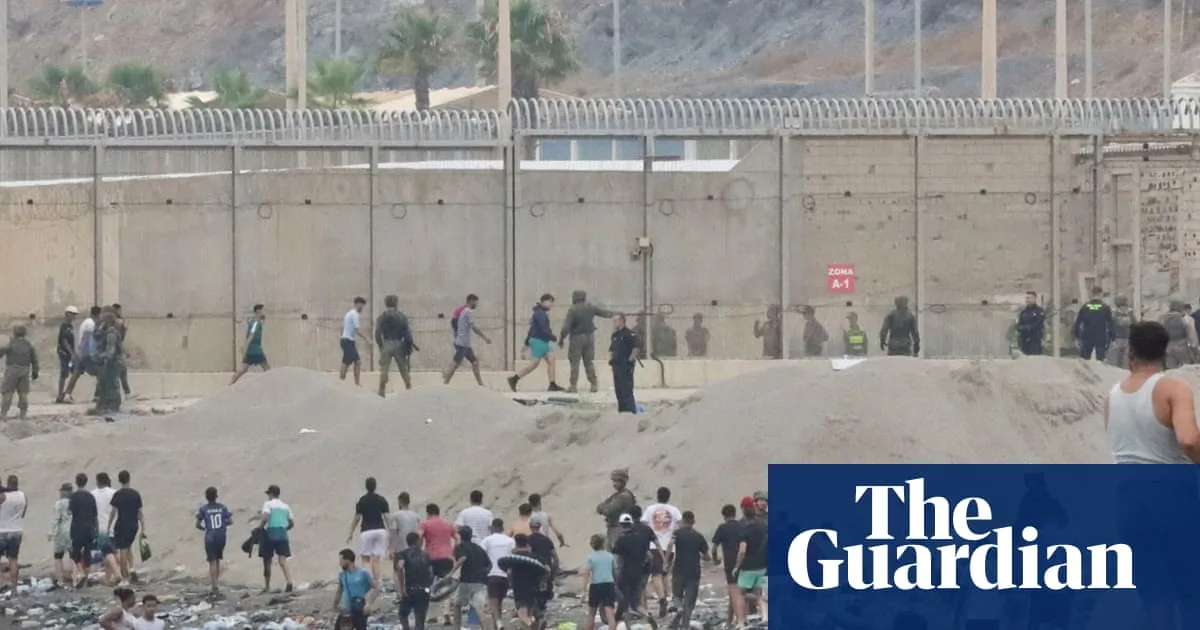
The pictures were more dramatic than the reality on the ground. Photograph: Reduan Dris/EPA View image in fullscreen The pictures were more dramatic than the reality on the ground. Photograph: Reduan Dris/EPA Wednesday briefing: How Misinformation and a hardened Immigration Policy turned Ceuta into Europe’s latest flashpoint In today’s newsletter: The past week shows how quickly images, rumours and right-wing political opportunism can eclipse the facts on the ground Good morning. Last week, an estimated 72,000 migrants began crossing into a tiny Spanish enclave on the tip of Morocco. Within 24 hours, most of them had headed home. At least 88 people died after attempting the crossing, according to local officials. This isn’t the whole story of what happened over the last week, but the facts are worth remembering. At an emergency meeting yesterday, EU interior ministers sought to draw a line under Ceuta, insisting that the passport-free Schengen Area had never been at risk from the arrival of migrants at this scale. Despite this, much of the media coverage has suggested that events in Ceuta represent a territorial threat to Europe, sparking calls for greater security across the region’s borders. It’s a pattern that has become familiar since the 2015 refugee crisis. As Europe has created fewer opportunities for migrants to legally cross its borders, people have tried to cross them illegally, resulting in dangerous bottlenecks, human tragedies, and a slew of spectacular images that the right has seized upon to justify draconian policies. For this morning’s newsletter, I spoke to Daniel Trilling, a journalist who writes about refugees and migration, about the political actors trying to capitalise on Ceuta, and why tragedies like this are bound to keep happening. That’s after the headlines. Environment | Eight of the biggest oil companies amassed profits of more than $90bn (£67bn) in just three months as the Iran conflict sent energy prices soaring and the emissions-fuelled Climate Crisis caused deadly heatwaves. UK politics | Women should not feel pressurised into experiencing an “ideal birth”, the new health secretary, Yvette Cooper, has said, promising a root-and-branch reform of standards after several damning maternity scandals. Middle East | Jordan is convening an emergency meeting over an “imminent” threat of an Israeli takeover of the most important Muslim site in Jerusalem, with the potential to “trigger a religious conflict”. Ukraine | Russian strikes in and around Kyiv killed at least 14 people, injured 27 and damaged warehouses, emergency service officials said. Some reports put the death toll at 15. Ceuta | Hundreds of people have gathered in the northern Moroccan town of Fnideq, near the border with Spain’s Ceuta, flashing photos of their missing loved ones to passersby in the hope of tracking them down. In depth: ‘The claim that this is some kind of invasion of Europe is entirely untrue’ View image in fullscreen Migrants who crossed into Spain via Ceuta are escorted by the Spanish army back to Morocco. Photograph: Antonio Sempere/AP On Thursday, a group of people roughly the size of Guildford’s population began crossing into Ceuta. Many of them swam around the border fence. Some drowned; others were crushed. Dozens died. “There were so many people in the sea. Everyone was trying to grab on to you to save themselves, and you were trying to escape and move forward so they wouldn’t drag you down or drown you,” one told the Guardian. Most of these people were young men searching for work and hoping to build a better life for themselves. There are no reports suggesting any of them reached mainland Europe. “It’s very difficult for people without the right documents to travel from Ceuta to mainland Europe, and Spain has lots of experience returning people who cross without permission,” Trilling says. “So the claim that this is some kind of invasion of Europe is entirely untrue.” Although Spain was reporting on Friday that most of these migrants had returned to Morocco, videos of men clambering on rocks and walking through Ceuta’s streets had already gone viral on social media, where they were amplified by right-wing voices. “Ceuta has been turned into a third world city in only 48 hours,” Tommy Robinson posted on X. Elon Musk, no stranger to sticking his oar into the politics of foreign nations, posted: “all military age males means it is an invasion”. “By the time the images started circulating, the so-called crisis was over. But the political damage was already done,” Trilling says. A social media hoax, which hinged on a Spanish supreme court ruling that migrants arriving by sea could not be summarily deported, seems to have played a pivotal role in encouraging the crossings. Instagram posts suggested Spain’s border with Morocco was opening up, TikTok videos showed people where to swim, and Facebook users began tracking coast guard patrols. It’s unclear who was behind these accounts, as several of them were deleted soon after the crossings. At a crisis meeting on Saturday, EU member states speculated that the events may have been coordinated. As the hoax spread, Moroccan border surveillance dwindled to a minimum, allowing thousands of people to cross into Ceuta. Some analysts have suggested that Rabat, Morocco’s administrative capital, deliberately opened the border to protest Pedro Sánchez’s recent visit to Algeria (Morocco has a territorial dispute with the country). Others have pointed to Rabat’s increasingly toasty relationship with the Trump administration, which has clashed with Sánchez during the Iran war. “The central problem is that European border policies have given countries like Morocco a means of exerting pressure on European states,” Trilling says. The EU has increasingly outsourced (“externalised,” in the policy lingo) border policing to non-EU countries, which have the power to loosen their borders whenever they choose. We’ve seen versions of Ceuta happen before: in 2021, Morocco allowed 10,000 people to cross into the territory during a diplomatic row with Spain. Turkey tried something similar on Greece in 2020, and Poland has long accused Belarus (a close ally of Russia) of encouraging migrants to cross into the Schengen Area. The EU has taken an increasingly hardline stance on migration since 2015. This has paradoxically helped to create some of the problems that politicians say they’re trying to solve. The fortification of security means that people are forced into taking illegal and unsafe routes where there might have been safe, legal routes previously. When border security is breached, it results in a sudden influx of people, and the kind of alarming images that we’ve seen this week, which are then used to justify even further restrictions. “The performance of control very often leads to precisely the sense in which things are out of control,” says Trilling. Following the events in Ceuta, Nigel Farage wasted no time in resurrecting his pernicious “Breaking Point” poster from 2016, and he and Zia Yusuf, Reform’s spokesperson, have described those who made the crossing as “fighting-age males.” The term is one of the right’s favourite new ways to frame people crossing borders, depicting them as threats, while giving little thought to those who lose their lives or don’t fit the brief. By Monday afternoon, Farage had alighted on a new policy that would use the Royal Navy to “stop the boats once and for all”. We published a useful explainer on why this would probably violate international law. It would be possible to dismiss this announcement as a last-ditch attempt to change the subject, considering the £5m gift that Farage currently seems to want to avert eyes from (and his impending byelection bin fight). But that would be missing the bigger picture. Ceuta has given the right a powerful new argument for why hardline immigration policies are common sense, and, by contrast, why a more pragmatic and humane approach to migration is foolish, harmful or, as one Spectator piece put it recently, the result of “luxury” beliefs. This sort of language encourages centre-left parties to accept the right’s logic. Take, for example, Germany’s chancellor, Friedrich Merz, who was among 22 signatories to a letter on Saturday that suggested Spain’s liberal migration policies compromise Europe’s security. These policies have no application in Ceuta, but Merz will soon be trying to fight off the far-right Alternative für Deutschland (AfD) in state elections. In a speech delivered from the White Cliffs of Dover on Monday, Andy Burnham pledged to be “relentless” in curbing small boats while building a system that offers “safe routes”. It marked a change from Starmer, whose attempts to appease would-be Reform voters culminated in his infamous “Island of strangers” speech. Still, it’s too early to say how Burnham will approach migration, and whether he will reopen routes that his predecessor closed. “Time and again, the right has tried to claim that you can basically shut yourself off from the rest of the world and make these things go away,” Trilling says. “But they don’t go away. And Ceuta is a perfect example of that.” What else we’ve been enjoying View image in fullscreen House leaders Blanco and Samantha Escandón present laurel crowns to their campers during the opening ceremony. Photograph: Salgu Wissmath/The Guardian I was really moved by these images from a summer camp for LGBTQ+ kids in Texas, a state where trans people have been regularly targeted and demonised. Michael What do Feast, Viennetta, Magnum, Calippo, Twister and Cornetto have in common? They were all invented in the 15-year golden age of British ice-cream. Hettie As a fair weather cyclist, I’ve had a smug summer, avoiding sardines-in-a-sauna style public transport on my bike. Reading about commuters on the heaving 17:46 from Euston has only confirmed this. Michael “In our culture, we vilify vulnerability and valorise independence”, the author Emily Kenway writes in this thoughtful opinion piece about the family members who sustain our care system. Hettie I for one have (obviously) always been a fan of the Turritopsis dohrnii, but at last the immortal jellyfish is getting proper recognition in this year’s Guardian invertebrate of the year competition. Michael Sport View image in fullscreen Marlen Reusser shows her time trial pedigree on stage four. Photograph: Tim de Waele/Getty Images Cycling | The world time-trial champion, Marlen Reusser, took the overall lead in the Tour de France Femmes after winning the fourth stage from Gevrey-Chambertin to Dijon. Football | Gianni Infantino’s authority was dealt a further blow after his No 2, the Fifa secretary general Mattias Grafström, called the failed World Cup private investment plan a “sad and reproachable series of events”. Football | The Manchester United captain, Maya Le Tissier, said her team will “stick together” and be ready for the new Women’s Super League season, despite their head coach Marc Skinner departing. The front pages View image in fullscreen Photograph: The Guardian “Oil giants make $90bn from price surge as Climate Crisis engulfs Europe”, is the Guardian’s front page. The Telegraph says “Setting free Pc Harper’s killers is ‘not justice’”, the Mail writes “9,300 domestic abusers set to be released”, Metro has “Jailed just last year … but my son’s killer already set freedom”, and the Sun’s take is “See you in court, PM”. The FT splashes “Google assembles $200bn Wall Street machine to supply chips for Anthropic”, the i Paper has “Private firms may face ban on profiteering to make care homes cheaper” and the Express writes “How many more lives will you risk by doing nothing?” The Times, on fiscal rules, says “Borrowing splurge in bid to boost economy”. Gianni Infantino’s reign as Fifa president is in severe peril after the collapse of his plans to sell off parts of the World Cup to private investment. Many Concacaf countries are considering following Europe’s lead by formally removing their support for Infantino, and there are widespread calls to remove him from his post. Lucy Hough speaks to columnist Jonathan Liew. Watch it on YouTube. Cartoon of the day | Ella Baron View image in fullscreen Illustration: Ella Baron/The Guardian The Upside A bit of good news to remind you that the world’s not all bad View image in fullscreen A biama dancer performing in Abidjan. Photograph: Miléquêm Diarassouba Once the soundtrack to postwar optimism and excess, Côte d’Ivoire’s dance music scene is evolving, thanks to TikTok and street dance battles. Seven years after the death of its biggest star, DJ Arafat, a new generation of artists and dancers are reinventing the coupé-décalé genre, with the new high-energy biama movement winning over young fans and social media users alike. Eromo Egbejule visits a 400-strong neighbourhood dance arena in Abidjan, where a local rapper calls the craze “a dance for the immature”. And finally, the Guardian’s puzzles are here to keep you entertained throughout the day. Until tomorrow. Explore more on these topics Morocco First Edition newsletter Spain Migration Africa Europe Middle East and north Africa newsletters Share Reuse this content
SRCThe Guardian - World News
LANGEN
LEANCenter-Left
WORDS2 130
ENT12
WED · 2026-08-05 · 05:54 GMTBRIEF NSR-2026-0805-99256
NSR-2026-0805-99256Analysis·EN·Political Strategy
Wednesday briefing: How misinformation and a hardened immigration policy turned Ceuta into Europe’s latest flashpoint
Last week, an estimated 72,000 migrants crossed into the Spanish enclave of Ceuta from Morocco, with most returning within 24 hours and at least 88 deaths reported during the crossing. Despite EU interior ministers stating the Schengen area was not at risk, media coverage and right-wing political opportunism amplified images and rumors, framing the event as a territorial threat to Europe.
Hettie O'BrienThe Guardian - World NewsFiled 2026-08-05 · 05:54 GMTLean · Center-LeftRead · 9 min
The Guardian - World NewsFIG 01
Reading time
9min
Word count
2 130words
Sources cited
1cited
Entities identified
12entities
Quality score
100%
§ 01
Briefing Summary
AI-generatedNEWSAR · AI
Last week, an estimated 72,000 migrants crossed into the Spanish enclave of Ceuta from Morocco, with most returning within 24 hours and at least 88 deaths reported during the crossing. Despite EU interior ministers stating the Schengen area was not at risk, media coverage and right-wing political opportunism amplified images and rumors, framing the event as a territorial threat to Europe. Journalist Daniel Trilling explains that this pattern of tragedies, fueled by misinformation and hardened immigration policies, is likely to continue as fewer legal border crossing opportunities exist. Social media hoaxes suggesting Spain's border was opening contributed to the crossings, with viral posts by figures like Tommy Robinson and Elon Musk further shaping the narrative.
Confidence 0.90Sources 1Claims 5Entities 12
§ 02
Article analysis
Model · rule-basedFraming
Political Strategy
Human Rights
Tone
Mixed Tone
AI-assessed
CalmNeutralAlarmist
Factuality
0.60 / 1.00
Mixed
LowHigh
Sources cited
1
Limited
FewMany
§ 03
Key claims
5 extracted01
The claim that this is some kind of invasion of Europe is entirely untrue.
quoteDaniel Trilling
Confidence
1.00
02
At least 88 people died after attempting the crossing into Ceuta, according to local officials.
statisticlocal officials
Confidence
0.95
03
The pictures of the Ceuta migrant crossings were more dramatic than the reality on the ground.
factual
Confidence
0.90
04
Misinformation and a hardened immigration policy turned Ceuta into Europe's latest flashpoint.
factual
Confidence
0.80
05
As Europe has created fewer opportunities for migrants to legally cross its borders, people have tried to cross them illegally, resulting in dangerous bottlenecks and human tragedies.
factual
Confidence
0.70
§ 04
Full report
9 min read · 2 130 words§ 05
Entities
12 identifiedKey playerOppositionContextPositiveNeutralNegative
Organizations1
Locations6
§ 06
Keywords & salience
10 termsimmigration policy
1.00
misinformation
0.90
ceuta
0.90
flashpoint
0.80
migrants
0.70
europe
0.60
refugee crisis
0.50
schengen area
0.50
human tragedies
0.40
political opportunism
0.40
§ 07
Topic connections
Interactive graph Network visualization showing 51 related topics
View Full Graph Person Organization Location Event|Click node to navigate|Edge numbers = shared articles