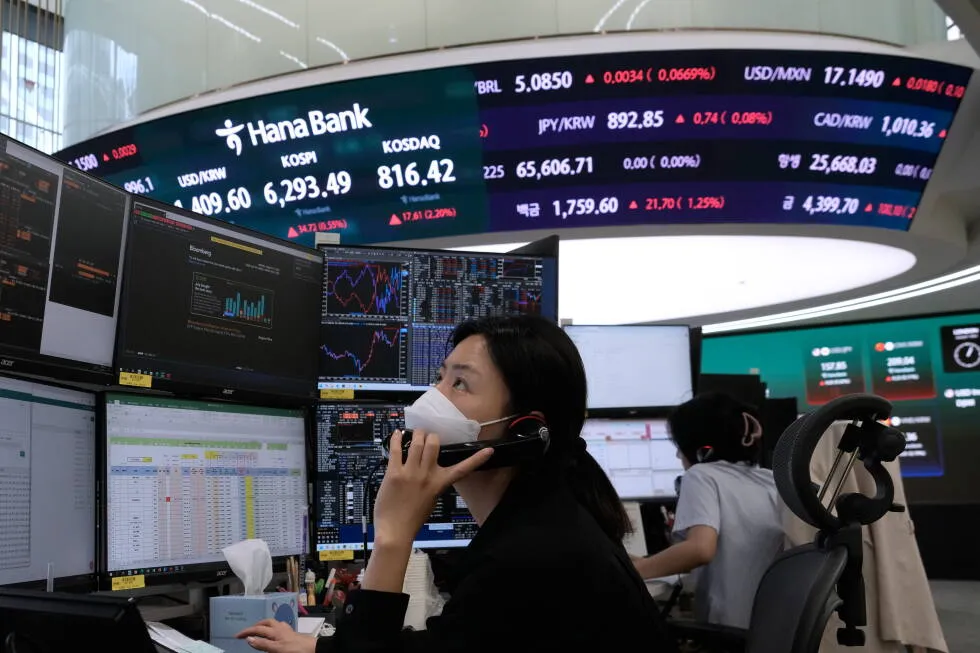
Asian shares track Wall Street gains, while oil prices bounce higher 1 of 5 | A currency trader talks on the phone at the foreign exchange dealing room of the Hana Bank headquarters in Seoul, South Korea, Monday, Aug. 10, 2026. (AP Photo/Ahn Young-joon) 2 of 5 | A currency trader talks on the phone near a screen showing the Korea Composite Stock Price Index (KOSPI) and the foreign exchange rate between U.S. dollar and South Korean won at the foreign exchange dealing room of the Hana Bank headquarters in Seoul, South Korea, Monday, Aug. 10, 2026. (AP Photo/Ahn Young-joon) 3 of 5 | Currency traders watch monitors near a screen showing the Korea Composite Stock Price Index (KOSPI) and the foreign exchange rate between U.S. dollar and South Korean won at the foreign exchange dealing room of the Hana Bank headquarters in Seoul, South Korea, Monday, Aug. 10, 2026. (AP Photo/Ahn Young-joon) 4 of 5 | A general view shows the New York Stock Exchange, Friday, Aug. 7, 2026, in New York. (AP Photo/Yuki Iwamura) 5 of 5 | A general view shows the New York Stock Exchange, Friday, Aug. 7, 2026, in New York. (AP Photo/Yuki Iwamura) By ELAINE KURTENBACH Updated 9:30 AM MESZ, August 10, 2026 Add AP News on Google Add AP News as your preferred source to see more of our stories on Google. Share Share Facebook Copy Link copied Print Email X LinkedIn Bluesky Flipboard Pinterest Reddit BANGKOK (AP) — Shares were mostly higher Monday in Asia, with Japan’s Nikkei 225 leading advances after stocks rose on Wall Street. Oil prices rose and U.S. futures were little changed. In Tokyo, the benchmark Nikkei 225 jumped 2.1% to 66,970.22, pulled higher by strong gains for technology companies. Computer chip equipment maker Tokyo Electron climbed 4.1%, while chip testing device maker Advantest rose 6.4%. In South Korea, the gains were more modest, as the Kospi added 0.7% to 6,299.66 as shares in major chipmakers slipped. Samsung Electronics lost 0.4%, while its smaller rival, memory chipmaker SK Hynix, lost 0.1%. Analysts said foreign investors were selling shares in the Big Tech companies to lock in profits from recent gains and rebalance holdings into other industries, such as defense contractors. Hong Kong’s Hang Seng gained 0.9% to 25,904.94, while the Shanghai Composite index picked up 0.7% to 3,966.59. In Australia, the S&P/ASX 200 lost 0.3% to 9,232.60. Taiwan’s Taiex surged 1.6% and the Sensex in India was up 0.2%. Oil prices rose after Israel rejected a deal announced by U.S. President Donald Trump for Gaza. Details emerged on the potential deal between Iran and Oman on managing the Strait of Hormuz as Tehran suggested that vessels linked to “hostile countries” would be barred. Meanwhile, Yemen’s Iranian-backed Houthi rebels struck a government-held port on the country’s Red Sea coast, deepening fears over threats to strategic shipping routes and a potential return to civil war. US stocks jump as employers unexpectedly cut 23,000 jobs, raising hopes that rate hikes can wait 4 MIN READ 21 Oil prices jump as fighting flares in the Middle East, while AI-led retreat pulls Asian stocks lower 3 MIN READ Stocks waver on Wall Street while crude oil prices fall for the first time in a week 3 MIN READ Brent crude, the international standard, gained 0.6% to $84.01 per barrel. U.S. benchmark crude advanced 0.3% to $78.46 per barrel. “Negotiators said that a deal to establish a safe shipping route was close, but Iran may now be exploring just how much it can extract from the U.S. in return,” Bas van Geffen, senior macro strategist for Rabobank, said in a commentary. On Friday, U.S. stocks rose and Treasury yields fell after the government reported that employers unexpectedly cut 23,000 jobs last month. A weaker jobs market raised hopes the Federal Reserve might wait longer before raising interest rates to fight inflation. That buoyed share prices, pushing every major index to a second straight week of gains and several fresh records. The S&P 500 rose 0.6% to 7,757.64, topping an all-time high. The Dow Jones Industrial Average rose 0.3% to 54,036.93, just short of the record it set on Wednesday. The Nasdaq composite rose 1.3% to 26,690.62. Overall, the jobs report dimmed one of the brighter areas of the economy, adding to worries about household spending at a time of high inflation. It included a revision to the figures for June and May that involved slashing a combined 103,000 jobs from payrolls for those months. Slowing employment complicates the Fed’s effort to balance job growth with fighting inflation. Higher interest rates can help tame inflation by slowing economic growth, but businesses will find it more difficult to expand under increased borrowing rates. As usual, technology stocks did much of the heavy lifting for the broader market. Nvidia jumped 2.3% and Broadcom rose 1.7%. The yield on the 10-year Treasury fell to 4.64% from 4.67% just before the jobs update. It was as low as 4.60% before recovering a bit. The yield on the two-year Treasury, which more closely tracks expectations for Fed action on interest rates, fell to 4.20% from 4.22% before the report’s release. It was as low as 4.15% before edging back up. This week, investors will get several important inflation updates. The most closely watched will be the consumer price index, or CPI, which measures costs for consumers. Inflation in July is forecast to have risen at a 3.4% rate, easing slightly from 3.5% in June. Inflation has held stubbornly above 3% for most of the year. In other dealings early Monday, the U.S. dollar rose to 158.45 Japanese yen from 157.71 yen. The euro fell to $1.1557 from $1.1568. ELAINE KURTENBACH Based in Bangkok, Kurtenbach is the AP’s business editor for Asia, helping to improve and expand our coverage of regional economies, climate change and the transition toward carbon-free energy. She has been covering economic, social, environmental and political trends in China, Japan and Southeast Asia throughout her career. twitter mailto
SRCAssociated Press (AP)
LANGEN
LEANCenter
WORDS1 000
ENT12
MON · 2026-08-10 · 06:53 GMTBRIEF NSR-2026-0810-100764
NSR-2026-0810-100764News Report·EN·Economic Impact
Asian shares are mixed after gains on Wall Street, while oil prices climb
Asian shares were mixed on Monday, with Japan's Nikkei 225 leading gains, following a positive close on Wall Street. Technology stocks, particularly in Japan, drove the Nikkei's advance.
Associated Press (AP)Filed 2026-08-10 · 06:53 GMTLean · CenterRead · 4 min
Associated Press (AP)FIG 01
Reading time
4min
Word count
1 000words
Sources cited
1cited
Entities identified
12entities
Quality score
100%
§ 01
Briefing Summary
AI-generatedNEWSAR · AI
Asian shares were mixed on Monday, with Japan's Nikkei 225 leading gains, following a positive close on Wall Street. Technology stocks, particularly in Japan, drove the Nikkei's advance. In South Korea, modest gains were tempered by foreign investors selling tech shares to lock in profits, rebalancing into other sectors like defense. Hong Kong and Shanghai saw slight increases, while Australia's index declined. Oil prices rose due to geopolitical tensions in the Middle East, including Israel rejecting a Gaza deal and Houthi rebel attacks impacting shipping routes. U.S. futures remained largely unchanged. The article also notes that U.S. stocks had previously risen on Friday due to a weaker jobs report, which fueled hopes the Federal Reserve might delay interest rate hikes.
Confidence 0.90Sources 1Claims 5Entities 12
§ 02
Article analysis
Model · rule-basedFraming
Economic Impact
Conflict
Tone
Measured
AI-assessed
CalmNeutralAlarmist
Factuality
0.80 / 1.00
Factual
LowHigh
Sources cited
1
Limited
FewMany
§ 03
Key claims
5 extracted01
Yemen’s Iranian-backed Houthi rebels struck a government-held port on the country’s Red Sea coast, deepening fears over threats to strategic shipping routes and a potential return to civil war.
factual
Confidence
1.00
02
In Tokyo, the benchmark Nikkei 225 jumped 2.1% to 66,970.22, pulled higher by strong gains for technology companies.
factual
Confidence
1.00
03
Oil prices rose after Israel rejected a deal announced by U.S. President Donald Trump for Gaza.
factual
Confidence
1.00
04
Asian shares were mostly higher Monday in Asia, with Japan’s Nikkei 225 leading advances after stocks rose on Wall Street.
factual
Confidence
1.00
05
Analysts said foreign investors were selling shares in the Big Tech companies to lock in profits from recent gains and rebalance holdings into other industries, such as defense contractors.
quoteAnalysts
Confidence
0.90
§ 04
Full report
4 min read · 1 000 words§ 05
Entities
12 identifiedKey playerOppositionContextPositiveNeutralNegative
Organizations6
§ 06
Keywords & salience
10 termsasian shares
1.00
wall street gains
0.90
oil prices
0.90
technology companies
0.80
chipmakers
0.70
foreign investors
0.60
stock markets
0.50
nikkei 225
0.40
kospi
0.40
israel
0.40
§ 07
Topic connections
Interactive graph Network visualization showing 51 related topics
View Full Graph Person Organization Location Event|Click node to navigate|Edge numbers = shared articles