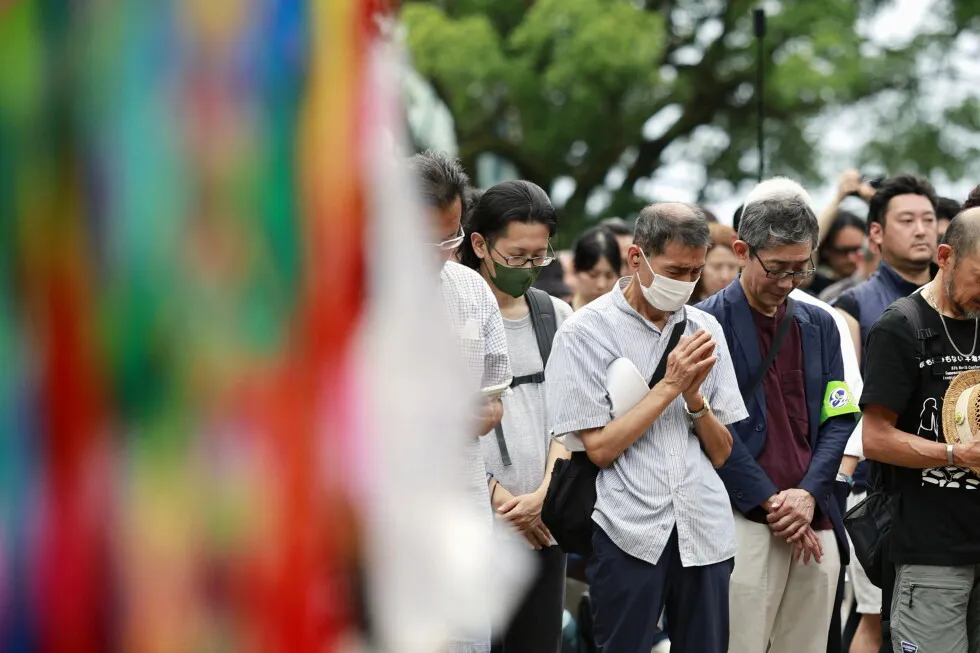
Taiwan representative in Japan boycotts Nagasaki anniversary ceremony over seating 0 seconds of 51 secondsVolume 0% Press shift question mark to access a list of keyboard shortcuts Keyboard ShortcutsEnabledDisabled Shortcuts Open/Close/ or ? Play/PauseSPACE Increase Volume↑ Decrease Volume↓ Seek Forward→ Seek Backward← Captions On/Offc Fullscreen/Exit Fullscreenf Mute/Unmutem Decrease Caption Size- Increase Caption Size+ or = Seek %0-9 Next Up Pope prays at tomb of St. Francis in Assisi as youth event marks 800th anniversary of his death 00:45 00:00 00:51 00:51 More Videos 00:45 Pope prays at tomb of St. Francis in Assisi as youth event marks 800th anniversary of his death 00:16 Matthew McConaughey meets Pope 00:48 New images of the sun show its surface in the finest detail yet 01:16 Scientists certain a SpaceX rocket slammed into the moon as predicted after drifting off course 01:06 GOP Sen. Cassidy says he supports Blanche for attorney general 01:42 Trump signs immigration actions on birthright citizenship, 'birth tourism' 00:36 Spain imposes border checks on Italian travellers in tit-for-tat move over Ceuta migrants row 00:49 Appeals court rules Trump can't build White House ballroom without congressional approval Close 1 of 6 | Nagasaki on Sunday marked the 81st anniversary of the US atomic bombing of the southern Japanese city, with its mayor denouncing growing support for Nuclear deterrence in the global community, including Japan and demanding his own government do more for Nuclear disarmament. The atomic bomb dropped by the United States on Nagasaki on August 9, 1945, killed 70,000 people, three days after the bombing of Hiroshima killed 140,000. 2 of 6 | People observe a minute of silence during a ceremony to mark the 81st anniversary of the U.S. atomic bombing at the Atomic Bomb Hypocenter Park in Nagasaki, southern Japan Sunday, Aug. 9, 2026. (Kotaro Ueda/Kyodo News via AP) 3 of 6 | Doves are leased over the Peace Statue during a ceremony to mark the 81st anniversary of the U.S. atomic bombing at the Peace Park in Nagasaki, southern Japan Sunday, Aug. 9, 2026. (Taichi Nagahisa/Kyodo News via AP) 4 of 6 | People observe a minute of silence during a ceremony to mark the 81st anniversary of the U.S. atomic bombing at the Peace Park in Nagasaki, southern Japan Sunday, Aug. 9, 2026. (Taichi Nagahisa/Kyodo News via AP) 5 of 6 | People observe a minute of silence during a ceremony to mark the 81st anniversary of the U.S. atomic bombing at the Peace Park in Nagasaki, southern Japan Sunday, Aug. 9, 2026. (Taichi Nagahisa/Kyodo News via AP) 6 of 6 | Japna’s Prime Minister Sanae Takaichi delivers a speech during a ceremony to mark the 81st anniversary of the U.S. atomic bombing at the Peace Park in Nagasaki, southern Japan Sunday, Aug. 9, 2026. (Taichi Nagahisa/Kyodo News via AP) By MARI YAMAGUCHI Updated 10:32 AM MESZ, August 10, 2026 Leer en español Add AP News on Google Add AP News as your preferred source to see more of our stories on Google. Share Share Facebook Copy Link copied Print Email X LinkedIn Bluesky Flipboard Pinterest Reddit TOKYO (AP) — Taiwan’s top economic representative in Japan said he boycotted this year’s memorial marking Nagasaki’s 81st anniversary of the U.S. atomic bombing of the Japanese city, accusing Nagasaki officials of being pro-China and insulting Taipei. Lee Yi-yang, head of the Taipei Economic and Cultural Representative Office in Tokyo, said in a social media post that seat assignments showed Nagasaki “deliberately denied Taiwan’s status as a nation, completely disregarding Taiwan’s sovereignty and dignity.” Lee said he and two of his deputies boycotted the ceremony because their designated seats as representatives of Taiwan were not among those reserved for diplomatic missions. Lee instead sent a lower-ranked official from Fukuoka. Nagasaki acted as “a pawn of China’s insistence that Taiwan is not a state and has no sovereignty,” Lee’s office said in a statement. Nagasaki officials said seats for Taiwanese officials were located near other envoys and not clearly distinguished as nondiplomatic guests. Nagasaki Mayor Shiro Suzuki was expected to speak to reporters later Monday. Japan and China normalized diplomatic ties in 1972, ending war animosities. The joint communiqué officially recognized Tokyo’s diplomatic ties with Beijing and ended those with Taipei, though Japan and Taiwan still have close economic and trade ties through nongovernmental channels between the two sides. At Sunday’s memorial at the Peace Park in the southwestern city, representatives from 98 countries and three international organizations, including the United Nations, the European Union and the International Committee of the Red Cross, Nagasaki officials said. Nagasaki marks 81st atomic bomb anniversary as mayor says Nuclear deterrence only increases risk 3 MIN READ Hiroshima marks 81st atomic bomb anniversary as mayor deplores the pursuit of nuclear weapons 2 MIN READ Taiwan kicks off annual military drills to counter a potential Chinese attack 2 MIN READ The United States launched the Nagasaki attack on Aug. 9, 1945, killing 70,000 by the end of that year, three days after the bombing of Hiroshima that killed 140,000. Japan surrendered on Aug. 15, 1945, ending World War II and the nearly half-century of aggression across Asia. Nagasaki also was boycotted in the 2024 anniversary by then-U.S. ambassador Rahm Emanuel and his counterparts from five other Group of Seven countries for not inviting Israel over the escalating conflict in the Middle East and concern of possible risks, such as protests and other safety issues at the ceremony. That prompted Nagasaki to set a policy of inviting countries, regions and organizations that have either diplomatic missions in Japan or at the United Nations, including North Korea and countries in conflict. Taiwan fits neither category as a guest but Nagasaki accommodated its representatives at their request last year, officials said. Lee also attended the Aug. 6 atomic bombing memorial in Hiroshima, where he was treated equally with other foreign envoys, he said in a statement. Lee also stressed that Taiwan has demonstrated itself to be a peace-loving nation, while China has increasingly posed threats to the region with its rapid military growth and nuclear weapons. Lee took up his post in Japan in September 2024 and last year became the first Taiwanese representative from the liaison office to attend the Hiroshima and Nagasaki ceremonies. He was given a similar seat assignment in Nagasaki last year but did not raise the issue over the “indignity” to prioritize friendship, he said. Associated Press video journalist Mayuko Ono contributed to this report. MARI YAMAGUCHI Yamaguchi is based in Tokyo and covers Japanese politics, security, nuclear energy and social issues for The Associated Press. twitter mailto
SRCAssociated Press (AP)
LANGEN
LEANCenter
WORDS1 095
ENT10
MON · 2026-08-10 · 08:53 GMTBRIEF NSR-2026-0810-100789
NSR-2026-0810-100789News Report·EN·Diplomatic
Taiwan representative in Japan boycotts Nagasaki anniversary ceremony over seating
Taiwan's top economic representative in Japan, Lee Yi-yang, boycotted Nagasaki's 81st anniversary atomic bombing memorial ceremony. Lee stated that seat assignments deliberately denied Taiwan's status as a nation, which he interpreted as Nagasaki officials being pro-China and insulting Taipei.
Associated Press (AP)Filed 2026-08-10 · 08:53 GMTLean · CenterRead · 5 min
Associated Press (AP)FIG 01
Reading time
5min
Word count
1 095words
Sources cited
0cited
Entities identified
10entities
Quality score
100%
§ 01
Briefing Summary
AI-generatedNEWSAR · AI
Taiwan's top economic representative in Japan, Lee Yi-yang, boycotted Nagasaki's 81st anniversary atomic bombing memorial ceremony. Lee stated that seat assignments deliberately denied Taiwan's status as a nation, which he interpreted as Nagasaki officials being pro-China and insulting Taipei. He and two deputies boycotted because their designated seats were not among those reserved for diplomatic missions, with a lower-ranked official attending instead. Nagasaki officials countered that Taiwanese officials' seats were located near other envoys and not clearly distinguished as non-diplomatic. Japan normalized ties with China in 1972, recognizing Beijing and ending ties with Taipei, though economic relations persist. Last year, Taiwan was accommodated at the ceremony, but Lee chose not to raise the issue of seating then.
Confidence 0.90Claims 5Entities 10
§ 02
Article analysis
Model · rule-basedFraming
Diplomatic
Human Interest
Tone
Measured
AI-assessed
CalmNeutralAlarmist
Factuality
0.80 / 1.00
Factual
LowHigh
Sources cited
0
No named sources
FewMany
§ 03
Key claims
5 extracted01
Three days after the Nagasaki bombing, the bombing of Hiroshima killed 140,000 people.
statistic
Confidence
1.00
02
The atomic bomb dropped by the United States on Nagasaki on August 9, 1945, killed 70,000 people.
statistic
Confidence
1.00
03
The mayor of Nagasaki denounced growing support for nuclear deterrence globally and in Japan.
quoteMayor of Nagasaki
Confidence
1.00
04
Nagasaki marked the 81st anniversary of the US atomic bombing on Sunday, August 9, 2026.
factual
Confidence
1.00
05
Taiwan representative in Japan boycotted Nagasaki anniversary ceremony over seating arrangements.
factual
Confidence
1.00
§ 04
Full report
5 min read · 1 095 words§ 05
Entities
10 identifiedKey playerOppositionContextPositiveNeutralNegative
Organizations2
Locations5
§ 06
Keywords & salience
9 termsnagasaki bombing anniversary
1.00
nuclear disarmament
0.90
nuclear deterrence
0.80
taiwan representative
0.70
diplomatic boycott
0.60
seating arrangement
0.50
atomic bombing
0.40
japan
0.40
taiwan
0.40
§ 07
Topic connections
Interactive graph No topic relationship data available yet. This graph will appear once topic relationships have been computed.