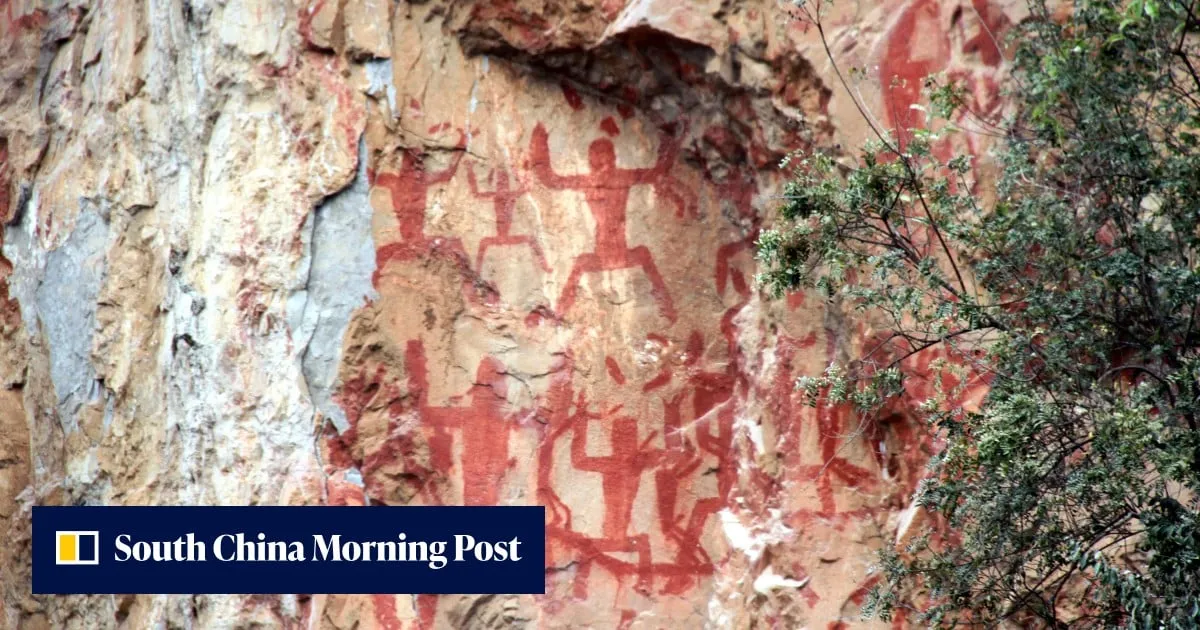
On the southern edge of China, near the border with Vietnam, a breathtaking array of wall art stretches 260km and is over 2,000 years old.This extraordinary collection, known as Huashan rock art after its most notable site, is celebrated for its vivid imagery depicting humans, animals, boats, weapons, and musical instruments.Located in Guangxi autonomous region, the site was designated as China’s 49th Unesco World Heritage site in 2016. Scholars believe these paintings illustrate the daily lives of the Luoyue people, an ancient ethnic group that once inhabited the borderlands of modern-day Vietnam and China.Remarkably, the artwork has withstood the test of time despite the region’s relentless heat, humidity, torrential rains, and frequent typhoons. Its preservation has long intrigued scientists, considering its exposure to such harsh natural conditions.In Inner Mongolia and Ningxia, most rock art is found in the form of petroglyphs — intricate carvings etched into stone — though rare examples of painted works using lime and white pigments have also been documented. Photo: Bradshaw FoundationResearchers may have uncovered the key to its longevity in a fundamental aspect of human existence.A recent study published in the Journal of Archaeological Science suggests that blood – possibly from childbirth – played a crucial role in the paint formulation.Researchers from Shandong University and the Guangxi Museum of Anthropology concluded that the artists likely crafted mortar by combining lime, red clay, and a mixture of animal and human blood.The analysis revealed that all paint chips contained serum proteins, an essential component of blood. Chemical examinations indicated that the human blood used in the paint contained prolactin-inducible protein and lactotransferrin – proteins associated with childbirth and breastfeeding.The Jinsha River rock art is a breathtaking collection of prehistoric red pigment paintings, revealed along the rugged gorges of the Jinsha River valley in Yunnan province, China, offering a glimpse into ancient artistry. Photo: YNKGSSomething in the mixture creates a biomineralised calcium carbonate that bonds the paint to the rock so effectively that it essentially integrates with the limestone. In cases where the calcium carbonate has eroded, the paint peels off the walls relatively easily.The team concluded that the blood was likely harvested shortly after childbirth and used to make the paint. Interestingly, it appears the Luoyue needed only a small amount of blood to initiate the crystallisation process, with just 8 millilitres required to cover a square metre.“The blood may have been sourced from women who had recently given birth, possibly reflecting a reverence for female fertility within this matriarchal, fisher-hunter-gatherer society,” the researchers noted.This analysis challenges earlier theories that plant saps rich in oxalic acid were used to create the paint, as no traces of plant material were found in its composition.Further ReadingThe researchers described the durability of the artwork as “astonishing,” noting that an electric drill was necessary to remove the paint for study.Human blood was blended with animal blood, varying by location. The paint from one site consisted of 97 per cent human blood, while a nearby location contained nearly one-third bovine blood.If this research holds true, the blood discovery may also significantly contribute to understanding why the ancient Luoyue created these artworks in the first place.Explore a close-up of the stunning 2,000-year-old Luoyue cliff paintings, which vividly depict ritual figures at the renowned Zuojiang Huashan rock art site in Guangxi, China. Photo: Shutterstock“These humans used natural materials to produce pigments and binders, and painted them on rock as documentation or ritual observance,” the authors stated.The blood may have symbolised auspicious values, such as fertility or respect for ancestors. This notion is reinforced by the fact that the artwork depicts ceremonial artefacts like ring-handled daggers, bronze drums, and sheep-horn knob bells.Moreover, the murals underscore collective society over individual figures, emphasising a shared communal identity.Historical records indicate that Luoyue society was matriarchal. Ancient Chinese chronicles describe them as having no fixed marital partners, with personal choice dictating relationships.“Indeed, most indigenous peoples in China’s southwest and Lingnan regions remained in matriarchal societies until the Han dynasty (202 BC–220),” the authors concluded.
SRCSouth China Morning Post
LANGEN
LEANCenter-Right
WORDS665
ENT12
TUE · 2026-08-11 · 06:00 GMTBRIEF NSR-2026-0811-101130
NSR-2026-0811-101130News Report·EN·Human Interest
Despite extreme climate, China’s 2,000-year-old rock art owes survival to post-partum blood
China's 2,000-year-old Huashan rock art, a UNESCO World Heritage site in Guangxi, has remarkably survived extreme climate conditions. Researchers from Shandong University and the Guangxi Museum of Anthropology suggest that the paint's longevity is due to the inclusion of blood, likely from childbirth.
Kevin McSpaddenSouth China Morning PostFiled 2026-08-11 · 06:00 GMTLean · Center-RightRead · 3 min
South China Morning PostFIG 01
Reading time
3min
Word count
665words
Sources cited
2cited
Entities identified
12entities
Quality score
100%
§ 01
Briefing Summary
AI-generatedNEWSAR · AI
China's 2,000-year-old Huashan rock art, a UNESCO World Heritage site in Guangxi, has remarkably survived extreme climate conditions. Researchers from Shandong University and the Guangxi Museum of Anthropology suggest that the paint's longevity is due to the inclusion of blood, likely from childbirth. Analysis revealed serum proteins and specific human blood proteins associated with childbirth and breastfeeding in the paint, which combined with lime and red clay to form a biomineralized calcium carbonate that bonded the pigment to the limestone rock. This discovery challenges previous theories and may offer insights into the Luoyue people's reverence for fertility and their communal society.
Confidence 0.90Sources 2Claims 5Entities 12
§ 02
Article analysis
Model · rule-basedFraming
Human Interest
Environmental
Tone
Mixed Tone
AI-assessed
CalmNeutralAlarmist
Factuality
0.80 / 1.00
Factual
LowHigh
Sources cited
2
Limited
FewMany
§ 03
Key claims
5 extracted01
Analysis of paint chips revealed serum proteins, indicating the use of blood.
factualResearchers
Confidence
0.95
02
Proteins found in the human blood used in the paint are associated with childbirth and breastfeeding.
factualResearchers
Confidence
0.90
03
China's 2,000-year-old Huashan rock art has survived extreme climate conditions due to the use of blood in its paint.
factualResearchers
Confidence
0.90
04
The blood likely initiated a biomineralised calcium carbonate that bonds the paint to the rock.
factualResearchers
Confidence
0.85
05
The blood may have been sourced from women who had recently given birth, possibly reflecting reverence for female fertility.
factualResearchers
Confidence
0.70
§ 04
Full report
3 min read · 665 words§ 05
Entities
12 identifiedKey playerOppositionContextPositiveNeutralNegative
Organizations4
Locations6
§ 06
Keywords & salience
9 termshuashan rock art
1.00
ancient paint preservation
0.90
post-partum blood
0.90
luoyue people
0.80
biomineralised calcium carbonate
0.70
unesco world heritage site
0.60
extreme climate
0.50
serum proteins
0.50
china
0.40
§ 07
Topic connections
Interactive graph Network visualization showing 51 related topics
View Full Graph Person Organization Location Event|Click node to navigate|Edge numbers = shared articles