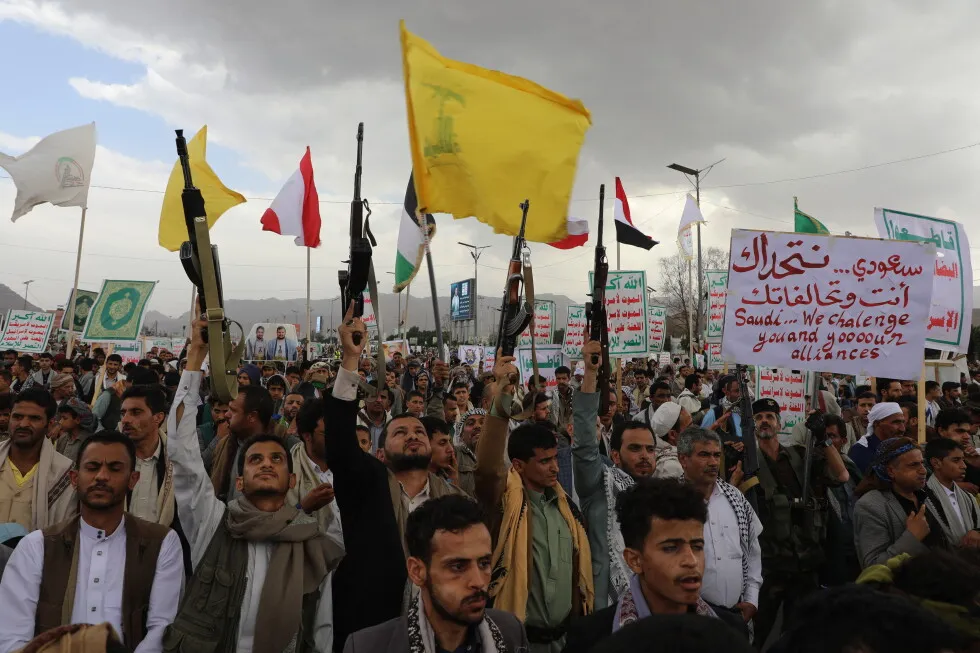
Iranian-backed Houthi rebels renew attacks on key port city, and other developments in the Mideast 1 of 5 | Houthi supporters attend a rally against the Saudi-led coalition in Sanaa, Yemen, Friday, July 31, 2026. (AP Photo/Osamah Abdulrahman) 2 of 5 | This image taken from video broadcast by Al-Masirah TV, a Houthi-controlled news channel, shows an explosion at the Sanaa International Airport compound during what the Iranian-backed Houthi rebels in Yemen said were several Saudi airstrikes in Sanaa, Yemen, July 13, 2026. (Al-Masirah TV via AP, File) 3 of 5 | Iran’s Foreign Minister Abbas Araghchi, center, is surrounded by security personnel as he walks in Najaf, Iraq, during Arbaeen commemorations, Monday, Aug. 3, 2026. (AP Photo/Anmar Khalil) 4 of 5 | Houthi supporters chant slogans during a rally against the Saudi-led coalition in Sanaa, Yemen, Friday, July 31, 2026. (AP Photo/Osamah Abdulrahman) 5 of 5 | Vehicles drive past a statue of a swinging boy at a square in Tehran, Iran, Monday, Aug. 10, 2026. (AP Photo/Vahid Salemi) By THE ASSOCIATED PRESS Updated 11:57 AM MESZ, August 11, 2026 Leer en español Add AP News on Google Add AP News as your preferred source to see more of our stories on Google. Share Share Facebook Copy Link copied Print Email X LinkedIn Bluesky Flipboard Pinterest Reddit Iranian-backed Houthi rebels renewed their attacks Tuesday on government-controlled areas in Yemen as ongoing violence threatened to reignite the country’s civil war and raised fears over new threats to shipping lanes. Iran’s foreign minister, meanwhile, underscored Tehran’s stance against reopening the Strait of Hormuz until the U.S. meets its conditions, in comments that came after U.S. President Donald Trump said he was now demanding compensation from Iran “for all of the people that they have killed” in the past. Here’s a look at the latest developments in the Iran war and the wider Middle East. Full coverage can be found here. Houthis hit targets in central Yemen and Red Sea port city Iranian-backed Houthi rebels in Yemen attacked the government-held port city of Mokha on the Red Sea coast and other areas of the country, deepening fears over threats to strategic shipping routes and a potential return to civil war. Yemen’s military said the rebels targeted both Mokha and the central province of Marib with missiles and drones but did not provide further details. The Houthis struck Marib and the eastern province of Hadramout last week, killing dozens of government troops and civilians. They hit Mokha with missiles and drones over the weekend and killed at least seven people, including three troops, according to the Yemeni military. Mokha is a main port under Yemen’s internationally recognized government and has been renovated to handle shipping to avoid the Houthi-held port of Hodeida. US military launches new strikes on Iran as clashes escalate over shipping routes 5 MIN READ A new threat by Yemen’s Houthis could widen the Iran war and put another trade chokepoint at risk 5 MIN READ 64 A new threat by Yemen’s Houthis could widen the Iran war and put another trade chokepoint at risk 5 MIN READ 64 The strikes came as part of a recent escalation by the Houthis against government forces in Yemen and oil facilities in neighboring Saudi Arabia, which supports the internationally recognized Yemeni government, and the kingdom’s shipping in the Red Sea. With the Strait of Hormuz effectively shut down by Iran, there has been a renewed focus on the Red Sea and Bab el-Mandeb Strait at Yemen’s southern tip, which is an alternate route for Saudi Arabia to ship its oil to open oceans. The Houthi attacks could reignite Yemen’s civil war after a four-year hiatus following a 2022 truce, and open a new front in the Middle East war. Iranian foreign minister underlines Tehran’s demands Iranian Foreign Minister Abbas Araghchi told reporters in Iran that the country had “astonished the whole world” in the war against the United States and Israel, proving “that it is a tough and invincible power.” Iran has refused to back down on its demands that the U.S. end its blockade of Iranian ports and fulfill other conditions before Tehran will consider reopening the Strait of Hormuz. Iran shut down the strait after Israel and the U.S. attacked the country on Feb. 28. The closure of the key waterway — through which roughly one-fifth of the world’s traded oil supplies passed before the war — has kept energy prices a major focus of U.S. politics ahead of November’s midterm elections. Araghchi said on his Telegram channel that in a call with German Foreign Minister Johann Wadephul late Monday, he had “emphasized that making the Strait of Hormuz secure requires an end to the United States’ aggressive actions and unlawful interventions, including the naval blockade and other violations of U.S. obligations.” Wadephul said on X that he had emphasized “the Strait of Hormuz needs to be opened unconditionally ensuring free and safe navigation for all.” Trump said in a social media post he was directing his negotiators to include “compensation from Iran, for all of the people that they have killed and gravely wounded with their roadside bombs and many conflicts.” That was after Iran demanded compensation for the devastation caused to the country by the U.S. and Israeli bombardment over the past five months. The U.S. president also claimed Monday in an Oval Office exchange with reporters that the U.S. has “100% control” of the Strait of Hormuz, but that the situation remains complex. He said the U.S. Navy’s blockade of the strait is preventing Iran from selling its oil on the international market, a move that is effectively choking the Iranian economy. “Now, can they make trouble? Yeah, they can make trouble, but they’re broke,” Trump said. “They have no money. You know, Iran is broke, totally broke. And they’re not paying their soldiers.” Former Syrian President Assad sentenced to death in absentia In Syria, a court sentenced former President Bashar Assad along with his younger brother to death for crimes against humanity and war crimes during Syria’s 14-year conflict that left about half a million people dead. Assad and his brother Maher, who fled to Russia after insurgents marched into Damascus in December 2014, were sentenced in absentia.
SRCAssociated Press (AP)
LANGEN
LEANCenter
WORDS1 042
ENT12
TUE · 2026-08-11 · 09:23 GMTBRIEF NSR-2026-0811-101160
NSR-2026-0811-101160News Report·EN·Conflict
Iranian-backed Houthi rebels renew attacks on key port city, and other developments in the Mideast
Iranian-backed Houthi rebels have renewed attacks on government-controlled areas in Yemen, including the port city of Mokha and the central province of Marib, raising concerns about threats to shipping lanes and a potential resurgence of the civil war. These strikes follow recent escalations by the Houthis against Yemeni government forces and Saudi oil facilities.
Associated Press (AP)Filed 2026-08-11 · 09:23 GMTLean · CenterRead · 5 min
Associated Press (AP)FIG 01
Reading time
5min
Word count
1 042words
Sources cited
3cited
Entities identified
12entities
Quality score
100%
§ 01
Briefing Summary
AI-generatedNEWSAR · AI
Iranian-backed Houthi rebels have renewed attacks on government-controlled areas in Yemen, including the port city of Mokha and the central province of Marib, raising concerns about threats to shipping lanes and a potential resurgence of the civil war. These strikes follow recent escalations by the Houthis against Yemeni government forces and Saudi oil facilities. Meanwhile, Iran's Foreign Minister reiterated Tehran's stance that the Strait of Hormuz will remain closed until the U.S. meets its conditions, which include ending port blockades. This comes as U.S. President Donald Trump is demanding compensation from Iran for past actions. Germany's Foreign Minister, however, emphasized the need for the Strait of Hormuz to be opened unconditionally.
Confidence 0.90Sources 3Claims 5Entities 12
§ 02
Article analysis
Model · rule-basedFraming
Conflict
Economic Impact
Tone
Mixed Tone
AI-assessed
CalmNeutralAlarmist
Factuality
0.80 / 1.00
Factual
LowHigh
Sources cited
3
Well sourced
FewMany
§ 03
Key claims
5 extracted01
The Houthis attacked the government-held port city of Mokha on the Red Sea coast and other areas of the country.
factualYemen’s military
Confidence
0.90
02
Iranian-backed Houthi rebels renewed their attacks Tuesday on government-controlled areas in Yemen.
factualThe Associated Press
Confidence
0.90
03
They hit Mokha with missiles and drones over the weekend and killed at least seven people, including three troops.
factualYemeni military
Confidence
0.85
04
Iran’s foreign minister underscored Tehran’s stance against reopening the Strait of Hormuz until the U.S. meets its conditions.
factualThe Associated Press
Confidence
0.85
05
The Houthis struck Marib and the eastern province of Hadramout last week, killing dozens of government troops and civilians.
factualThe Associated Press
Confidence
0.80
§ 04
Full report
5 min read · 1 042 words§ 05
Entities
12 identifiedKey playerOppositionContextPositiveNeutralNegative
Organizations2
§ 06
Keywords & salience
8 termshouthi rebels
1.00
yemen civil war
0.90
shipping lanes
0.80
iran
0.70
saudi-led coalition
0.60
middle east
0.50
strait of hormuz
0.50
missiles and drones
0.40
§ 07
Topic connections
Interactive graph Network visualization showing 51 related topics
View Full Graph Person Organization Location Event|Click node to navigate|Edge numbers = shared articles