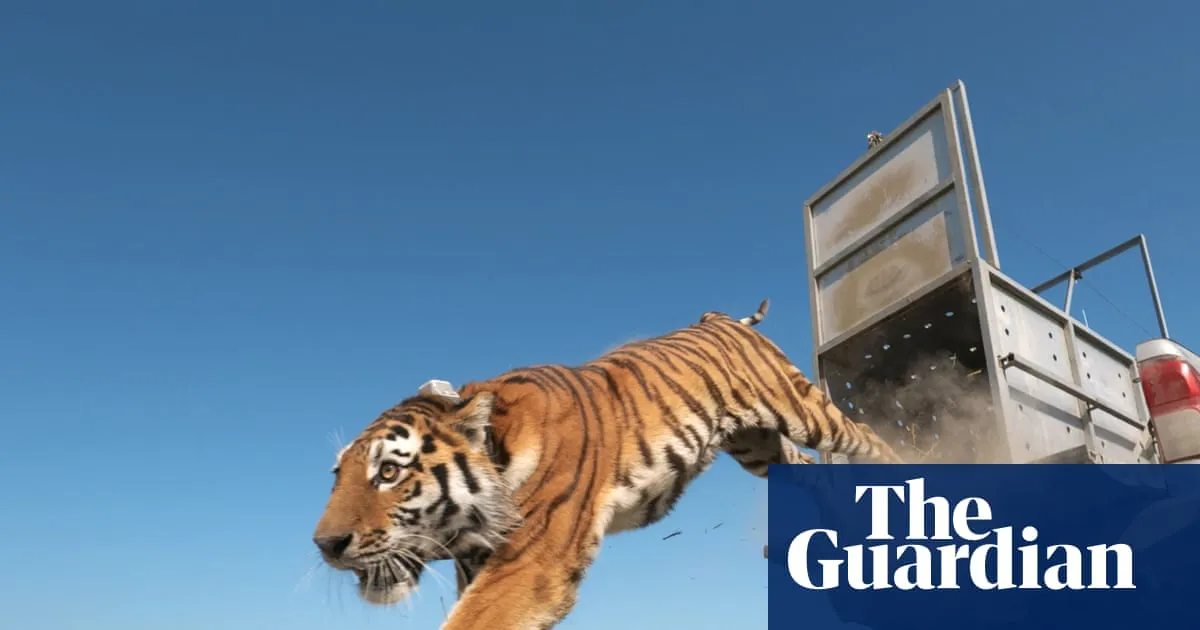
On 31 July, “Umit” – which means hope in Kazakh – was released into a nature reserve on the edge of Lake Balkhash after more than a decade of careful planning to return the Caspian tiger to the region. With this release, Kazakhstan became the first country to restore its tiger range after they had been thought extinct, with the last reliable sighting in the country recorded more than 70 years ago.Umit – a wild-caught female tiger transported from the Russian far east – will be joined by more big cats in the coming years, with plans to establish a self-sustaining population of about 50. A wild-caught male flown from Russia is still being monitored by authorities and will be released when he is judged fit to survive alone. Two wild tiger cubs are also being reared on the reserve in special enclosures, with as little human contact as possible, and are likely to be released into the marshlands next year, to feast on boar, deer and kulans, a type of wild donkey.“Today, we became witnesses of a truly historic event,” declared Yerlan Nysanbayev, Kazakhstan’s environment minister, after the release. “There is a lot of work ahead on monitoring tigers and forming a stable population, but today the first and very important step has been taken.”Amur tiger in Kazakhstan after being released into the wildernessThe Caspian tiger was considered extinct in the 1970s after decades of fur hunting, habitat destruction and eradication campaigns. Its range once spanned from eastern Turkey to north-west China, including Armenia, Azerbaijan, Iran and swathes of central Asia, mostly in forest highlands and along the edges of lakes and rivers, particularly in Tugai forests that were widely destroyed for agriculture.It was officially declared extinct in 2003, but a scientific breakthrough just six years later laid the foundation for the recent release. DNA analysis of the tiger’s genetic history revealed that the Caspian tiger and the Amur tiger found in eastern Siberia were almost identical, with populations probably intermingling until the early 1900s before they were isolated by hunting. What became known as the Caspian tiger spread west from Siberia and were separated from the Amur tiger by a single letter of genetic code.“For all intents and purposes, this is the return of the Caspian tiger, only this time they flew instead of walking,” said Dale Miquelle, an authority on Siberian tigers who heads Wildlife Conservation Society’s Russia programme. “The idea of bringing back a subspecies of tigers that has disappeared is very exciting. This is as close as we’re going to get to that process.”Today, it would be practically impossible for the Caspian tiger to re-establish its former range. A 2017 feasibility study identified two places in the region with enough suitable habitat to re-establish populations, both in Kazakhstan. The most promising was thought to be Ile-Balkhash, where Umit was released, which the Kazakh government made a nature reserve in 2018.While this summer’s release is the first example of a cross-border tiger translocation, there have been several successful releases in the Russian far east as part of efforts to restore the Amur tiger’s former range. One scheme involved rescuing orphaned cubs whose mothers had been shot by hunters in Siberia, and then releasing them into former ranges when they were strong enough. The project, which Miquelle worked on, was a huge success – especially because there was no human contact with the young big cats.“The success rate was pretty close to 100% after the release. These animals adapt amazingly quickly. One young female killed a Himalayan black bear within 24 hours of being released and others have learned to hunt on their own in the wild really quickly,” he says.But it is not all good news. Wild tigers have suffered a catastrophic century, with numbers falling from about 100,000 at the beginning of the 20th century to about 5,500 today. In many parts of Asia, they are still declining – and facing new threats from climate breakdown and disease. In recent years in Russia, African swine fever wiped out enormous numbers of wild boar, a tiger’s favourite prey, causing many to target human settlements. Ensuring there is enough food for the returning caspian tigers is key to their survival, says Miquelle.“I am very hopeful this can work. In Russia, a number of translocations resulted in the recolonisation of tiger habitat. So there’s a blueprint that suggests that this can work as long as there is suitable habitat and sufficient prey,” he says.Find more age of extinction coverage here, and follow the biodiversity reporters Rebecca Ratcliffe, Phoebe Weston and Patrick Greenfield in the Guardian app for more nature coverage.
SRCThe Guardian - World News
LANGEN
LEANCenter-Left
WORDS772
ENT12
TUE · 2026-08-11 · 10:00 GMTBRIEF NSR-2026-0811-101187
NSR-2026-0811-101187News Report·EN·Environmental
The return of the caspian tiger: how a species feared extinct has come back to Kazakhstan
Kazakhstan has initiated a historic program to reintroduce the Caspian tiger, a species thought extinct for 70 years. On July 31st, a female tiger named "Umit" was released into a nature reserve near Lake Balkhash, marking the first step in establishing a self-sustaining population of approximately 50 tigers.
Patrick GreenfieldThe Guardian - World NewsFiled 2026-08-11 · 10:00 GMTLean · Center-LeftRead · 4 min
The Guardian - World NewsFIG 01
Reading time
4min
Word count
772words
Sources cited
3cited
Entities identified
12entities
Quality score
100%
§ 01
Briefing Summary
AI-generatedNEWSAR · AI
Kazakhstan has initiated a historic program to reintroduce the Caspian tiger, a species thought extinct for 70 years. On July 31st, a female tiger named "Umit" was released into a nature reserve near Lake Balkhash, marking the first step in establishing a self-sustaining population of approximately 50 tigers. This initiative, involving careful planning and collaboration with Russia, aims to restore the tiger's range based on scientific findings that the Caspian and Amur tigers are genetically identical. More tigers, including cubs being raised with minimal human contact, are planned for release in the coming years. The project addresses habitat loss and hunting that led to the Caspian tiger's decline, with the hope of successful recolonization if suitable habitat and prey are available.
Confidence 0.90Sources 3Claims 5Entities 12
§ 02
Article analysis
Model · rule-basedFraming
Environmental
Human Interest
Tone
Measured
AI-assessed
CalmNeutralAlarmist
Factuality
0.80 / 1.00
Factual
LowHigh
Sources cited
3
Well sourced
FewMany
§ 03
Key claims
5 extracted01
Yerlan Nysanbayev stated, 'Today, we became witnesses of a truly historic event.'
quoteYerlan Nysanbayev
Confidence
1.00
02
The Caspian tiger and the Amur tiger are almost genetically identical, with populations likely intermingling until the early 1900s.
factual
Confidence
1.00
03
Kazakhstan became the first country to restore its tiger range after they had been thought extinct, with the last reliable sighting over 70 years ago.
factual
Confidence
1.00
04
Kazakhstan released a Caspian tiger named Umit into a nature reserve, marking the return of the species to the region after being thought extinct.
factual
Confidence
1.00
05
Plans are in place to establish a self-sustaining population of about 50 tigers in Kazakhstan.
prediction
Confidence
0.80
§ 04
Full report
4 min read · 772 words§ 05
Entities
12 identifiedKey playerOppositionContextPositiveNeutralNegative
Organizations1
Locations8
§ 06
Keywords & salience
9 termscaspian tiger
1.00
species restoration
0.90
kazakhstan
0.80
extinct species
0.70
wildlife conservation
0.70
amur tiger
0.60
population establishment
0.50
genetic history
0.50
habitat destruction
0.40
§ 07
Topic connections
Interactive graph No topic relationship data available yet. This graph will appear once topic relationships have been computed.