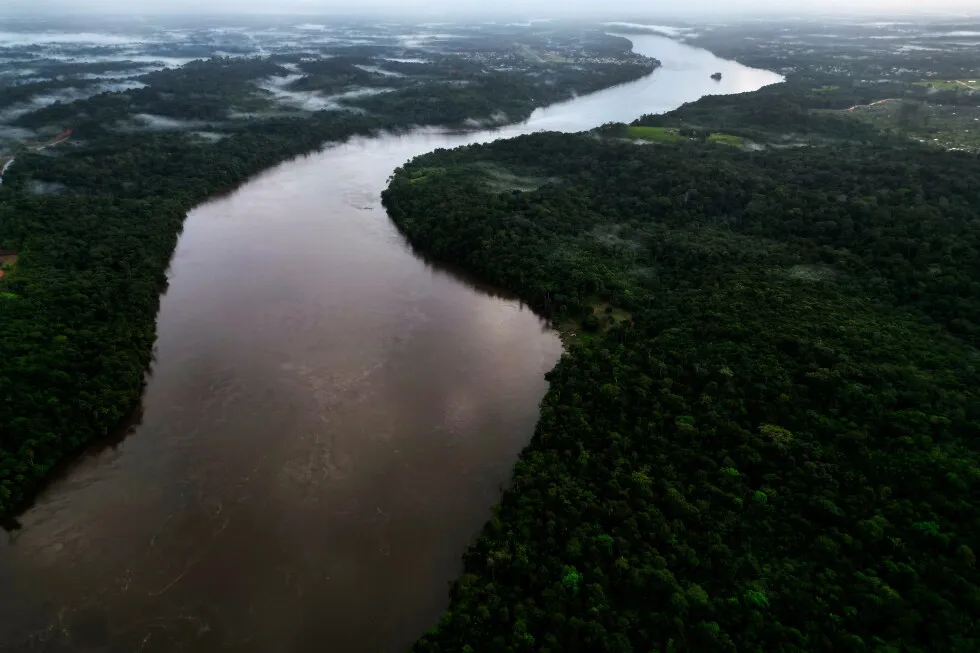
Trees line the Oiapoque-river" class="entity-link entity-location" data-entity-id="182938" data-entity-type="location">Oiapoque River on the border between Brazil and French Guiana, in Oiapoque, Amapa state, Brazil, March 10, 2026. (AP Photo/Eraldo Peres, File) Updated [hour]:[minute] [AMPM] [timezone], [monthFull] [day], [year] SAO PAULO (AP) — Brazil’s Supreme Court is set to weigh a series of cases in the coming days that could reshape protections for the Amazon rainforest and the Indigenous communities that depend on it.The cases span from Indigenous land rights, recent rollbacks on environmental safeguards and infrastructure projects. Despite their differences, they share a common path to the court.In recent years, a mostly conservative Congress approved measures that environmentalists say violate constitutional rights. President Luiz Inácio Lula da Silva, whose administration has pursued a more environmentally focused agenda, vetoed some measures outright and parts of others. But lawmakers overrode those objections, and the disputes ultimately reached the Supreme Court, which environmental advocates increasingly view as the last line of defense against the weakening of environmental protections in Brazil. Brazil President Luiz Inacio Lula da Silva speaks during a news conference at the COP30 U.N. Climate Summit, Nov. 19, 2025, in Belem, Brazil. (AP Photo/Andre Penner, File) Brazil President Luiz Inacio Lula da Silva speaks during a news conference at the COP30 U.N. Climate Summit, Nov. 19, 2025, in Belem, Brazil. (AP Photo/Andre Penner, File) Add AP News on Google Add AP News as your preferred source to see more of our stories on Google. Share The cases illustrate the constraints facing the Lula administration. Despite notable achievements in reducing deforestation and directing resources to foster ecological investments, the government has often struggled to counter a conservative Congress where agribusiness interests wield significant influence.“The government is very weak in the legislative arena,” said Suely Araújo, a policy coordinator at the Climate Observatory, a network of environmental nonprofits. “It often opposes anti-environmental bills, but it lacks the political strength to persuade Congress to vote with it.” 1 MIN READ 1 MIN READ 5 MIN READ Agribusiness holds considerable sway in CongressThe Lula administration is not only outnumbered in Congress, but also has less leverage to negotiate than previous Brazilian governments. In recent years, lawmakers have gained greater control over the federal budget, a key tool of political bargaining.Agribusiness, one of Brazil’s most powerful economic sectors, also holds a majority in Congress and has pushed through measures that weaken environmental protections. As a result, the Supreme Court has emerged as a check on Congress, helping preserve parts of Lula’s environmental agenda when lawmakers push in the opposite direction.The office of the president’s chief of staff, which coordinates the government’s relations with Congress, said in a statement to The Associated Press it would not comment on cases pending before the Supreme Court. Brazil is the world’s largest producer of soybeans and beef. While most Brazilian beef is consumed domestically, most soybeans are exported. From January through July 2026, China, Brazil’s largest trading partner, bought 50% of its beef exports and 70% of its soybean exports, according to official trade data. A section of the Amazon rainforest stands next to soy fields in Belterra, Para state, Brazil, on Nov. 30, 2019. (AP Photo/Leo Correa, File) A section of the Amazon rainforest stands next to soy fields in Belterra, Para state, Brazil, on Nov. 30, 2019. (AP Photo/Leo Correa, File) Add AP News on Google Add AP News as your preferred source to see more of our stories on Google. Share The expansion of Brazil’s agricultural frontier, particularly for cattle ranching and soybean production, is the country’s leading cause of deforestation, much of it in the Amazon.The Parliamentary Agricultural Front did not respond to a request for comment. Agribusiness groups have long said they oppose illegal deforestation and point to increased agricultural productivity even as forest clearing has declined.Protecting the rainforest is critical to tackling climate change. The Amazon helps regulate climate and rainfall patterns and stores vast amounts of carbon that, if released, could further accelerate global warming. Shaping the future of Indigenous landsOn Friday, Brazil’s Supreme Court began reviewing final motions seeking clarification of a 2025 ruling that rejected the “time limit” thesis, a legal theory backed by the agribusiness caucus that would restrict Indigenous land claims to territories they occupied or were under legal dispute when the Constitution took effect on Oct. 5, 1988.Supporters say the cutoff provides legal certainty for landowners. Indigenous groups argue it disregards decades of expulsions and forced displacement, particularly during Brazil’s agricultural expansion in the 20th century.The justices are considering motions filed by the government, political parties, farmers and Indigenous organizations, with votes due by Aug. 18. Among other issues, they are expected to address compensation rules and possible deadlines for completing Indigenous land demarcations.Ricardo Terena, a lawyer with the advocacy organization Articulation of Indigenous Peoples of Brazil, said some of the proposals could effectively stall future demarcations by adding administrative hurdles and broadening compensation rights for non-Indigenous occupants, allowing them to remain on disputed land until payment is made. The Kawahiva Indigenous people, who remain isolated and uncontacted in the Amazon, is one of the many communities who may be affected by the proceedings. Authorities confirmed their presence in Mato Grosso state in 1999, but only completed the physical demarcation of their territory, mapping it out earlier this month.According to the nonprofit Survival International, the remaining Kawahiva are nomadic hunter-gatherers who survived attacks and disease and continue to avoid contact with outsiders. 2 other cases that could reshape Amazon governanceOn Wednesday, Brazil’s top court is also scheduled to consider two other significant sets of cases: state laws that led to the end of the soy moratorium and a new environmental license law that fast-tracked approval of strategic infrastructure projects.In January, major grain traders withdrew from the soy moratorium, a nearly 20-year-old pact credited with reducing Amazon deforestation by barring soy grown on cleared land. The agreement collapsed after top soy-producing states passed bills revoking tax benefits for participating companies. Justice Flávio Dino issued an injunction temporarily halting the state legislation, and the full court is now set to review his order.Also on Wednesday, the court is expected to consider a challenge to the new environmental licensing law that took effect in February. The law fast-tracks permits for projects with significant impact, including mines, highways, and industrial plants.Araújo of the Climate Observatory said she expects the Supreme Court to strike down at least what environmentalists consider the law’s most clearly unconstitutional provisions, including those allowing self-licensing for projects with moderate environmental impacts. She added the law is already having tangible consequences in the Amazon, citing the paving of a controversial highway and plans to dredge a major river without adequate prior environmental review.The environment ministry has defended the soy moratorium, saying it helped reduce Amazon deforestation even as Brazil expanded production. On the environmental licensing law, the ministry said the government had sought to veto provisions it considered problematic and remained concerned about maintaining minimum national standards.“Brazil needs an environmental licensing system that is more efficient, predictable, technically robust and capable of addressing the challenges of an economy that must expand infrastructure investment while confronting climate change and biodiversity loss,” the ministry said.___The Associated Press’ climate and environmental coverage receives financial support from multiple private foundations. AP is solely responsible for all content. Find AP’s standards for working with philanthropies, a list of supporters and funded coverage areas at AP.org. Sá Pessoa covers the Brazilian Amazon rainforest for The Associated Press. She is based in Sao Paulo, Brazil.
SRCAssociated Press (AP)
LANGEN
LEANCenter
WORDS1 243
ENT12
TUE · 2026-08-11 · 13:23 GMTBRIEF NSR-2026-0811-101240
NSR-2026-0811-101240News Report·EN·Environmental
Key Amazon cases reach Brazil’s Supreme Court following Lula’s defeats in Congress
Brazil's Supreme Court is set to review several cases that could significantly impact Amazon rainforest protections and Indigenous land rights. These cases arise from a conservative Congress passing measures that environmentalists argue violate constitutional rights, which President Lula da Silva's administration vetoed, only for lawmakers to override those vetoes.
By
GABRIELA SÁ PESSOAAssociated Press (AP)Filed 2026-08-11 · 13:23 GMTLean · CenterRead · 5 min
Associated Press (AP)FIG 01
Reading time
5min
Word count
1 243words
Sources cited
1cited
Entities identified
12entities
Quality score
100%
§ 01
Briefing Summary
AI-generatedNEWSAR · AI
Brazil's Supreme Court is set to review several cases that could significantly impact Amazon rainforest protections and Indigenous land rights. These cases arise from a conservative Congress passing measures that environmentalists argue violate constitutional rights, which President Lula da Silva's administration vetoed, only for lawmakers to override those vetoes. The court is now the last defense for environmental protections against legislative rollbacks driven by the powerful agribusiness lobby. Key cases include the clarification of a ruling on Indigenous land claims, the end of the soy moratorium, and a new environmental licensing law that fast-tracks infrastructure projects. These legal battles highlight the challenges Lula's administration faces in advancing its environmental agenda against a strong congressional opposition.
Confidence 0.90Sources 1Claims 5Entities 12
§ 02
Article analysis
Model · rule-basedFraming
Environmental
Legal & Judicial
Tone
Measured
AI-assessed
CalmNeutralAlarmist
Factuality
0.70 / 1.00
Factual
LowHigh
Sources cited
1
Limited
FewMany
§ 03
Key claims
5 extracted01
The government is very weak in the legislative arena and often opposes anti-environmental bills but lacks the political strength to persuade Congress.
quoteSuely Araújo
Confidence
0.90
02
President Lula's administration has faced legislative defeats in Congress, where agribusiness interests hold significant influence.
factual
Confidence
0.90
03
A conservative Brazilian Congress has passed environmental rollbacks that environmentalists argue violate constitutional rights.
factual
Confidence
0.90
04
Brazil's Supreme Court will hear cases that could significantly alter Amazon rainforest protections and Indigenous community rights.
factual
Confidence
0.90
05
The Supreme Court is increasingly seen by environmental advocates as the final defense against weakening environmental protections in Brazil.
quoteenvironmental advocates
Confidence
0.80
§ 04
Full report
5 min read · 1 243 words§ 05
Entities
12 identifiedKey playerOppositionContextPositiveNeutralNegative
Organizations5
§ 06
Keywords & salience
9 termsamazon rainforest
1.00
supreme court
0.90
indigenous land rights
0.80
environmental safeguards
0.70
lula administration
0.70
brazil congress
0.60
environmental protections
0.60
agribusiness
0.50
deforestation
0.40
§ 07
Topic connections
Interactive graph Network visualization showing 51 related topics
View Full Graph Person Organization Location Event|Click node to navigate|Edge numbers = shared articles