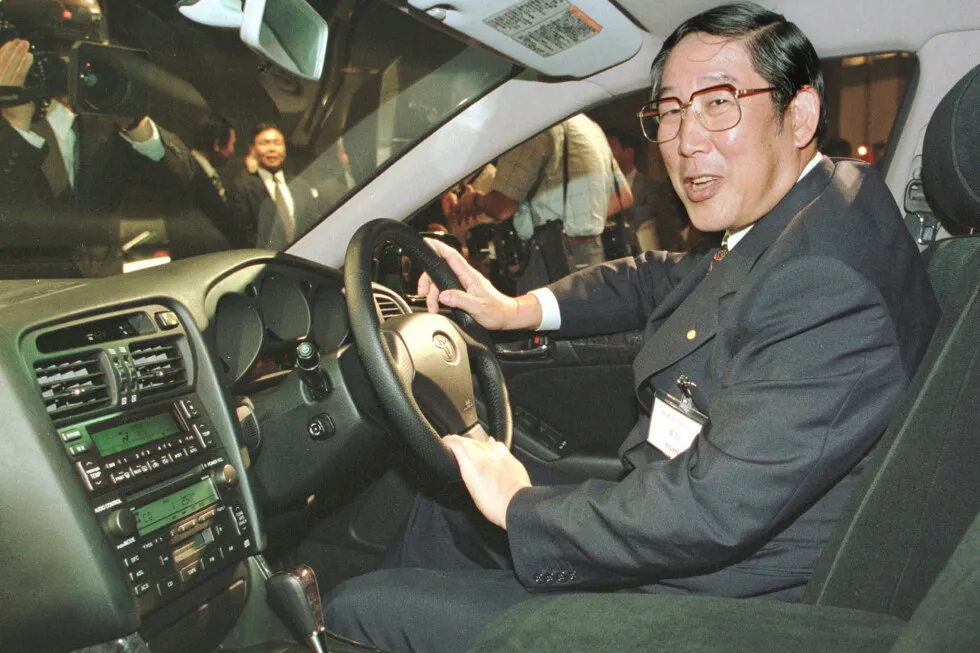
Hiroshi Okuda, former Toyota chief credited for leading the Japanese automaker’s global climb, dies 1 of 3 | Hiroshi Okuda, then, president of Toyota Motor Corp., smiles as he sits at the steering wheel of the “Aristo,” Toyota’s remodeled sports sedan during a press conference at a Tokyo hotel, Aug. 27, 1997. (AP Photo/Shizuo Kambayashi, File) 2 of 3 | Hiroshi Okuda, then Toyota Motor Corp. chairman, speaks during a press conference at a Tokyo hotel on Nov. 1, 2004. (AP Photo/Shizuo Kambayashi, File) 3 of 3 | Outgoing chairman of the Japan’s foremost business lobby, the Nippon Keidanren, Hiroshi Okuda, left, leaves the podium following his one and the last speech as a chairman as newly named chairman Fujio Mitarai, Canon Corps Chief Executive Officer looks on during the annual meeting in Tokyo, May 24, 2006. (AP Photo/Junji Kurokawa, File) By YURI KAGEYAMA Updated 2:18 AM MESZ, August 12, 2026 Add AP News on Google Add AP News as your preferred source to see more of our stories on Google. Share Share Facebook Copy Link copied Print Email X LinkedIn Bluesky Flipboard Pinterest Reddit Tokyo (AP) — Hiroshi Okuda, the former chief executive of Toyota, who led the Japanese automaker’s stellar rise in global markets, has died, the company said Wednesday. He was 93. The date and cause of his death were not immediately available. Okuda served as president then chairman of Toyota Motor Corp. from 1995 through 2006. In his 45-year career at Toyota, Okuda is especially remembered for having led the development of the gas-electric hybrid Prius in 1997, a model with the fuel-efficient technology that was ground-breaking at that time. The Prius became a symbol of the auto industry ’s push for green driving. Okuda was instrumental in helping drive Toyota’s reputation for fuel-efficiency at a time when gas prices were already surging, such as its bestseller Camry, as well as the hybrids. Born in central Japan, the area where Toyota has its headquarters, Okuda graduated in 1955 from the prestigious Hitotsubashi University in Tokyo, with a degree in business. Okuda, reputedly outspoken and always ready with a quick laugh, was unusual in not being from Toyota’s founding Toyoda family, as the leadership at the world’s top automaker tended to be. The former chief executive was key in leading Toyota’s global expansion over his years at the helm, not only in sales, but also production, setting up manufacturing plants in the U.S. and Europe. Japan’s Toyota reports hefty profit on cheap yen and solid car sales 1 MIN READ Fujitsu and leading Japanese robotics companies to use Nvidia technology in ‘physical AI’ 2 MIN READ Ford to partner with Chinese automaker Geely in Spain in new joint venture 2 MIN READ Okuda, a black belt in judo, was vocal about his concerns over the possible backlash that Toyota might face, as its growth meant the inevitable dethroning of the American so-called “Big Three,” General Motors, Ford and Chrysler, synonymous for U.S. manufacturing grandeur. He liked to emphasize how the auto industry was global and connected, using the term “harmony” to drive home that message. Toyota, as well as other Japanese automakers like Honda Motor Co. and Nissan Motor Co., were raking in huge profits, while the Americans were sinking into losses. That helped ring in the “Japan-bashing” sentiments starting in the 1980s. As is still the case today, the cheap yen was also pointed to as giving Toyota and the other Japanese makers an unfair advantage. A cheap yen raises the value of overseas earnings for the Japanese, when translated into yen. Okuda was adviser on Toyota’s board when Toyota added an American for the first time on its board, Jim Press, in 2007. He was also a proponent of promoting younger management, when that was still relatively rare in Japanese corporate circles, although that usually meant empowering men in their 50s instead of their 60s. “A company must change when things are going well. There’s no point in trying to change after things start going bad,” he told reporters in 2005. That emphasis on staying nimble encapsulates Toyota’s basic principle of constantly improving, known as “kaizen,” which, along with just-in-time production, centering on the idea of avoiding huge inventory, is at the core of Toyota’s founding philosophies. Respected in the business community here, Okuda served as head of major business lobbies, such as the Japan Business Federation known as Keidanren, the Japan Automobile Manufacturers Association, the Prime Minister’s Economic Strategy Council of Japan and the Japan Federation of Employers’ Associations. Toyota did not immediately have details on surviving family. Funeral arrangements were being made by the family, and plans may be coming later on a more public formal ceremony, according to the company. YURI KAGEYAMA Kageyama covers Japan news for The Associated Press. Her topics include social issues, the environment, businesses, entertainment and technology. twitter instagram facebook mailto
SRCAssociated Press (AP)
LANGEN
LEANCenter
WORDS813
ENT12
WED · 2026-08-12 · 00:23 GMTBRIEF NSR-2026-0812-101404
NSR-2026-0812-101404News Report·EN·Human Interest
Hiroshi Okuda, former Toyota chief credited for leading the Japanese automaker’s global climb, dies
Hiroshi Okuda, former CEO of Toyota, who was instrumental in the company's global expansion, has died at the age of 93. Okuda led Toyota as president and chairman from 1995 to 2006.
Associated Press (AP)Filed 2026-08-12 · 00:23 GMTLean · CenterRead · 4 min
Associated Press (AP)FIG 01
Reading time
4min
Word count
813words
Sources cited
0cited
Entities identified
12entities
Quality score
100%
§ 01
Briefing Summary
AI-generatedNEWSAR · AI
Hiroshi Okuda, former CEO of Toyota, who was instrumental in the company's global expansion, has died at the age of 93. Okuda led Toyota as president and chairman from 1995 to 2006. During his 45-year career, he is particularly remembered for overseeing the development of the groundbreaking gas-electric hybrid Prius in 1997, which became a symbol of fuel-efficient driving. He also played a key role in expanding Toyota's production and sales internationally, establishing manufacturing plants in the U.S. and Europe. Okuda was known for his outspoken nature and emphasis on continuous improvement and global harmony within the auto industry. He also held leadership positions in major Japanese business organizations.
Confidence 0.90Claims 5Entities 12
§ 02
Article analysis
Model · rule-basedFraming
Human Interest
Technology
Tone
Measured
AI-assessed
CalmNeutralAlarmist
Factuality
0.90 / 1.00
Factual
LowHigh
Sources cited
0
No named sources
FewMany
§ 03
Key claims
5 extracted01
Okuda was key in leading Toyota's global expansion in sales and production, including setting up plants in the U.S. and Europe.
factual
Confidence
1.00
02
Okuda was instrumental in driving Toyota's reputation for fuel-efficiency during a time of surging gas prices.
factual
Confidence
1.00
03
Okuda served as president and chairman of Toyota Motor Corp. from 1995 through 2006.
factual
Confidence
1.00
04
Okuda led Toyota's global rise and is remembered for leading the development of the gas-electric hybrid Prius in 1997.
factual
Confidence
1.00
05
Hiroshi Okuda, former chief executive of Toyota, has died at age 93.
factualToyota
Confidence
1.00
§ 04
Full report
4 min read · 813 words§ 05
Entities
12 identifiedKey playerOppositionContextPositiveNeutralNegative
Organizations4
Locations4
§ 06
Keywords & salience
9 termstoyota
1.00
hiroshi okuda
1.00
global expansion
0.90
hybrid vehicles
0.80
prius
0.80
fuel efficiency
0.70
automaker
0.60
leadership
0.50
nippon keidanren
0.40
§ 07
Topic connections
Interactive graph No topic relationship data available yet. This graph will appear once topic relationships have been computed.