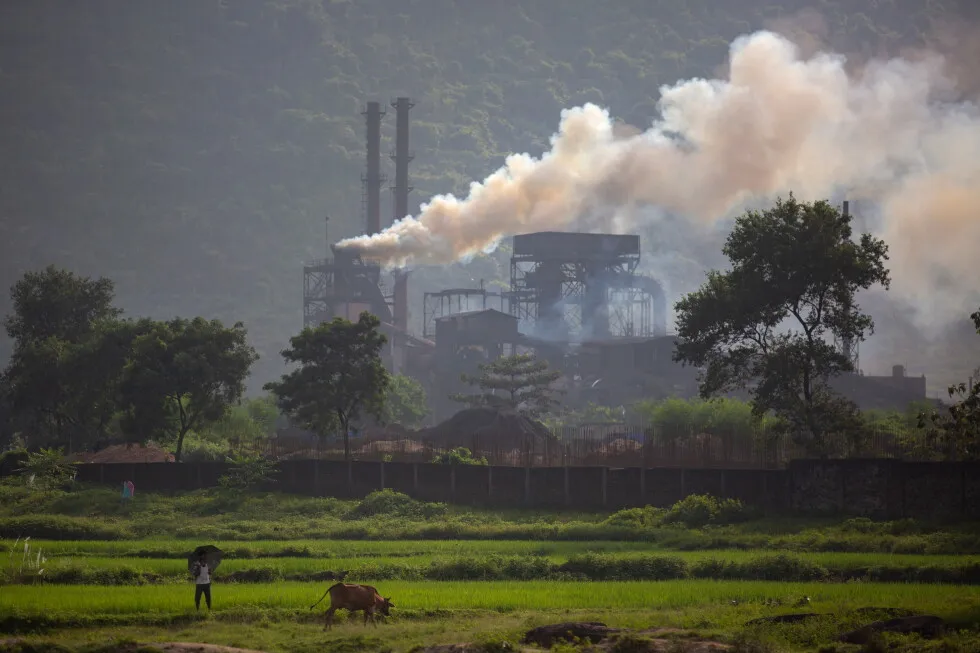
FILE- Smoke rises from a coal-powered steel plant at Hehal village near Ranchi, India, in eastern state of Jharkhand, Sept. 26, 2021. (AP Photo/Altaf Qadri, File) Updated [hour]:[minute] [AMPM] [timezone], [monthFull] [day], [year] BENGALURU, India (AP) — Smaller steel companies responsible for nearly 40% of India’s crude steel production could cut their electricity bills by about a third while sharply reducing carbon emissions by switching to renewable energy, according to a report released Wednesday.The report, “Powering India’s Secondary Steel Transition,” found renewable electricity could reduce annual power costs by about 22 million to 24 million rupees ($250,000 to $275,000) per unit, or up to 34%. The report was jointly produced by a consortium of environmental groups and industry bodies including the Confederation of Indian Industry, India" class="entity-link entity-organization" data-entity-id="183539" data-entity-type="organization">WWF-India, the nonprofit group Climate Catalyst and the think tank JMK Research.Electricity accounts for up to 40% of operating costs for many small steel producers, making it one of the industry’s largest expenses. Profit margins at many of India’s smaller steel companies have been affected by rising fuel costs resulting from the Iran war. India, the world’s most populous nation, is among the largest emitters of carbon dioxide and other greenhouse gases contributing to global warming. The steel sector accounts for as much as 12% of India’s annual emissions. Decarbonizing the sector is essential to meet the country’s goal of achieving net-zero emissions by 2070. 2 MIN READ 1 MIN READ 6 MIN READ Shifting to clean power also could help shield Indian steel companies from European carbon taxes that took effect at the start of this year.“With rising pressure on all industries to reduce their carbon emissions, a high-emitting sector like steel has to look at ways to reduce emissions at the least cost possible,” said Prabhakar of JMK Research, one of the report’s authors, who uses only one name. “With the huge growth in renewables in India, shifting to renewable electricity is low-hanging fruit for reducing carbon pollution.” Steel firms can save with joint clean power investmentsThe report found the most practical option for small steel producers is to jointly invest in and own a renewable energy project from which they can draw electricity based on their investment and electricity needs.This approach lowers the upfront financial burden for individual companies and creates projects large enough to be commercially viable, the report said. “A cluster-based approach can fundamentally change how small steelmakers access renewable energy,” Prabhakar said. “Aggregating demand through industrial associations makes projects more bankable, enables optimal plant sizing and reduces the investment risk borne by any single unit.”renewable energy adoption remains limited among India’s smaller and medium-sized steel companies despite the country’s clean power capacity tripling over the past decade. The report estimated only about 11% of smaller steelmakers use renewable power, compared with roughly 22% of India’s overall electricity mix.Helping small and medium steelmakers access clean energy is essential to India’s ambitious climate goals, said Vinoth Balakumar of the Confederation of Indian Industry. “The companies are ready to change and have realized that, to maintain profits, they could try to shift to renewable electricity,” he said. Low awareness, red tape and high costs slow clean power shiftOwners of small steel companies said they are willing to shift to clean power because many of their domestic and international customers prefer steel with a lower carbon footprint. But high costs, government regulations and, in some regions, a lack of awareness about the benefits of renewable electricity are slowing the transition.“When capital costs are really high, it makes it less viable for smaller companies,” said Sanjay Tripathi, a steel company owner in the central Indian state of Chhattisgarh.In the western state of Gujarat, the country’s second-largest generator of renewable energy, steelmakers said inadequate transmission and grid infrastructure prevent them from using all the solar power they have invested in.“We are being asked to reduce our solar power production by up to 80% at times by state government authorities,” said Dhirubai Patel, who owns a steel company in Rajkot, home to one of India’s largest steelmaking clusters in Gujarat.Patel and several other steel manufacturers in the city invested in a solar power plant that began operating in 2021. “Our request is for the government to invest in infrastructure and make it easier for us to do business. We have a lot of good policies, but there is a lack of cooperation from officials in many government departments,” Patel said. “They are still living in the old era and need a change in their mindset.”___Follow Sibi Arasu on X at @sibi123. Reach him at [email protected]. ___The Associated Press’ climate and environmental coverage receives financial support from multiple private foundations. AP is solely responsible for all content. Find AP’s standards for working with philanthropies, a list of supporters and funded coverage areas at AP.org. Sibi reports on climate change from India and South Asia
SRCAssociated Press (AP)
LANGEN
LEANCenter
WORDS808
ENT12
WED · 2026-08-12 · 06:53 GMTBRIEF NSR-2026-0812-101481
NSR-2026-0812-101481News Report·EN·Economic Impact
India’s small steelmakers could save money and cut emissions with switch to renewable power
A new report suggests that India's smaller steel companies, responsible for nearly 40% of the nation's crude steel production, could significantly reduce their electricity costs by up to 34% and lower carbon emissions by switching to renewable energy. The report, "Powering India’s Secondary Steel Transition," highlights that electricity is a major operating expense for these firms.
By
SIBI ARASUAssociated Press (AP)Filed 2026-08-12 · 06:53 GMTLean · CenterRead · 4 min
Associated Press (AP)FIG 01
Reading time
4min
Word count
808words
Sources cited
2cited
Entities identified
12entities
Quality score
100%
§ 01
Briefing Summary
AI-generatedNEWSAR · AI
A new report suggests that India's smaller steel companies, responsible for nearly 40% of the nation's crude steel production, could significantly reduce their electricity costs by up to 34% and lower carbon emissions by switching to renewable energy. The report, "Powering India’s Secondary Steel Transition," highlights that electricity is a major operating expense for these firms. Jointly investing in and owning renewable energy projects is proposed as a practical solution to mitigate high upfront costs and make projects commercially viable. Despite the potential benefits, challenges such as high capital costs, regulatory hurdles, and inadequate grid infrastructure are slowing the adoption of clean energy among these companies. This transition is crucial for India to meet its net-zero emission goals by 2070 and avoid potential carbon taxes.
Confidence 0.90Sources 2Claims 5Entities 12
§ 02
Article analysis
Model · rule-basedFraming
Economic Impact
Environmental
Tone
Measured
AI-assessed
CalmNeutralAlarmist
Factuality
0.80 / 1.00
Factual
LowHigh
Sources cited
2
Limited
FewMany
§ 03
Key claims
5 extracted01
A cluster-based approach can fundamentally change how small steelmakers access renewable energy.
quotePrabhakar of JMK Research
Confidence
1.00
02
The steel sector accounts for as much as 12% of India’s annual emissions.
statisticreport
Confidence
0.90
03
Renewable electricity could reduce annual power costs by about 22 million to 24 million rupees ($250,000 to $275,000) per unit, or up to 34%.
statisticreport
Confidence
0.90
04
Smaller steel companies responsible for nearly 40% of India’s crude steel production could cut electricity bills by about a third while sharply reducing carbon emissions by switching to renewable energy.
statisticreport
Confidence
0.90
05
Shifting to clean power also could help shield Indian steel companies from European carbon taxes.
factualarticle
Confidence
0.80
§ 04
Full report
4 min read · 808 words§ 05
Entities
12 identifiedKey playerOppositionContextPositiveNeutralNegative
People1
Organizations4
§ 06
Keywords & salience
10 termsrenewable energy
1.00
steel industry
0.90
carbon emissions
0.90
cost reduction
0.80
india
0.70
decarbonization
0.70
net-zero emissions
0.60
electricity costs
0.50
jmk research
0.40
wwf-india
0.40
§ 07
Topic connections
Interactive graph Network visualization showing 51 related topics
View Full Graph Person Organization Location Event|Click node to navigate|Edge numbers = shared articles